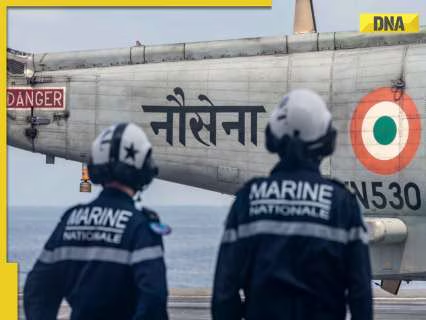
Navy Day honours India’s sea warriors, celebrating courage, self-reliance, and indigenous strength, highlighted by powerful naval demonstrations, INS Vikrant’s showcase, and the nation’s enduring maritime pride
Navy Day is one of the most inspiring days in our national calendar, celebrating courage, commitment, and India’s growing strength at sea. It reminds us that the men and women in white serve day and night to keep our waters safe, protect our coastlines, and ensure peace for every Indian. The story of Navy Day is not only about war and victory but also about pride, discipline, and dedication.
The first Navy Day in India was celebrated on 21 October 1944, when the Royal Indian Navy wanted to reach more people and create awareness about the Navy’s vital role. Parades were held in port cities, and public meetings took place in inland areas. The response was overwhelming. People felt excited to see their Navy up close, and the event was a great success. Seeing this positive reaction, it was decided that such celebrations should continue every year, on a bigger scale and during cooler weather. So, Navy Day 1945 was celebrated on 1 December in Bombay and Karachi.
Over time, Navy Day became a proud tradition. Until 1972, it was marked on 15 December, with Navy Week being observed around that date. But things changed after the extraordinary victory in the 1971 India–Pakistan War. During the Senior Naval Officers Conference in May 1972, a landmark decision was made — Navy Day would be celebrated on 4 December every year to commemorate India’s successful naval operations in that war.
The reason behind this is heroic and unforgettable. On 4 December 1971, the Indian Navy launched a bold attack on Pakistan’s Karachi Harbour. This operation, known for its precise planning and fearless execution, changed the course of the war at sea. Indian Navy missile boats struck fuel depots, enemy ships, and shore facilities, causing major destruction. These attacks broke Pakistan’s naval strength and gave India full control over the Arabian Sea. It was India’s first major naval offensive and remains a shining example of bravery and maritime skill.
At the same time, air operations from India’s aircraft carrier INS Vikrant targeted enemy airfields in Chittagong and Khulna, now in Bangladesh. These missions weakened enemy defences in the Bay of Bengal and supported India’s success on the eastern front. The coordination between sea and air forces proved India’s rising capability and determination. That is why 4 December became more than just a date — it became a symbol of the Indian Navy’s excellence, courage, and national pride.
Today, Navy Day is not only a remembrance of that great victory but also a celebration of the people who protect India’s maritime borders every day. It honours their discipline, sacrifice, and steady commitment to duty. The Indian Navy plays a crucial role beyond warfare — rescuing lives during natural disasters, fighting piracy, and ensuring the safety of trade routes that connect India to the world. Navy Week, observed from 1 to 7 December, gives everyone a chance to understand their work and the technology that keeps India safe.
The theme for Indian Navy Day 2025, “Combat Ready, Cohesive and Self-Reliant,” perfectly expresses the spirit of the force. It highlights the importance of staying ready for any challenge, working as one team, and relying on indigenous technology. This year, the focus is on showcasing Indian-made platforms and promoting the Make in India initiative to strengthen our self-reliant defence vision.
The Indian Navy Operational Demonstration 2025 is taking place at Shangumugham Beach in Thiruvananthapuram, Kerala, on 3 and 4 December. This grand show of maritime power features warships, submarines, and naval aircraft performing coordinated manoeuvres. The President of India, Droupadi Murmu, the Supreme Commander of the Armed Forces, is the Chief Guest, and Admiral Dinesh Kumar Tripathi, the Chief of Naval Staff, is hosting the event. Kerala’s Chief Minister Pinarayi Vijayan and Governor Rajendra Arlekar are also present to honour the occasion.
On 3 December, thousands gathered at Shangumugham Beach to witness the breath-taking sight of naval strength on display. INS Vikrant, India’s first indigenous aircraft carrier built at Cochin Shipyard, was the centre of attraction. Fighter jets took off from its deck to the thunderous applause of the crowd. Around 20 major warships, submarines, fast attack boats, and 32 aircraft, including fighter jets and helicopters, participated in the show. Highlights included anti-piracy operations by the MARCOS commandos, formation flying, and demonstrations of frontline frigates and missile corvettes.
The event did not just show power; it also celebrated spirit. The Hornpipe dance by the Sea Cadet Corps, cultural performances, and dazzling fireworks added colour and joy to the evening. The ceremonies began with a guard of honour for the President, representing respect for the armed forces and their leadership. This celebration outside a major naval base shows the Navy’s effort to bring its world closer to the people.
Navy Day is more than a military celebration. It is a reminder of duty, teamwork, and national pride. It teaches the value of courage and discipline, qualities that shape both soldiers and citizens. When we see a naval ship sailing with the tricolour fluttering high, it is not just a symbol of power — it is the spirit of India, fearless and self-reliant, guarding every wave and every shore.
(The author of this article is a Defence, Aerospace & Political Analyst based in Bengaluru. He is also Director of ADD Engineering Components, India, Pvt. Ltd, a subsidiary of ADD Engineering GmbH, Germany. You can reach him at: [email protected])
(Disclaimer: The views expressed above are the author’s own and do not reflect those of DNA)