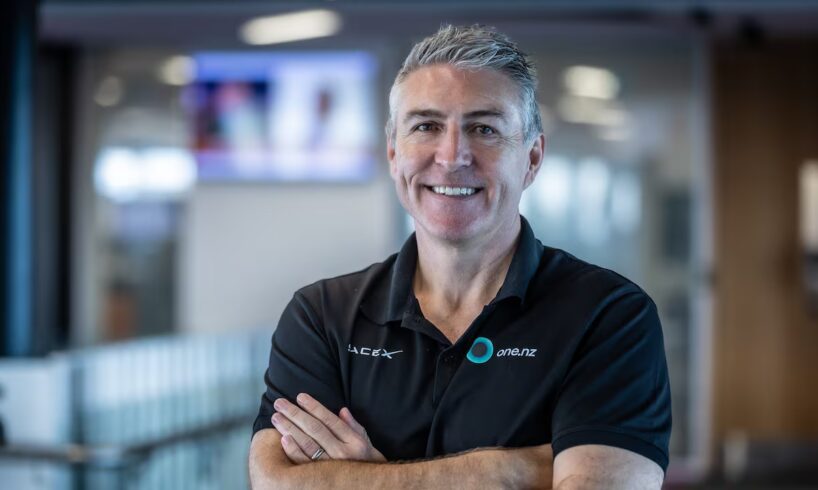
The journey began with robotic process automation (RPA), the software that handles repetitive tasks that would otherwise require human attention. The impact was immediate and quantifiable.
“If we didn’t have RPAs in our organisation, I think we would need another 20% more people, probably 500 more people in the organisation,” Paris says.
From there, the company deployed machine learning and generative AI for customer service, marketing, network management, procurement and sales. This second phase focused on productivity gains, with AI making recommendations that humans would then action.
Today One NZ claims to be among global leaders in what Paris calls “agentic AI”, systems that take action autonomously without human oversight. The company has integrated 31 AI agents into its organisational structure, working alongside human employees.
“It took us eight hours to build our first agentic AI and two weeks to deploy it. That’s way faster than it would take to hire and train a person for a role in an organisation.”
The applications extend beyond back-office automation. An AI network concierge now triangulates data across multiple systems in seconds, a task that previously required multiple teams. The system both reactively fixes customer issues and proactively optimises network performance before problems emerge.
One NZ’s results are striking: AI systems now power network infrastructure up and down automatically, saving 20% of the energy bill.
During major events like Eden Park Rugby matches, One NZ’s robots optimise network capacity without human monitoring. In storms, AI manages generator distribution across the network in near real-time, working toward what Paris describes as “our living, breathing, self-optimising, self-healing network”.
The impact on customer experience has been equally dramatic. “When I started in the organisation, on average, our customers would call us once every seven months,” Paris says. “It’s now once every two years.” Many network issues are now resolved before customers even know a problem exists.
One NZ’s AI also handles cyber security at scale. Paris cites an example where AI tools identified and blocked 120,000 fraudulent messages targeting one customer. The network faces hundreds of attacks daily from foreign actors attempting to compromise critical infrastructure. AI now detects and automatically deals with attacks.
AI technology is available now from major providers like OpenAI, Google and Microsoft. He says there’s a perception that data needs to be perfectly clean before it is used in an AI system. That’s not the case, AI can structure unstructured data quickly, it is something the technology does well.
Another common misconception is that legacy systems can’t integrate with AI systems. Paris says it can be done, although it requires effort.
“If you’re not using AI, you need to be. It’s business-case-by-doing. You just need to get started. Otherwise, you’re going to be left behind and be disrupted by this technology.”
Telcos like One NZ have traditionally planned four to five years ahead, but that timeline no longer works when it comes to AI. Time scales are compressed.
Having the right skills is critical. A quarter of One NZ’s AI budget goes toward training employees and getting tools into their hands, helping teams understand that AI enhances rather than replaces their work.
Paris says the biggest obstacle to AI adoption is not technical. “The biggest block is cultural and getting your organisation to think differently about how it needs to operate.”
You just need to get started. Otherwise, you’re going to be left behind and be disrupted by this technology.
Jason Paris, One NZ
In this case, the company is, in his words, “fixing the plane while it’s in the air”, with an operating model that needs complete transformation to keep pace with the technology’s rapid evolution.
This tension between legacy structures and AI’s capabilities may prove to be the defining challenge for New Zealand businesses in 2025, not whether to adopt the technology, but whether they can transform their organisations fast enough to make it work.
Paris’s experience at One NZ represents the leading edge. It also highlights a widening gap in New Zealand’s AI adoption story. While large enterprises with substantial resources forge ahead, small and medium-sized businesses face a different reality.
Craig Young, CEO of Tuanz, the technology users organisation, sees this divergence daily. His organisation established an AI community specifically because members felt “a little at sea” trying to figure out what AI meant for their businesses.
He says: “The big guys have the money to invest and they can push through. In the medium space, they have some control over the tools they use, but they’re so busy.”
Economic pressures make it harder still. Investing in new technology without a quick rate of return is difficult when organisations are working hard just to exist.
What Tuanz sees across its membership is largely ad hoc AI use rather than strategic implementation. Employees use AI tools to assist their tasks, but without organisational tracking or control. “While there’s real value in it, organisations aren’t necessarily finding the use cases that immediately give them a return,” Young says.
One critical lesson has emerged: keep humans in the loop. “We’re finding a lot of places where, if you forget to have a person in the process, things can break down,” Young says.
Young describes himself as an “AI pragmatist rather than necessarily an optimist”. The technology will deliver value once organisations work out the use cases. ”But it always takes longer than you think. It’s more work than you think. And it’s more costly than you think.”
While businesses grapple with implementation challenges, some communities are taking matters into their own hands. In Nelson, high school teacher Richard Brudvik-Lindner saw the release of ChatGPT in November 2022 as a transformative moment comparable to the launch of Windows 95.
Richard Brudvik-Lindner, creator of Nelson AI Sandbox.
His response was to create the Nelson AI Sandbox. It is a storefront operation on the main street where anyone could experiment with AI tools for free.
“We’re not cheerleaders or evangelists for AI. We’re just saying AI is a reality. So what we can do is amplify the good uses of AI and make people aware of what the concerns should be.”
The initiative has worked with dozens of non-profits and small businesses, achieving a 97% satisfaction rate. Through funding from the Rada Foundation, organisations operating on tight budgets have found ways to boost staff productivity. The sandbox has even spawned local start-ups.
This weekend, it will host what may be the world’s first “vibe-a-thon”: teams using AI-powered coding tools to collaboratively build a game teaching AI use.
As adoption spreads, so do concerns about risk management. Natassja Savidge, a technology consultant at Christchurch-based Inde, sees a pattern in the organisation’s approach to AI implementation.
“A lot of the time, people are asking for AI when what they actually need is automation or integration solutions. The most concerning requests come from boards mandating AI adoption without identifying specific business problems. The first question should be: ‘What are your pain points?’”
Natassja Savidge, a technology consultant at Christchurch-based Inde.
Risks extend beyond wasted investment. Free AI tools can expose sensitive data to public training datasets. Savidge says: “There are people who are uploading company Excel files into free ChatGPTs. That information is going into publicly trained data.” In some cases, private information about executive salaries has surfaced as people use the chatbots.
Perhaps most critically, Savidge says over-reliance on AI risks eroding fundamental skills. “If you’ve outsourced everything to AI, but then you have this critical issue and AI gets stuck in a loop, you’re going to have to pay someone a lot of money to come in.”
She knows of a New Zealand organisation that rushed to automate its call centre and removed staff, only to find itself rehiring people within weeks when the AI solution failed.
“You’re kind of losing your ability to have the human in the loop potentially over time.”