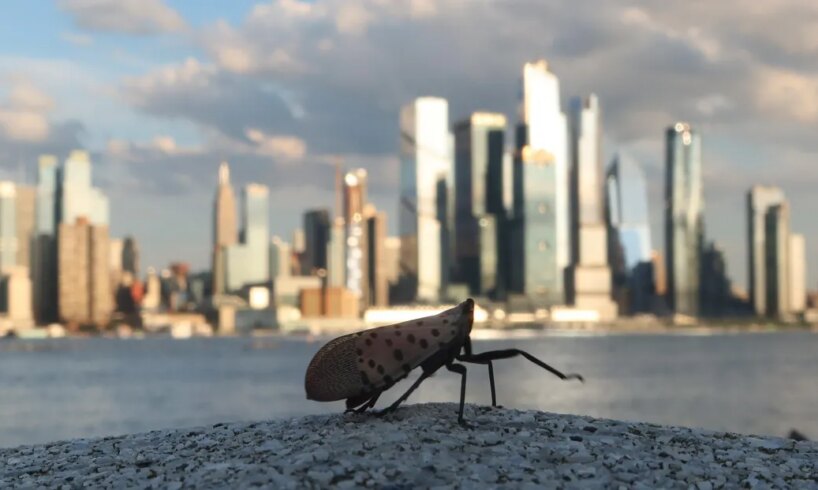
Last summer, I was standing on a block near my house when I saw a very distinctive bug skittering up a tree trunk. It had a polka-dotty wing, with red underneath. It was, unmistakably, an invasive spotted lanternfly.
These are all over Brooklyn — they took off here around 2020 and 2021. And I knew what I was supposed to do in this situation: kill it.
Ordinary people have been told to kill the invasive spotted lanternfly, and many have embraced the task. But the bugs haven’t caused as much damage as scientists first feared, and eradicating them was never a likely option.There’s a moral cost to taking insect life. Three philosophical frameworks could help us decide how to act here: consequentialism (considering outcomes), deontology (considering motivations) and virtue ethics (considering what’s good, and what a good person would do).Even after all of that, there might be no action that feels perfectly right. Luckily, there’s a name for the bad feeling that’s left behind after you do something you’ve decided is good: “moral residue.”
Following orders, I ran after it and inelegantly tried to hike my leg up the tree trunk to stomp it dead. A neighbor I didn’t know yelled at me from down the street, something like: “Get it! Get the lanternfly!”
I didn’t know quite how to respond because, actually, I’d been feeling ambivalent. On the one hand, I like being part of a civic group project, and it is satisfying to squash a bug. But I also wanted to say something like, “Isn’t it weird that we’re all happily participating in a campaign to kill living creatures? Something about it just feels wrong.”
Lanternfly season is now upon us. And I’m once again going to be faced with a moral question that comes up repeatedly in conservation, when we’re forced to choose between different types of beings and their lives: Should I personally be killing these invasive lanternflies? And what is the right way for any of us to think through that kind of decision, anyway? So this year, I enlisted the help of an environmental scientist who is also deeply schooled in moral philosophy to help me figure this out.
The lanternflies are here. Now what?
Around 2004, lanternflies landed — from their native habitat in China, India, and Southeast Asia — in South Korea. And they did a lot of damage there. Mostly to grapevines, but also to apples and other tree fruit, to ornamental trees, and to timber trees. Then, in 2014, the bug was detected in the United States, in Pennsylvania.
Non-native species arriving in new places are not always a forever problem, but the worry is that a non-native species without natural predators can get out of control. They can displace other species or, in the case of lanternflies, potentially kill a lot of trees.
So Pennsylvania took serious steps to manage the lanternflies, such as quarantines and pesticides. But the containment measures didn’t totally work. And when the general public got wind of the problem, some of them started taking matters into their own hands. (One enterprising individual even blasted some lanternflies with a blowtorch.) By 2018 and 2019, despite the efforts to stop their spread, the lanternflies landed in the city of Philadelphia, about 60 miles away from where they’d first been detected. And in the summer of 2020, amid everything else going on, their populations were exploding.
There’s footage of the bugs absolutely blanketing the sidewalk at the entrance of an unlucky Philadelphia Chipotle. There are photos of them wrapping around the trunks of Pennsylvania trees. And ordinary people in Philadelphia fought back — as they’d been told to! That summer of 2020, the Pennsylvania Department of Agriculture posted on Facebook about the lanternflies, saying that people should “squish their guts out any time you see them.”
People got…very into this. Stomping. Squishing. But — and here’s where it gets tricky — it doesn’t seem like the individual stompers have had that much of an actual impact on lanternfly population levels.
Scientists I talked to said that the point wasn’t to eradicate the bugs as much as slow their spread, to give other places more time to prepare. If you look closely, you can see that the public outreach campaigns in Pennsylvania, and eventually New York, also recommend things like reporting lanternflies if you see them outside of the quarantine zone (in Pennsylvania, you can even call the hotline at 1-888-4BADFLY) and scraping away egg masses, which is more efficient than stomping individual bugs.
When I started to hear about lanternflies in New York City, though, it seemed like those nuances had gotten lost. People were kind of just stomping with abandon — even with a sense of glee.
But there were also signs that people were conflicted about the kill orders. A friend told me that, in the summer of 2021, she saw someone running after a lanternfly, yelling out, “The New York Times told me to kill you!” I personally know a couple of people who gave up stomping. The question even made it on Jimmy Fallon, where comedian Kate McKinnon winked openly at the audience while pretend-promising to kill the bugs the next time she saw them.
People were starting to wonder why exactly we had to kill the lanternflies, which are, quite frankly, gorgeous. And actually, the science was getting more murky on this question, too. The initial worries about how the lanternflies might kill all these trees and crops? Those have not panned out. As of now, in the US, the bugs are mostly a problem for grapes and, therefore, for grape growers. The damage they can do at vineyards is real, and there is still an argument to be made around making sure that they don’t expand to new places, where they might be even more destructive.
These past couple of summers, I have shared Kate McKinnon’s ambivalence about stomping lanternflies and how happy we all seem to be to comply with the kill orders. But this year, I wanted to face my ambivalence head-on — make a moral choice I can live by. So I called up Chelsea Batavia, an environmental scientist who has thought and written a lot about these issues. And when I did, I learned more than I had bargained for about the ethics of conservation — and of decision-making in general.
Bugs, choice, and “moral residue”
As I was thinking through my decision about whether or not to kill lanternflies this summer, if they should be so unlucky as to cross my path, I read through several different papers and articles. And there was one that I kept thinking about, which had been written by Batavia. She lives in Washington State, where she now works in government. (She’s representing her own views here, not the state of Washington.) Back when she was a PhD student at Oregon State University, studying ecosystem management and environmental ethics, she got interested in moral dilemmas in conservation. People who care about conservation are mostly trying to do the right thing, but sometimes, they face conflicting moral demands.
“You know, it’s challenging,” she told me when I called her up. For example: “Should we be killing barred owls to save spotted owls?”
This happened in the Pacific Northwest starting in 2013. Images of the bodies of invasive barred owls that had been killed in the name of conserving another species made people uncomfortable. And Batavia gets that. “It’s like, ‘thou shall not kill,’” she told me. But when you dig into the details, it gets more confusing. “We can think about it as an abstract, but at the end of the day, we are making decisions. We’re acting in the context of particulars, right? And once you get into those particulars, these high-level, ’Yes, we should kill,’ or, ’No, we should not kill’…there’s too much nuance.”
Batavia started thinking deeply about the ethics of this kind of situation. And she agreed to help me think through my version of that with the lanternflies.
People were kind of just stomping with abandon — even with a sense of glee.
“I guess a first response is that I think it is grossly inappropriate for anybody to be killing gleefully,” she told me.
This seemed like a very reasonable place to start. A lot of my discomfort is about how the killing can feel like this big collective game. But even if you put gleeful killing aside, there is still the question of killing at all. Batavia suggested looking into the world of “normative ethics,” which is about helping us choose what to do. It has three main frameworks we can consider. Number one is consequentialism.
”Consequentialism says, very coarsely put, the right action is the one that produces the best outcomes. So the focus is on what happens,” she explained.
In the case of the lanternflies, there’s one big obvious outcome: “We’re killing life,” says Batavia.
Many smart people think that insects are conscious and feel pain. So that’s in the “don’t kill them” column.
But on the flip side, humans are conscious and feel pain, and humans can be harmed by lanternflies. Especially humans who grow grapes. So that’s in the “kill them” column. Batavia pointed out a whole world I hadn’t thought of, also in the “kill them” column: If I stomp on lanternflies now, then maybe I’m preventing people in California or other states from having to make this decision. I’m also preventing the lanternfly’s future children from being killed.
“How do we weigh the value of a potential life that never was against the life that is here right now?” she asked. “I think that consequentialism is a useful tool for thinking through things.” But, she notes, it’s not a cure-all for decision making. “There’s a lot of uncertainty, and there are a lot of types of outcomes that can’t be quantified — and even if they could, they would not be comparable. So, I think that’s not helpful for you making your decision to try to make a calculation based on the best outcomes.”
I was relieved to hear this. Part of me thought I had to have all the information in order to responsibly make this decision — read all the appendices of all the studies. But that’s not necessarily required in order for me to make an ethical choice. It might even be a way for me to avoid a difficult decision. Though Batavia did say, it’s of course important that scientists keep learning more about outcomes. Like, if it turns out that the lanternflies making it to California is definitely going to cause mass human famine, that could really change my moral calculation. But for the moment, we decided to leave consequentialism aside.
The second framework Batavia told me about is deontology, which means “the science of moral duty.” It focuses on the intention behind my action. Why am I doing it?
“When you talk about feeling like you’re participating with your community and doing something to support your hometown, that to me sounds a lot like a deontological claim,” Batavia said. “You’re thinking about your intention. Your motivation is not to be cruel and kill lanternflies. Your motivation is to be a good neighbor, to make that connection, so to me, that’s not irrelevant. That is something to pay attention to.”
Okay, so we put those issues into the mix. And then, framework number three is called virtue ethics. It is a really old branch of normative ethics that essentially says that virtues should guide your actions.
“Aristotle talked about virtues being things like courage and temperance,” Batavia told me. “The idea is then, as you are moving through your life and you have to make moral decisions, you do what a virtuous person would do.” But: “The reason why this was not very popular as we got into the Enlightenment and we were looking for rules, it’s, like, that’s not a rule.”
There’s definitely something to be said for rules, but this flexible framework seems useful to me, too. Because there actually are multiple reasonable ways to think about this. Like, maybe a virtuous person would take on the task of killing bugs on behalf of their community. Or maybe a virtuous person would decide that the principle of protecting life is the most important thing here — gleeful killing of creatures can be a slippery slope. The important thing is to think about what’s actually good, and then try to take action to get there.
I also realized I had been assuming that I needed to make an ironclad decision that I could never violate — I think because I wanted to make sure I wasn’t letting myself off the hook. But it’s also true that there’s no law that says I always kill lanternflies or never do. Maybe I’d been looking for something overly simple.
“When I see work in conservation ethics — and a lot of ethics in general — it tends to be quite definitive. It says, like, ‘this is right,’ ‘this is wrong,’ and I really like language that gives us a way to say that it’s not that simple,” Batavia told me.
When she was getting her PhD, she felt like she really needed language like that to describe these conservation moral dilemmas, like the one with the invasive owls. “So I started snooping through some really gnarly moral philosophy stuff,” she said. She was “Looking for any scholarship that acknowledges that basically, moral ambiguity is a thing, that there’s this gray zone,” she said. “And that’s how I found this language around moral residue.”
The important thing is to think about what’s actually good, and then try to take action to get there.
Moral residue describes the feeling that’s left behind when you make what you think is the best ethical choice…and it still just feels bad.
“ It’s an emotional response, actually, which is super interesting, because moral philosophy puts a high premium on the mind, on rationality, on logic, on thinking, and deliberation,” she said. “So it was really interesting that an emotional signal is given language.”
Allowing my emotions into the room was clarifying. I’d had an idea that, if I still felt bad about my decision, that meant I hadn’t arrived at the right decision. But actually, I realized that I might just feel bad about both options — and I still have to choose.
“One thing moral residue is not meant to do is let anybody off the hook,” Batavia cautioned. “There is no ‘no-action’ option. You either kill them or you don’t. And I think you’re probably going to have to sit with some sort of discomfort either way.” But she thinks wading into the complexity is the right way to handle things. “That’s a responsible way to be, as a free, willing moral agent in the world,” she told me. “Like, if that’s not what we’re doing here as people, then I guess I’m not sure what we’re doing.”
Finding the best “good”
By the end of our conversation, I knew that Batavia wasn’t going to tell me what to do. But I did ask her what she would do if the lanternflies got to Washington.
“If they get to Washington, I’m definitely going to learn more,” she said. “But I think that this is where I would acknowledge my unwillingness to accept that personal burden of taking a life.”
She said she wouldn’t stomp them.
“And that would be a loss — because I would recognize that I do have an obligation for all the reasons that we’ve already talked about, why it might prevent future moral injury. But I think my reverence for life is probably a little bit too strong of a signal for me at this point.”
My conversation with Batavia helped me make my own decision. When the lanternflies come out this summer, I am going to stomp them. That’s not where Batavia landed for herself, but she modeled a way of making the decision that accepts the moral residue and makes the choice based on what feels most important to her. For me, the communitarian value of helping people in my region really matters. But, I also accept that means I’m going to be taking insect lives, and that my individual actions actually don’t have that much of an impact. I’ll have to live with the bad feeling that brings — the moral residue.
There is one big thing that I’m going to force myself to do differently from last year. This summer, if someone shouts out encouraging words as I go in for the kill, I’m going to make myself speak up about my discomfort. To say something like, “I actually hate killing these bugs. Isn’t it a rough trade-off that we’re being asked to make?” Because I think that having a weird, honest conversation with a stranger about something that matters might also be good in itself.
You’ve read 1 article in the last month
Here at Vox, we’re unwavering in our commitment to covering the issues that matter most to you — threats to democracy, immigration, reproductive rights, the environment, and the rising polarization across this country.
Our mission is to provide clear, accessible journalism that empowers you to stay informed and engaged in shaping our world. By becoming a Vox Member, you directly strengthen our ability to deliver in-depth, independent reporting that drives meaningful change.
We rely on readers like you — join us.
Swati Sharma
Vox Editor-in-Chief