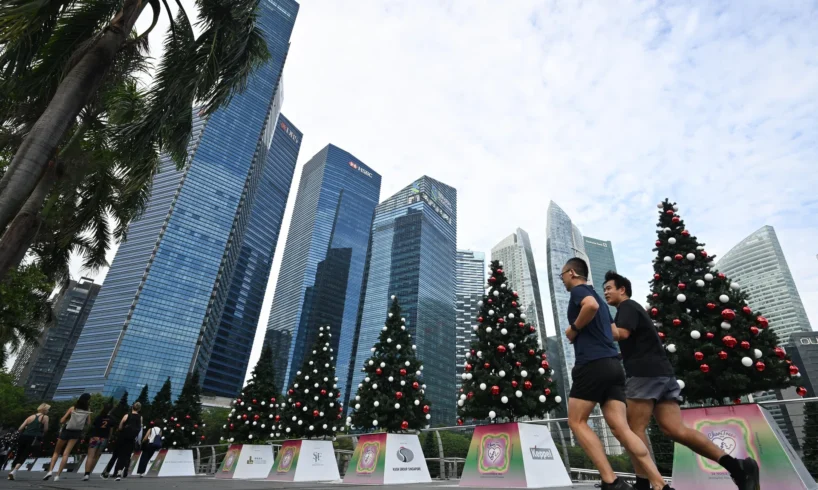
Full-year growth for 2025 is now expected at 4.1%, with a boost from manufacturing
[SINGAPORE] Private-sector economists have turned more optimistic about the Republic’s 2026 growth, with a median expectation of 2.3 per cent in the latest quarterly survey released by the Monetary Authority of Singapore (MAS) on Wednesday (Dec 17).
This is up from their 1.9 per cent forecast in a September survey, and in the upper half of the 1 to 3 per cent forecast range issued by the Ministry of Trade and Industry (MTI) in November.
DBS economist Chua Han Teng noted that 2.3 per cent growth in 2026 would mark an easing of momentum from 2025, but also a return to Singapore’s long-term potential growth rate.
The increased optimism, said OCBC chief economist Selena Ling, is driven by how the “strong performance” of non-oil domestic exports and manufacturing has extended into late 2025, and may persist into early 2026.
US tariffs have also proven less devastating than feared, she added. Markets are now “more comfortable” that Singapore has engines of growth beyond manufacturing, including financial and professional services as well as public infrastructure-led construction.
A key reason for 2026 forecast upgrades, said Moody’s Analytics economist Denise Cheok, is that contrary to many economists’ expectations, “stronger-than-expected front-loading” ahead of US tariffs has yet to taper off.
Most expected the surge to wane in the second half of 2025, with the downturn extending to 2026, she said. Instead, exports and industrial production have been gaining momentum since August, with this likely to continue into at least the first few months of 2026.
Strong end for 2025
As 2025 draws to a close, full-year forecasts for gross domestic product growth have narrowed and risen.
The latest median expectation is 4.1 per cent, a sharp upgrade from 2.4 per cent in the previous survey, driven by manufacturing but with “upgrades seen across all major sectors”.
This is in line with MTI’s forecast of around 4 per cent, upgraded in November from an earlier range of 1.5 to 2.5 per cent. This was after Q3 figures came in higher than expected, on trade resilience and strong manufacturing demand, particularly for semiconductors.
In 2026, growth momentum is likely to be supported by a construction boom, capital expenditure related to artificial intelligence (AI), and falling interest rates, said Maybank economist Chua Hak Bin.
“The AI boom will likely broaden and lift exports, investment and tech services activity,” he added.
DBS’ Chua said that while tariff challenges and uncertainties may cause a moderation in trade, this is likely to be cushioned by resilience in modern services and construction.
For 2025, manufacturing growth is now forecast at 5.4 per cent, up from 0.8 per cent in the last survey. Full-year export growth is expected at 4.5 per cent, up from 2.2 per cent.
For the other sectors, growth forecasts were 4.8 per cent for construction, up from 4.7 per cent; 4.4 per cent for wholesale and retail trade, up from 2.9 per cent; 4.1 per cent for finance and insurance, up from 3.3 per cent; and 0.9 per cent for accommodation and food services, up from 0.5 per cent.
For Q4, respondents expect year-on-year growth of 3.6 per cent. This comes after Q3’s performance of 4.2 per cent far surpassed their forecast of 0.9 per cent.
The findings reflect the views of 20 economists who responded to MAS’ survey of professional forecasters sent out on Nov 21.
Inflation expectations steady
Inflation expectations remain largely unchanged from September’s survey.
For 2026, headline inflation is forecast at 1.5 per cent, up from 1.4 per cent in the last survey. The forecast for core inflation, which excludes accommodation and private transport, remains at 1.3 per cent.
For 2025, expectations for headline and core inflation stayed unchanged at 0.9 per cent and 0.7 per cent, respectively.
For Q4, headline and core inflation are expected to be 1.1 per cent and 1 per cent, respectively.
Unemployment is expected to be 2 per cent by the end of 2025, an improvement from the 2.2 per cent forecast in the last survey.
Expectations for monetary policy remain similarly stable, though changes are now expected to come later in the year.
In the September survey, one respondent expected policy to be loosened in January with a reduction of the slope of the Singapore dollar nominal effective exchange rate policy band. Two respondents thought this would happen in April, while another two expected the slope to be flattened then.
In the latest survey, no respondents expect any move in January. But for April, one respondent expects the slope to be reduced, while another expects it to be increased instead.
For July, two respondents expect policy to be tightened with an increase in slope. This is in contrast to September’s survey, where no respondents expected tightening in the first three policy reviews of 2026.
Maybank’s Dr Chua said recent higher inflation may have increased the risk of MAS tightening. Core inflation reached a low of 0.3 per cent in August – the lowest since February 2021 – before rising to 0.4 per cent in September and 1.2 per cent in October.
“We expect the MAS to maintain the current modest appreciation bias in 2026, amid a resilient economic outlook and a normalisation of inflation towards historical averages,” he said, adding that he sees a greater risk of MAS tightening policy, rather than loosening it.
OCBC’s base case is for MAS to hold policy through July, unless core inflation exceeds the upper end of the official 0.5 to 1.5 per cent forecast range.
Nonetheless, the second half of 2026 is “still a long way away, and anything can happen” before then, said Ling.
Another possible reason to expect MAS to tighten, said Moody’s Cheok, is oil price volatility amid tensions in Europe and the Middle East. This could prompt MAS to tighten for the sake of capping imported inflation.
Risks to outlook
Geopolitical risks – including an escalation in trade tensions and wars – remain the most cited downside risk to Singapore’s economic outlook, named by all respondents and seen as the top risk by 58.8 per cent.
Entering the top three downside risks was a potential burst of the AI bubble, with spillovers to financial markets, which was cited by 41.2 per cent. Coming third was the risk of a broader external slowdown.
However, an AI-led technology upcycle was also the most common upside risk, cited by 76 per cent and named as the top risk by 52.9 per cent. Other upside risks were resilient global growth and an easing of trade tensions.
Decoding Asia newsletter: your guide to navigating Asia in a new global order. Sign up here to get Decoding Asia newsletter. Delivered to your inbox. Free.