Operation Jackpot, a secret naval commando operation, played a crucial role in India’s 1971 victory, with eight brave Bengali submariners forming Bangladesh’s most lethal naval strike force and severing Pakistan’s maritime lifeline.
As India commemorates the 54th anniversary of the historic 1971 victory that gave birth to Bangladesh, one extraordinary chapter remains largely unknown to the world: Operation Jackpot—the audacious naval commando operation that severed Pakistan’s maritime lifeline and hastened the surrender of 93,000 troops.
While history books celebrate the ground battles and air superiority, few know about the eight brave Bengali submariners who escaped from a French port and transformed into Bangladesh’s most lethal naval strike force.
The great escape from toulon
The saga began not in the war zones of East Pakistan, but in the coastal city of Toulon, France, in March 1971. A Pakistani submarine, PNS Mangro, was docked there for training exercises with 13 Bengali crew members among the personnel. As news of Operation Searchlight’s atrocities reached them, one officer—Mosharraf Hussain—and his Bengali comrades faced an agonizing choice: continue serving the military committing genocide against their people, or risk everything for freedom.
Commodore Abdul Wahed Chowdhury, who led this daring group, later recounted the tense moments: “I was in charge of the safe where all confidential documents and passports were kept. I took out all 45 passports and put them in my room. If I took only the 13 Bengali passports, it would raise suspicion.”
On March 29, 1971, eight of them made their move. When Pakistani embassy officials rushed to intercept them in Rome, the defectors stood firm: “We were born afresh on March 26. We are going to fight for our country.” Racing against time, they flew to Geneva and then to India, becoming the first military personnel to respond to Bangladesh’s liberation call from abroad.
From submariners to commandos
By May 1971, Pakistan’s stranglehold on East Pakistan seemed unbreakable. India had blocked air routes, but the sea lanes remained open—Pakistan’s crucial lifeline for reinforcements and supplies. The Mukti Bahini had no navy, no ships, and no naval warfare capability. What they had were eight trained submariners and an impossible mission.
On May 23, 1971, a secret training camp codenamed ‘C2P’ was established at Plassey, West Bengal, on the banks of the Bhagirathi River. Here, the eight Bengali submariners, alongside Indian Navy instructors, began forging Bangladesh’s naval commando force. Nearly 500 young volunteers—mostly university students and civilians—underwent a grueling three-month regimen: 18-hour training days covering combat diving, limpet mine deployment, hand-to-hand combat, and navigation through hostile waters.
Pakistani intelligence agents attempted to infiltrate the camp in June and July, but Indian security thwarted every attempt.
The night that changed everything
On the night of August 14-15, 1971, as Pakistan celebrated its Independence Day, Bangladesh’s naval commandos struck with devastating precision. Operation Jackpot targeted four crucial locations simultaneously: Chittagong, Mongla, Chandpur, and Narayanganj.
Commodore Chowdhury led 60 commandos in the assault on Chittagong, Pakistan’s most vital port. “It was practically a suicidal mission,” he recalled. “We attacked each ship with three commandos using limpet mines.”
The results were spectacular. In a single night, the commandos destroyed nine ships in Chittagong harbor alone, crippling the port. Internationally, Chittagong was declared non-operational for shipping. The operation achieved a 100 percent success rate with zero casualties among the commandos.
Over the following months, Operation Jackpot expanded its reach. According to documented military records, the naval commandos ultimately sank over 100,000 tons of shipping across Bangladesh’s ports—45 vessels in total. Each successful strike tightened the noose around Pakistani forces, cutting off supplies, reinforcements, and any hope of sustained resistance.
The strategic masterstroke
The brilliance of Operation Jackpot lay not just in its tactical execution but in its psychological impact. Pakistan had claimed the situation in East Pakistan was “returning to normal.” The naval strikes shattered this narrative dramatically, proving to the world that the resistance was alive, organized, and capable of sophisticated military operations.
Insurance companies refused to cover ships heading to Bangladesh ports. International shipping ground to a halt. Pakistani forces, already demoralized and facing relentless guerrilla attacks on land, now found their maritime supply route severed.
“The commando operation broke the lifeline of the Pakistanis in totality,” Commodore Chowdhury stated in a later interview. “They had no option but to surrender soon.”
A legacy preserved
Today, as we mark Vijay Diwas, Operation Jackpot stands as a testament to courage, innovation, and the power of asymmetric warfare. The Bangladesh government recognized these heroes with the Bir Bikrom gallantry award, though their full story took decades to emerge publicly.
The eight submariners who fled France, the 500 young commandos who trained at Plassey, and the countless support personnel who made Operation Jackpot possible deserve their place in the pantheon of 1971 heroes. They proved that determination and strategic brilliance could overcome overwhelming odds.
As Commodore Chowdhury wisely reflected: “Liberation War comes once in a lifetime.”
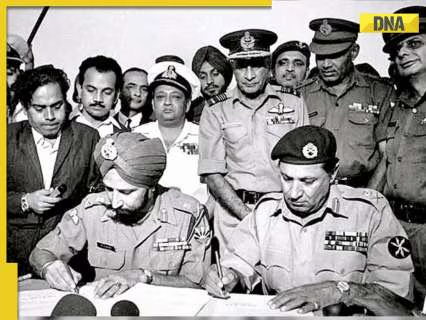
This Vijay Diwas, as we remember the surrender at Dhaka’s Racecourse Ground, let us also honor the silent warriors who fought in the waters—the frogmen who swam through darkness to strike at the enemy’s heart, ensuring that victory would come not just on land and air, but from the seas as well.
(Girish Linganna is an award-winning science communicator and a Defence, Aerospace & Geopolitical Analyst. He is the Managing Director of ADD Engineering Components India Pvt. Ltd., a subsidiary of ADD Engineering GmbH, Germany)
(Disclaimer: The views expressed above are the author’s own and do not reflect those of DNA)