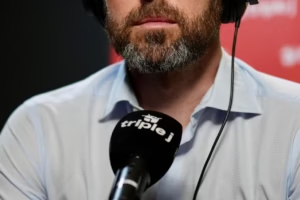
“We’re able to get consistent growth rates in the ponds by utilising the flow of seawater. If we want more nutrients, we turn up the flow,” Elsom said.
Uluu has developed pellets suitable for plastic manufacturers from seaweed.Credit:
Sea Forest, which pitches itself as “dedicated to fighting climate change”, listed on the ASX’s boards on November 26 with an initial market capitalisation of $112 million, a value since stretched to $140 million. The company will use the capital inflow to build out distribution plants in Australia, and boost production and sales, while also targeting overseas markets.
It was not the obvious environmental benefits of reducing emissions, however, that spurred ASX investors. “We thought that the industry … would get very excited by this [emissions reduction], but we found no one was willing to pay and so adoption was slower than expected,” Elsom said.
What eventually attracted interest from the agriculture sector was another side effect of Asparagopsis – an average weight gain of 6 per cent in cattle consuming the seaweed.
“Animals actually grow faster and there’s an increased revenue from a heavier animal. Those results are really accelerating [its] adoption across the industry,” Elsom said.
About 100,000 head of feedlot cattle are already eating the company’s trademark SeeFeed supplement under multi-year supply agreements with big beef producers Teys Australia and Chadwick Consolidated Group. And there is plenty of room for expansion given Australia has around 30 million head of cattle, with about 1.7 million of those in grain-fed operations, the company claims. Overseas giants Danish dairy firm Arla and Dutch multinational co-operative FrieslandCampina are also showing interest.
Loading
On the other side of the country, another company called Uluu is tackling plastic pollution by replacing it with seaweed. “We produce a group of natural polymers called PHAs which nature built, therefore nature understands and nature can break back down again at end of life,” said co-founder Michael Kingsbury.
Kingsbury says Uluu’s material behaves exactly like plastic derived from fossil fuel hydrocarbons and can be used in the same injection-moulding equipment. But at the end of its life, it is compostable and breaks down naturally without releasing microplastics.
The West Australian start-up, now nearly five years old with a team of 25, is making plastic-like pellets for product development and customer trials at major firms like Quiksilver, sleepwear brand Papinelle and Audi.
“They give us those characteristics that society has become reliant on,” he said. “These PHAs really behave like plastics. You can melt them down, you can injection-mould them, you can extrude them into fibres and yarn and blow-mould them. They repel water, they’re strong, they’re light,” he said.
Seaweed grows about 30 times as fast as land plants, absorbing carbon and cleaning oceans of marine pollutants.
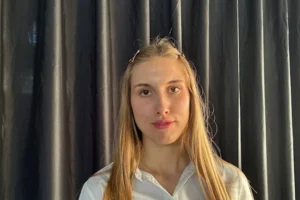
Uluu co-founders Michael Kingsbury and Julia Reisser.Credit:
A recent funding round by the firm raised $16 million, enough to build a larger facility and produce the bigger volumes it hopes will allow it to lock in contracts and underwrite a commercial-scale plant in 2028 capable of manufacturing thousands of tonnes a year.
At the moment, it uses Indonesia’s farmed seaweed but ultimately hopes to source material from Australia. Uluu’s seawater fermentation process breaks down kelp sugars with saltwater microbes to create PHAs which are extracted without harmful solvents. Leftover seaweed contains 50 per cent protein, making it a useful byproduct.
Uluu has big ambitions to replace some of the globe’s 400 million tonnes of petrochemical plastic made each year, each tonne of which emits about 2.5 tonnes of carbon dioxide. “We want to become like the Dow or DuPont of the future,” Kingsbury said. “We have this potential for a carbon negative production process where we can offset more carbon than we emit.”
Uluu is backed by German firm Burda Principal Investments and Novetex Textiles founder Ronna Chao. Sea Forest counts former world champion surfer Mick Fanning, Tasmanian businessman Peter Gunn and skincare entrepreneur Zoë Foster Blake on its books.
“Mick is just as passionate about reducing emissions as I am,” says Elsom.
The Business Briefing newsletter delivers major stories, exclusive coverage and expert opinion. Sign up to get it every weekday morning.