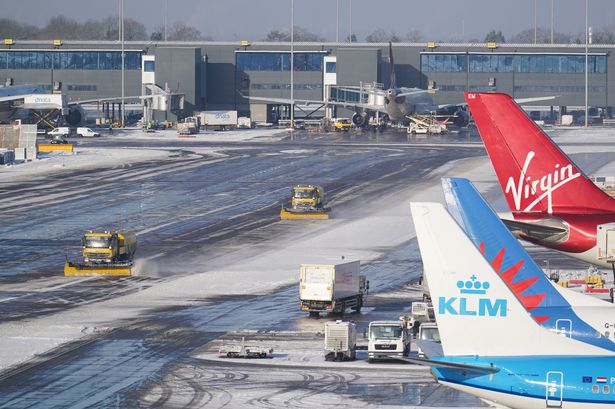
The airport has a fleet of more than 30 snow-clearing vehicles ready to be deployed
Manchester Airport has a fleet of snow-clearing vehicles ready to be deployed in wintery weather (Image: PA)
Snow may be nice to look at, yet it can certainly wreak havoc when it comes to transport. On Monday many parts of the UK woke up to snow, ice and frost with temperatures falling below freezing overnight on Sunday, and not rising much higher than 0C throughout the day.
The wintery conditions resulted in several road closures on Monday morning and delays to trams and trains. Liverpool John Lennon Airport was forced to close its runway completely for several hours while teams cleared away the snow and ice.
Despite the freezing conditions, Manchester Airport continued to operate as usual. It did urge passengers to allow extra time to get to the airport, and monitor their airlines closely for any updates on their flights. Although, departures weren’t immune to the weather conditions elsewhere and several flights to Amsterdam were cancelled due to conditions at Schiphol.
The cold weather is set to continue throughout the week with temperatures remaining low as an Arctic air mass continues to cover the UK, according to the Met Office. While there are currently no further warnings issued for Greater Manchester, the airport remains prepared for extreme weather conditions – here’s how.
How does Manchester Airport prepare for snow?
Manchester Airport’s snow vehicle fleet(Image: Manchester Airport)
Manchester Airport uses sophisticated forecasting systems to monitor the weather closely, and as the airport is located in the ‘Cheshire Gap’, it can be more prone to snowfall as showers which develop in the Irish Sea combine with winds from the north west and move into Cheshire.
Ice can be an issue for runways in particular as ground temperatures are colder than the air at night, so any moisture can soon freeze over, even if it’s warmer than 0C. Unlike on roads and pavements, grit can’t be used as it can damage aircraft. Instead the runway is treated with de-icing fluid to prevent any moisture from freezing, while the surface is also slightly grooved to create more traction for aircraft.
Should snowfall occur and reach a certain depth, the airport has to close the airfield in order to deploy its fleet of more than 30 snow-clearing vehicles, which allows the runway to be cleared as quickly as possible. Just a small amount of snow can have an impact; only one inch of settled snow means the teams have to clear more than 7,000 cubic metres of snow from the runways.
One of the vehicles in action (Image: MEN MEDIA)
The fleet includes nine Combined Jet Sweepers which are equipped with 12m snow ploughs to the front and high-powered snow blowers to the rear, each worth more than £100,000 each.The airport also has nine tractor-mounted ploughs, six snow brushes and three de-icers, used to spread de-icing fluid on runways and taxiways.
Five gritters are used on roads and walkways, but not on parts of the airfield used by aircraft. During the winter months the airport also puts on extra staff to provide support, including an adverse weather standby team who can be deployed depending on the forecast.
The airport has also expanded its snow vehicle fleet to include three All Terrain Vehicles, which are fitted with prill spreaders to negotiate walkways and aircraft stands. These vehicles can cover a larger area and help clear deeper accumulations of snow more quickly and effectively.
With this week’s cold weather set to continue over the coming days, the airport is advising passengers to take extra care when travelling to the airport, allow extra time for their journey and monitor their airline for any updates.
For more of today’s top stories, click here.