2026 hasn’t exactly seen a peaceful start. In a shocking turn of geopolitical events, Venezuelan leader Nicolás Maduro was captured by the US on Saturday. Facing narco-terrorism charges, he was flown to New York, where he is still being held in custody alongside his wife, Cilia Flores. President Trump announced that the United States would be taking control in Venezuela, stating they are going to “get the oil flowing.”
Maduro has pleaded not guilty to the charges during an initial hearing in federal court. Meanwhile, Maduro ally Delcy Rodríguez was formally sworn in as Venezuela’s interim president, while up to 50 million barrels of oil resources are set to go to the US.
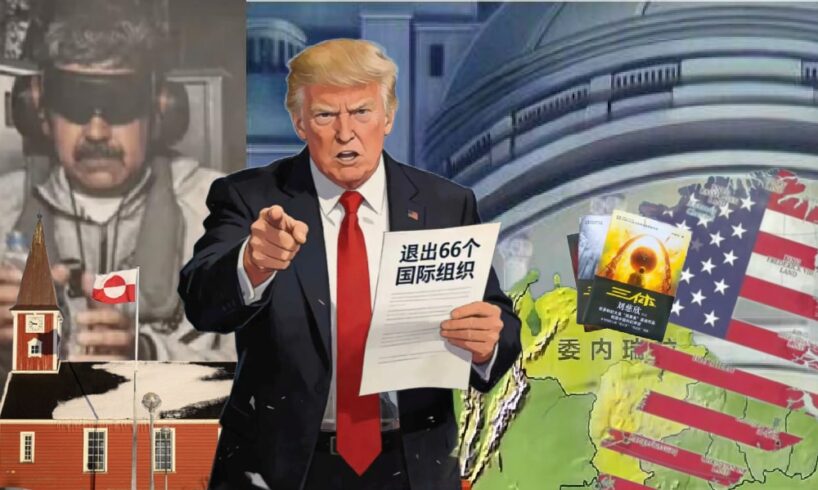
Further shaking up geopolitical tensions were Donald Trump’s comments suggesting an American takeover of Greenland, arguing that the US needs to control Greenland to ensure the security of the NATO territory in the face of rising threats from China and Russia in the Arctic.
On Chinese social media, these developments have been dominating trending lists, with “Greenland” (格陵兰岛), “military force” (武力), “Trump” (特朗普), “Venezuela” (委内瑞拉), and “Maduro” (马杜罗) among the hottest keywords across various platforms from January 6 to today.
So what is the main gist of these discussions? From official reactions to dominant interpretive frames used by Chinese commentators and bloggers, there are various angles that are highlighted the most. I’ll explore them here.
Chinese officials strongly condemned the capture of the Venezuelan president. Foreign Minister Wang Yi (王毅) stated in Beijing on Sunday that China has never accepted the idea that any country has the right to act as an “international police” or an “international judge.” The Ministry of Foreign Affairs called for Maduro’s immediate release.
Spokesperson Lin Jian (林剑) described the strikes on Venezuela as “a grave violation of international law and the basic norms governing international relations,” while spokesperson Mao Ning (毛宁) condemned what she called the United States’ “long-standing and illegal sanctions” on Venezuela’s oil sector.
These statements match the broader trajectory of China–Venezuela relations.
Over the past decades, particularly since Xi Jinping’s leadership began, the relationship between the two countries has evolved from a basic economic partnership into a more strategically significant one.
During Maduro’s 2023 visit to Beijing, the two sides elevated China–Venezuela ties to a so-called “all-weather strategic partnership” (全天候战略伙伴关系), signaling close, deep, and broad bilateral relations that go beyond a general partnership, with oil cooperation as a central pillar. (In 2025 alone, Venezuela exported around 470,000 barrels per day of crude oil to China.)
Following China’s condemnation of the US actions, Venezuelan Foreign Minister Gil expressed gratitude for China’s support, underscoring their bilateral friendship.
Beyond the official response to the recent developments, there are three main frameworks within which the ‘Trump turmoil’ is discussed on Chinese social media.
Chinese media commentators are calling Trump’s capture of Maduro a potential “major turning point” for the world. While many described the developments as a sign that “the world has gone crazy” (这个世界太疯狂了), those trying to make sense of what happened see the US move as a warning: that relatively weak countries may increasingly become playgrounds for major powers & potential targets of US aggression.
Within this reading, China is portrayed as the most stable and peaceful superpower, increasingly important in a future multipolar world order.
On the popular podcast Qiánliáng Hútòng FM (钱粮胡同), recent developments were discussed as part of America’s dominant behavior on the world stage over decades. The hosts argued that, unlike previous US leaders, Trump is far less secretive about his goals and, in this case, no longer even follows the process of seeking UN authorization or congressional approval.
Similar views appeared elsewhere, including in a trending Bilibili video by the political commentary channel Looking at America from the Inside (内部看美国), which described the Venezuela raid not as an endpoint, but as a “signal” of what is yet to come, as the US, sensing structural decline, increasingly acts reactively rather than strategically.
Zhihu author Fēng Lěng Mù Shī (枫冷慕诗), whose post rose in the platform’s popularity charts on Wednesday, also framed the moment as pivotal. While the US may once have held the upper hand, they argue, other countries now have an actual choice in which side to take in a world ruled by superpowers. They write:
💬 “If the US truly had the strength to crush everyone and dominate everything completely, it might still be able to control global affairs. But now, with the rise of China, countries bullied by the US have new choices. If you were one of them, what would you choose? To cooperate with a bandit who might kill you with an axe at any moment? Or to cooperate with a reasonable businessman who follows the rules? I believe any rational person would make the obvious choice.“
Social media posts made with AI featuring “Know-It-All Trump” or “The King of Understanding.”
At the same time, US behavior also became a source of banter. Some netizens, from Bilibili to Xiaohongshu, posted about “The Know-It-All King” (懂王 Dǒng Wáng—a Chinese nickname for Trump reflecting his often-quoted claims to understand complex issues better than anyone) as a comical villain on a shopping spree for new territories to conquer.
Weibo post: a creative solution to the Greenland issue?
One poster offered a creative solution to the Greenland issue:
💬 “Regarding Greenland, a simple diplomatic solution would be for Barron Trump [Trump’s son, b. 2006] to marry Princess Isabella [of Denmark, b. 2007], with Greenland given to the United States as the dowry. 😁”
Taiwan also quickly entered the discussion. In English-language media, some commentators suggested that the raid on Venezuela could smooth and accelerate Beijing’s path toward taking Taiwan.
China’s Taiwan Affairs Office firmly rejected such comparisons. Spokesperson Chen Binhua (陈斌华) emphasized that the Taiwan issue is China’s internal affair and fundamentally different from Venezuela’s situation. Many social media commenters also argued that comparing Venezuela to Taiwan makes little sense, stressing that Venezuela is a sovereign state while Taiwan is considered a province of China.
Even so, Taiwan continues to surface in discussions on Venezuela in various ways. Some users jokingly suggested that the US has now provided a “copy-paste example” of what a tactically impressive raid might look like, while others more seriously draw comparisons between the arrest of Maduro and a hypothetical arrest of Taiwanese President Lai Ching-te.
The central question in these debates, also raised by Taiwanese media commentator Hou Han-ting (侯汉廷), is this: if Lai Ching-te were captured alive in Beijing today, what right would the United States have to object? A common view in these discussions is that Trump’s actions lower the threshold for such scenarios and implicitly pave the way for China’s ‘reunification’ with Taiwan.
This reading seems to sharply contrast Washington’s own framing. In a speech on Monday, US Defense Secretary Hegseth described China as the US’s primary competitor and claimed that America is “reestablishing deterrence that’s so absolute and so unquestioned that our enemies will not dare to test us.”
On Chinese social media, however, this claim is openly questioned: does the raid on Venezuela actually deter China or Russia, or does it instead give them greater freedom of action?
💬 As political commentator Hu Xijin wrote on Weibo: “Americans might do well to ask the Taiwan authorities if the US military action in China has made the Democratic Progressive Party authorities pushing Taiwan independence feel more secure, or more anxious?”
A third major angle centers on Europe’s role. Hu Xijin has been particularly active in commenting on these developments, especially after Tuesday’s joint statement by the leaders of seven European countries pushing back against Trump’s Greenland remarks.
Hu described the moment as one of “unprecedented turmoil within the Western bloc” and, with Denmark (including Greenland) being a NATO member, as a signal of “the collapse of the so-called ‘values alliance’.” This idea was further strengthened by Trump’s withdrawal from the UN Framework Convention on Climate Change, alongside exits from 65 other organizations, which he described as “contrary to the interests of the United States.”
On Chinese social media, Europe is, on the one hand, seen as one of the weakest actors in this geopolitical episode, while at the same time being criticized as the biggest “hypocrite.”
This week’s joint statement—and Europe’s broader position—are framed as weak due to Europe’s structural dependence on the US.
Weibo commentator Zhang Jun (@买家张俊) argues that Europe leans on a “rules-based international order” which, in reality, would amount to little more than a “US-based order” should Trump succeed in taking Greenland. At the same time, the European statement lacked economic sanctions or concrete follow-up measures, amounting to little more than mere rhetoric.
💬 As one nationalistic account put it: “Europe wonders why, even after kneeling down and licking America’s shoes, it still ends up getting hit.”
Europe is mainly criticized for being “hypocritical” for remaining largely silent on Venezuela, while forcefully defending Greenland’s sovereignty once Trump turned his attention there.
Britain, in particular, has been singled out in Chinese media narratives surrounding the developments in Venezuela. Guancha ran a piece accusing the BBC of instructing journalists not to use the word “kidnap” when describing Maduro’s capture, suggesting the broadcaster was “whitewashing” the US’s illegal actions. It also pointed to Prime Minister Keir Starmer’s response in a BBC interview, describing his comments on US actions against Venezuela as “playing tai chi” (打起了太极)—a Chinese idiom for being evasive and dodging the question.
One Weibo user (@突破那一天) noted that a Jan 5 speech by Foreign Secretary Cooper appeared to frame US actions as contextually justified, while simultaneously stressing that Greenland’s future is a matter solely for Greenlanders and Danes—accusing her of applying a double standard on sovereignty and speaking out clearly only when the target is a Western ally.
Other users summed up Europe’s role as one of “deceiving others and deceiving themselves” (自欺欺人).
Another commenter suggested that Europe has been so focused on perceived threats from Russia and China while throwing itself into America’s arms, that it failed to notice the real danger. “Oh Europe, little piggy Europe,” they mocked. “You’ve let the wolf into the house.”
How unexpected was the American military operation in Venezuela, really? One final aspect that trended online was how eerily familiar it all felt.
In the second book of the popular 2008 Chinese sci-fi trilogy The Three-Body Problem, author Liu Cixin (刘慈欣) described a scenario in which Venezuela, ruled by the fictional President Manuel Rey Diaz, is attacked by the US. That Venezuela storyline from the sci-fi novel has become widely discussed for its parallels to the current developments.
The Three Body Problem from 2008 featured a storyline about the US invading Venezuela.
The famous Japanese anime series Black Jack (怪医黑杰克) by Osamu Tezuka (1928–89) also went trending for featuring a fictional plot that many netizens see as strikingly similar to what happened in Venezuela.
It involves the president of the United Federation, named Kelly, citing “global justice” to justify cross-border airstrikes on the presidential residence of the small, oil-rich fictional country Republic of Aldiga, before arresting its leader, General Cruz. Some netizens noted how the blond President “Kelly” even somewhat resembles Trump.
Scenes from Black Jack (怪医黑杰克) by Osamu Tezuka
(Some commenters argued that Osamu Tezuka was not predicting the future so much as drawing on an already familiar pattern of US interventions abroad, and that the character “Kelly” was more likely modeled on Ronald Reagan.)
In Liu Cixin’s Three-Body Problem, there’s a classic line told by retired Beijing teacher Yang Jinwen to former construction worker Zhang Yuanchao, who dismisses world news as “irrelevant”. In the book, Yang tells him:
📖 “Every major national and international issue, every major national policy, and every UN resolution is connected to your life, through both direct and indirect channels. You think the US invasion of Venezuela is none of your concern? I say it has more than a penny’s worth of lasting implications for your pension.”
In the current situation, some netizens think that the quote needs to be rewritten. In 2026, it would be:
💬“Do you really think the US arresting Venezuela’s president Maduro, conflicts in the Middle East, tensions across the Taiwan Strait, or Europe’s energy crisis are none of your concern? Don’t be naive. They drive up electricity bills, food prices, and mortgage rates. In the end, what gets drained is both your wallet and your future retirement security.”
It’s clear that many people are, in fact, deeply concerned about these geopolitical developments. As some have noted, science fiction is not always about distant futures. Sometimes, it turns out, we are already living in them.
In Liu Cixin’s version of the story, ‘Rey Diaz’ drives the Americans away through a united fight of the people, breaking the streak of victories by major powers over developing countries and turning the Venezuelan president into a hero of his time.
This story, I suspect, is going to end very differently. For now, it is still being written.🔚
By Manya Koetse
(follow on X, LinkedIn, or Instagram)
Spotted a mistake or want to add something? Please let us know in comments below or email us. First-time commenters, please be patient – we will have to manually approve your comment before it appears.
©2025 Eye on Digital China/What’s on Weibo. All rights reserved. Do not reproduce our content without permission – you can contact us at [email protected].