Shafaq News
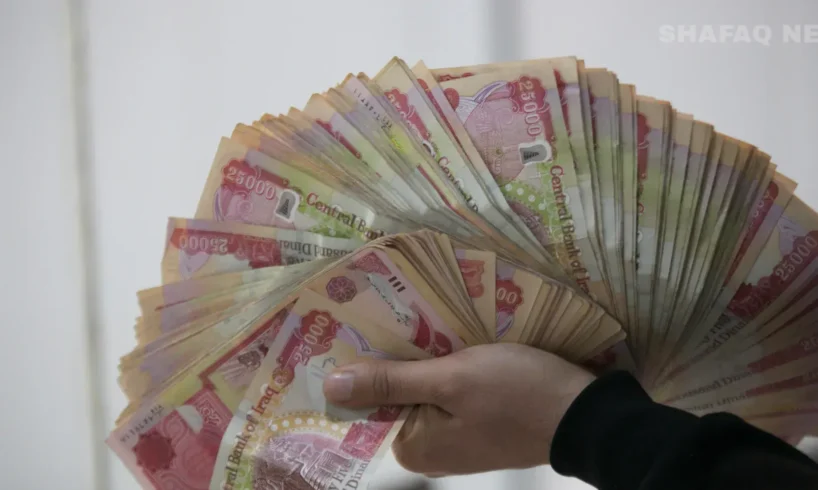
For millions of Iraqi households, the start of each month
carries a single, overriding expectation: that state salaries will arrive, in
full and on time. According to a 2024 report from the Ministry of Finance, more
than 35 million Iraqis now depend on public wages, turning government payrolls
into the country’s most dependable source of income.
At a time of tightening oil revenues, political uncertainty,
and a federal budget still stalled in parliament, those payments anchor Iraq’s
fragile social stability.
National Payroll Engine
Over the past two decades, salaries, pensions, and welfare
payments have hardened into Iraq’s most important safety net. 2025 Data from
the Ministry of Labour and Social Affairs show that around 4.5 million civil
servants receive monthly wages, alongside 2.9 million civilian and military
pensioners. These numbers account for more than 40% of Iraq’s workforce —one of
the highest ratios among oil-producing nations.
In practice, a single public salary often supports several
dependents, including extended family members, elderly parents, and children.
In Iraqi provinces where private-sector activity remains weak, these salaries
circulate beyond the immediate recipient, sustaining local markets and small
businesses.
Read more: Rumors and panic: What’s really behind Iraq’s financial scare?
Even minor delays can force families to postpone rent, cut
food spending, or defer education costs. Stability, therefore, rests less on
how much people earn than on whether payments remain predictable.
Speaking to Shafaq News, financial adviser to caretaker
Prime Minister Mohammed Shia Al-Sudani, Mudhir Muhammad Saleh, describes
salaries, pensions, and welfare payments as “sovereign obligations” that cannot
be postponed. Monthly spending on these commitments reaches about 8 trillion
Iraqi dinars ($6.5B), rising to 96 trillion dinars ($78B) annually —nearly half
of total federal expenditure.
“These payments give the budget an economic and social
dimension beyond accounting,” Saleh remarks.
Why $55 per barrel Matters
That social contract rests almost entirely on oil. According
to 2024 data released by the International Monetary Fund (IMF), oil revenues
account for about 90% of Iraq’s total income.
Within this reality, Iraqi authorities have identified $60
per barrel as the critical threshold. Above it, payroll obligations can be met
with careful management; below it, fiscal options narrow sharply. Heavy revenue
concentration, fixed spending commitments, and limited reserves combine to make
this price floor decisive.
Recent experience illustrates the dynamic. Oil prices
averaging around $80 per barrel in 2024 allowed the payroll system to operate
smoothly, masking deep structural weaknesses in Iraq’s economy.
Read more: Iraq’s budget: political fiscal gaps threaten national stability in 2025
By 2025, as prices slipped to roughly $65–70 per barrel,
those vulnerabilities became harder to ignore. Declining revenues, compounded
by political deadlock over budget approval, pushed the government toward
short-term borrowing from the central bank and state-owned banks. Contractor
payments were delayed, while investment spending absorbed most of the
adjustment.
Looking ahead to 2026, with oil projected at or below $55
per barrel, the payroll system faces a far tighter squeeze, testing the state’s
ability to preserve social stability.
Speaking to Shafaq News, economic analyst Ahmed Eid
characterizes the situation as “a deferred crisis rather than a temporary
deficit.” In his view, the danger lies less in abrupt salary cuts than in the
gradual erosion of public finances through borrowing, reserve depletion, and
postponed reform.
The core risk, he adds, is not immediate reductions in pay
but the cumulative strain created by mounting debt and delayed structural
change. “Reliance on oil, bloated spending, and weak non-oil revenues turn job
security into a temporary illusion and put public finances to a harsh test,”
Eid observes, warning that without serious reforms tied to the 2026 budget,
“today’s salaries could threaten tomorrow’s stability.”
Kurdistan as A Stress Test
The strain on salary payments is even more visible in the
Kurdistan Region, where payroll dominates public spending, and revenue volatility
quickly translates into social tension. In its 2024 report, the Kurdish
Ministry of Finance disclosed that the Kurdistan Regional Government (KRG) pays
salaries to more than 1.2 million public employees. Wages account for an
estimated 70–75% of Erbil’s total spending, leaving little room to absorb
shocks.
Under the Federal Budget Law, the KRG is required to deliver
a specified volume of oil to the federal government in exchange for budget
funding. That mechanism has repeatedly stalled amid disputes over production
levels, export transparency, and revenue accounting.
When transfers are suspended or reduced, Kurdish authorities
often resort to staggered or partial salary payments, stretching disbursements
over weeks and intensifying public pressure.
Read more: Iraq’s public sector workforce set to shrink, private sector to take lead in a decade
The latest escalation followed delays in May and June 2025
salaries. The impasse eased only after an arrangement under which the Iraqi
government required the KRG to deliver all oil production to the State
Organization for Marketing of Oil (SOMO). Under this framework, the KRG must
export a minimum of 230,000 barrels per day, with additional production also
included. In return, the Iraqi Ministry of Finance will disburse an advance of
$16 per barrel —either in cash or in kind— for the quantities received, in line
with the amended Federal Budget Law.
Hard Fiscal Choices
Economist Mustafa Al-Faraj warns that the 2026 budget faces
mounting fiscal pressure, marked by widening deficits and rising debt. He urges
the Iraqi government to set the oil price assumption in the upcoming federal
budget at no less than $55 per barrel.
“As long as oil is $55, salaries are safe,” Al-Faraj states.
“But if prices fall below $50, covering payroll will become a real concern.”
Cautioning that salary obligations may soon exceed what oil
revenues alone can sustain, he argues that this reality underscores the urgency
of genuine economic reform and credible support for the private sector,
policies he noted successive governments have repeatedly endorsed in an effort
to push Iraq’s economy beyond oil dependence.
Read more: Youth in despair, no jobs to share: Iraq’s workforce hanging in the air
Written and edited by Shafaq News staff.