Dr. Shirley Williams, who died in Little Current on Manitoulin Island on Dec. 19 at 87 years of age, was a linguist, language professor, activist, elder and knowledge keeper. For several decades she instructed and revitalized the Anishinaabemowin language at Trent University in Peterborough, Ont., a place known in her mother tongue as Nogojiwanong, meaning “place at the end of the rapids.”
She was a resilient, barrier-breaking professor who, in addition to teaching the language, authored dictionaries and lexicons, created curricula and wrote other works vital to the cultural resurgence and survival of her language.
Open this photo in gallery:
Shirley Williams, shown in 2008, joined the Trent University faculty in 1986.Michael Cullen/Supplied
“She embodied what it means to be a wise teacher in the fullest sense,” Trent University president and vice-chancellor Cathy Bruce said of Dr. Williams, whose traditional Anishinaabe name, Migizi ow-Kwe, means Eagle Woman. “Her contribution to the teaching of Indigenous languages will have a lasting impact locally, provincially and nationally.”
Shirley Ida Eliza Mary Immaculata Pheasant was born on Dec. 4, 1938, in South Bay, Wiikwemkoong, Manitoulin Island, Ont. She was the daughter of John Simon Neganigwane and Nancy Shigwadja, who had 10 children (including one who died as a baby). Her father was a fisherman, did other seasonal land-based work and started a farm. Her mother was an accomplished seamstress who also managed and preserved the harvest from the family garden.
Shirley Williams began her life on the land and waters, observing and participating in seasonal work and community life. She details this formative period in Shoolee: The Early Years, her bilingual memoir of childhood published in 2018. She was named after Shirley Temple by an older sister. “Shoolee” was another name that was dear to her, coined by her brother James because he could not pronounce “Shirley” as they grew up. She remained with her birth family until age 10, when she left for the St. Joseph’s Residential School in Spanish, Ont. She remained there for six years. Her father had wanted to keep her at home until that age so that she would retain their language. He then agreed to let her attend school with a goal of learning about mainstream society and the force of the Indian Act.
“She was between two worlds,” said Trent University professor emeritus John S. Milloy, author of A National Crime: The Canadian Government and the Residential School System, 1879 – 1986. “She wasn’t a cultural nationalist or radical. She was a welcoming presence for those of us who were not Indigenous. I literally sat at her feet during faculty meetings, which had a very open approach with considerable jocularity. I was kind of her protégé. She was a gateway for me.” Prof. Milloy felt her support as he began unprecedented archival research of residential school records on behalf of the Royal Commission on Aboriginal Peoples. “I found what we knew would be there: a charnel house,” he said.
Shirley Williams earned her BA in Native Studies at Trent and a master’s degree in Environmental Studies at York University. She also garnered diplomas from the Native Languages Instructor program at Lakehead University and the Curriculum Development program at the University of Oklahoma. In 2017, she received an honorary doctor of laws degree from Ontario Tech University for her contributions to Indigenous language pedagogy and community leadership.
Prof. Williams joined the Trent University faculty in 1986 and was named professor emerita when she retired in 2004. Prior to that, she became the first female scholar to attain a full professorship on the basis of Indigenous knowledge. Onondaga scholar David Newhouse, former head of the Chanie Wenjack School for Indigenous Studies, said Prof. Williams’s contribution, “was unparalleled in this university’s history. To get a full professorship on the basis on traditional knowledge is a great achievement and a tribute to Trent.”
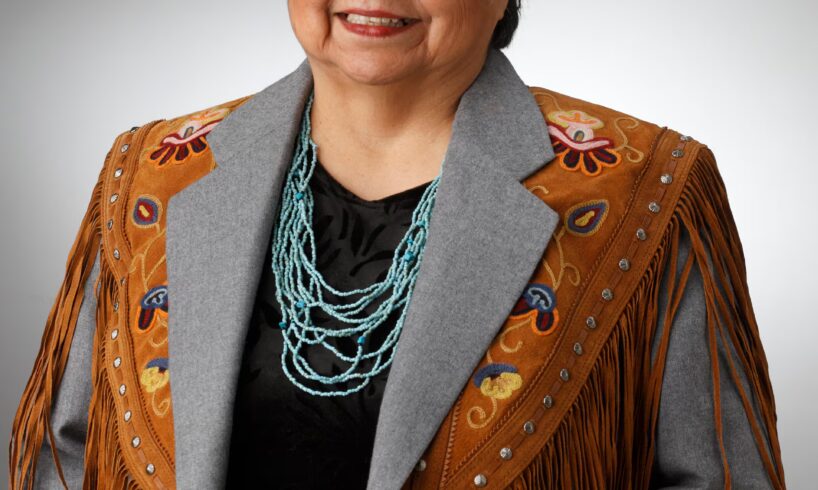
Open this photo in gallery:
A portrait of Shirley Williams by Michael Cullen for his 1996 project ‘The Chair.’Michael Cullen/Supplied
Prof. Newhouse and Dr. Bruce also emphasized that Prof. Williams played a critical pedagogical role in training other language teachers and in the production of language textbooks. As with many things, she took on her tasks with humour. Prof. Newhouse recalls her delight in recounting how she asked a group of elders how to say “jockstrap” in Anishinaabemowin as she worked on a hockey lexicon. The word is Ninii-pizowin.
Language instructors across Canada and elsewhere have benefitted from her example. Isadore Toulouse, also from Wiikwemkoong, is related to Prof. Williams and became her “spirit son” to be mentored by Dr. Williams as a mother figure.
Mr. Toulouse describes himself as a “language warrior” and teaches online courses to students as far away as Australia from his base in Traverse City, Mich. He also writes lexicons and short stories in Anishinaabemowin as he furthers his “Auntie’s” legacy.
“A lot of people adopted her as their grandmother/mentor both for language retention and cultural ways,” Mr. Toulouse said. The two travelled together to conferences in Australia, New Zealand and Hawaii as part of an international effort to preserve and revitalize Indigenous languages.
Louise Garrow, originally of Sagamok Anishnawbek First Nation, had been a student at Trent in what was then the Native Studies department, now the Chanie Wenjack School for Indigenous Studies, and then returned as an academic adviser for Indigenous students. “She had a strong female Indigenous presence and language presence. It took a long time for Trent to respect the languages. History and political process were more important. Shirley demonstrated the importance of language. She wasn’t a rant person. She just lived it.” Ms. Garrow said her friend did not speak much of her residential school experience, but recalled what her father had told her before she set out to St. Joseph’s. “That was her big charge. She took that as a mission.”
In 2016, Prof. Williams appeared on a panel at Trent with Prof. Milloy and others about residential schools to coincide with the screening of an animated film by Gord Downie about Chanie Wenjack, a boy who died running from a residential school.
When Prof. Williams spoke out about her own residential school experience, “she didn’t pull any punches,” recalled Prof. Milloy. “She was clear that the approach was one of cultural assault. At the same time, she looked for a path forward. One of her names was Immaculata. She had found a place [in society] and thought others could.” Dr. Bruce, then a professor recalled that Prof. Williams, “spoke with grace and confidence, holding an eagle feather telling that story as a truth and as a foundation for healing.”
In a yet-to-be-published second part of her memoir, Shoolee: The Residential School Years, Prof. Williams wrote, “We learned that in this place there was no love or kindness shown to us, especially when we got punished and got strapping for speaking our language. … They always told us if we continue to use it, we would not get a job in the society and not get us a job in the future.”
Prof. Willams’s longtime friend and colleague Chris Welter, a retired Trent administrator, is forever impressed by Prof. Williams’s humanity. “She was loving, generous and inclusive. Some Indigenous people have fear and distrust of we non-Indigenous people, and understandably so. Shirley treated everyone as if there was no race barrier. She treated everyone with respect, care and kindness.”
As a retired professor, Prof. Williams maintained a very busy working life. She co-launched Emosaawdamajig (Those Who Walk For The Water), the Kawartha Lakes Water Walks, a female-led initiative to walk and pray along bodies of water emphasizing women’s role in protecting water quality. She also wrote, served as a translator and advised Indigenous organizations and medical groups on matters concerning community health, Indigenous culture and combatting drug addiction and youth suicide.
In 2016 Prof. Williams received Trent University’s Distinguished Alumni Award. In 2024, she was nominated for a Juno Award with the group Nimkii and the Niniis in the Traditional Indigenous Artist of the Year category.
Before returning to Manitoulin Island a few years ago, she would pay a summer visit each year to her friend and former colleague Louise Garrow in Ottawa. She always brought a basket of blueberries as the two came from families that had gathered the berries when they were children on Manitoulin Island and along the north shore of Georgian Bay. “Those berries connected me to home. Those berries were medicine,” Ms. Garrow said.
In the preface to her childhood memoir, Prof. Williams wrote that her mother would ask, “‘When you leave this world, what are you going to tell the Creator when you are asked what you have done for your community?’ Over the years, the more I thought about what my mother had said, the more I reflected upon my own experiences helping the young people in my family understand who they were, the more I realized how important it was to share. I saw the need for our people to be able to read and speak in our own language and understand what it was like in the early days.”
Shirley Williams leaves her daughter, Janette Corston; sisters, Rosella Kinoshameg and Barb Nolan; and several grandchildren and great-grandchildren.
You can find more obituaries from The Globe and Mail here.
To submit a memory about someone we have recently profiled on the Obituaries page, e-mail us at [email protected].