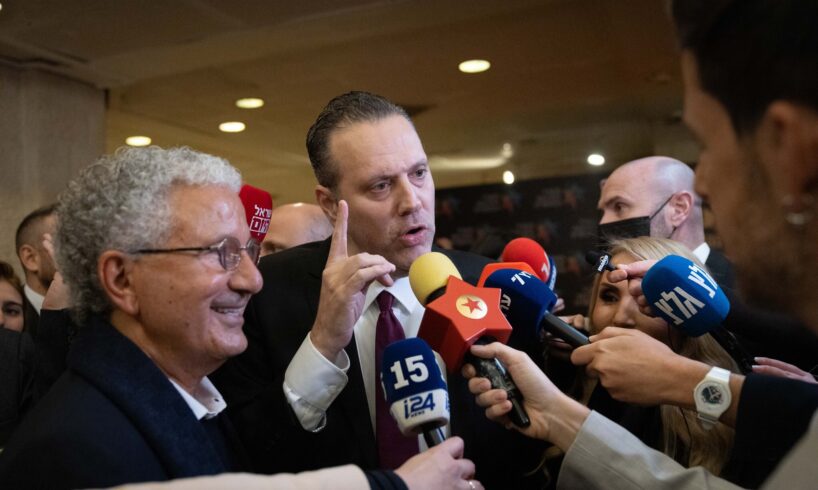
More than two dozen organizations representing artists, dancers, musicians, writers, and other creatives have signed a letter protesting Culture Minister Miki Zohar’s sweeping cancellations of a series of 2026 arts awards.
“Awards do not benefit only the creators themselves — they strengthen the whole cultural ecosystem,” stated the letter published Sunday, which asked Zohar to reconsider his decision, arguing that awards play a role as an engine for local culture, benefiting the creators and advancing Israeli culture internationally.
Zohar did not publicly announce the cuts, and several organizations suddenly discovered that they had not been allocated funds.
The organizers behind the Dvora Omer Prize, named after the children’s book author offering a NIS 100,000 ($31,500) award for children’s and young adult literature, were the first organization to realize what was happening, without being notified by the ministry, said Iris Ronli Riklis, CEO of the Forum of Cultural Institutions, an umbrella group representing some 150 arts and culture organizations and a signatory on the letter
“They figured out that theirs was canceled and that was the trigger,” said Ronli Riklis. “We asked what was happening, as the [Culture and Sport] Ministry adviser hadn’t discussed it at all with us.”
Get The Times of Israel’s Daily Edition
by email and never miss our top stories
By signing up, you agree to the terms
By last week it became clear that the awards, which included cash grants totaling about NIS 5 million ($1.6 million), had been canceled across the board. The cancellations include 60 prizes in literature, 40 awards in the visual arts, 20 grants in music, and about four in dance.
Some of the signatories questioned whether the cancellations were an attempt by Zohar to divert funding to an alternative film awards he set up.
At first, many presumed that the cuts were due to wartime budget concerns, said Ronli Riklis.
The Forum then asked whether the funding for the cultural awards had been diverted by Zohar to fund the film awards ceremony he set up in December as an alternative to the Ophir Awards in protest of the prizes handed out at this year’s ceremony. The Ophir Awards is run by the Israeli Academy of Film and decides Israel’s Oscar submission each year.
In September, following the Best Feature win at the Ophir Awards ceremony for “The Sea,” about a 12-year-old Palestinian boy, Zohar said he would halt the ministry’s funding for the Ophir Awards and the 2026 ceremony.
“He took out a bunch of awards to back his lack of belief in the film industry,” said Ronli Riklis.
The 2023 Ophir Awards ceremony, also known as the Israeli Oscar on September 10, 2023.(Avshalom Sassoni/Flash90)
Zohar is viewed by many as being overly censorious of Israel’s film industry, regularly attempting to cut funding or support for any films that appear critical of the government and its policies.
The Culture Ministry responded that the decision to cancel the awards was made at the beginning of 2025, and it wasn’t intended to divert funds to the film awards ceremony.
Zohar responded, saying that the decision was made to review the awards because they were biased towards the left.
“For years, a series of prizes were awarded to artists and creators in various fields using the tax money of all Israeli citizens, while clearly ignoring artists whose views represent the majority of the public,” he wrote on X.
“In light of this, I ordered a halt to funding the prizes until a professional committee is established to distribute awards to artists and creators from all sectors of society,” wrote Zohar. “Culture belongs to all of the people of Israel, not just to one side of the political map, and it is my duty as Minister of Culture to strengthen and develop culture for all citizens.”
Ronli Riklis denied that the current awards favored specific segments of society, noting that the process involved in awarding each of the prizes includes advisory boards that choose panels of judges.
Each panel then considers each applicant according to a carefully balanced list of criteria, aiming for award recipients from a range of religious and secular backgrounds, hailing from different geographic origins, with the goal of covering every cross-section of the Israeli public.
The awards, which include modest financial grants, help support independent creatives, she said.
“People work on their own, the ministry doesn’t support them, they’re supported by these prizes,” said Ronli Riklis. “That’s why there are some 60 prizes in literature. A person sits at their desk, writes a poem or a book, and this helps them support themselves.”
Is accurate Israel coverage important to you?
If so, we have a request.
Every day during the past two years of war and rising global anti-Zionism and antisemitism, our journalists kept you abreast of the most important developments that merit your attention. Millions of people rely on ToI for fact-based coverage of Israel and the Jewish world.
We care about Israel – and we know you do too. So we have an ask for this new year of 2026: express your values by joining The Times of Israel Community, an exclusive group for readers like you who appreciate and financially support our work.
I’m with you and will give
I’m with you and will give
Already a member? Sign in to stop seeing this
You appreciate our journalism
You clearly find our careful reporting valuable, in a time when facts are often distorted and news coverage often lacks context.
Your support is essential to continue our work. We want to continue delivering the professional journalism you value, even as the demands on our newsroom have grown dramatically since October 7.
So today, please consider joining our reader support group, The Times of Israel Community. For as little as $6 a month you’ll become our partners while enjoying The Times of Israel AD-FREE, as well as accessing exclusive content available only to Times of Israel Community members.
Thank you,
David Horovitz, Founding Editor of The Times of Israel
Join Our Community
Join Our Community
Already a member? Sign in to stop seeing this