Operating on the X platform, a large network of inauthentic accounts disguised as both citizens and companies is targeting Poland’s grassroots efforts to supply generators to Ukraine amid Russia’s winter strikes.
With the onset of extreme winter frosts, Russia has intensified terrorist strikes on Ukraine’s energy infrastructure. The aggressor’s goal is to provoke a humanitarian catastrophe in Kyiv and other Ukrainian cities. From the perspective of international law, these strikes qualify as crimes against humanity and are yet another confirmation of the genocidal nature of Russian aggression.
To help overcome the energy crisis, partner countries have increased their support for Ukraine. This is not limited to government initiatives alone.
In Poland, for instance, the “Heat for Kyiv” campaign was launched, which later evolved into a global initiative. Initially, the organizers—the Stand With Ukraine foundation—planned to raise 400,000 zlotys and purchase small generators. However, within the first day alone, Poles donated over 1 million zlotys. As of now, approximately 2 million euros have been raised, and this week the first batch of 130 more powerful generators has already arrived in Kyiv.
At the same time, Russia has deployed an aggressive disinformation campaign in the Polish information space, attempting to discredit this initiative. Meanwhile, in the Ukrainian information space, Russian bot farms are spreading narratives designed to undermine trust in the state leadership and spread panic.
Moscow’s strategy is not new. In previous years, it has been repeatedly documented that Russian bot networks become active during massive attacks on Ukraine’s energy system. In this way, the enemy combines actions “on the ground” with actions in the information space, trying to achieve maximum cumulative effect: demoralization, panic, and other negative reactions.
It is also not news that Russia simultaneously conducts disinformation campaigns in different countries. One of the aggressor’s key objectives is to destroy international unity around supporting Ukraine. In this case, Russia’s goal is not only to reduce energy aid to Ukraine, but also to provoke an artificial conflict between Ukrainians and Europeans.
Russian Bot Disguised as a “Polish Lawyer”
The main tool that enables Russia to interfere in other states’ information fields is social networks and platforms: Facebook, TikTok, X (Twitter), etc. Despite all efforts to combat abuse, social networks remain vulnerable: Russian intelligence services maintain bot farms that generate disinformation narratives, spread fakes, and other malicious content.
For example, Russian bot farms are currently actively spreading fake messages in the Polish segment of X claiming that after the first generators arrived in Ukraine as part of the “Heat for Kyiv” campaign, similar models immediately appeared for sale on the Ukrainian platform OLX.
“This is how Ukraine deceives us!!! When Poland sent generators to Ukraine, numerous advertisements for the sale of this type of equipment suddenly appeared on Ukrainian OLX! Doesn’t this make you think?” – writes the anonymous account “Centrum Usług Prawnych” (“Legal Services Center”), reposting an inauthentic video from TikTok that supposedly proves the fact of Polish aid being stolen in Ukraine.
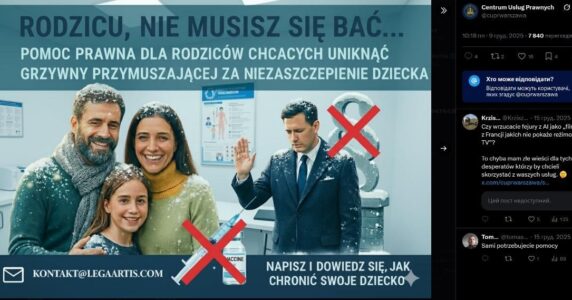
This is just one of many examples of Russian bot farm activity, but it is worth examining in more detail. To begin with, the “Centrum Usług Prawnych” account has all the hallmarks of belonging to a bot farm, specifically a Russian one. For instance, its pinned post is an AI-generated poster that promises “legal assistance to parents who wish to avoid mandatory fines for their child’s lack of vaccination.”
This “invitation” is not coincidental, as Russia has long been using anti-vaxxers in its information operations, including to disrupt mobilization in Ukraine.
Despite its name, the account has no connection to jurisprudence or law. Examination of its content shows that its sole purpose is to spread anti-Ukrainian and anti-European materials, as well as directly retransmit Russian narratives. Here are just a few examples of such content posted by the “Centrum Usług Prawnych” account between 10:00 and 12:20 on January 28:
Here you have the “threat” to the Polish border, the “disastrous” results of Maidan, the “seizure” of UOC churches, and “political repression” – the entire set of Russian propaganda clichés from the virtual front page of Russia Today.
Overall, during the mentioned time period (i.e., within 140 minutes), the “Centrum Usług Prawnych” account posted 19 messages, which is extraordinarily high: this is the pace of an automated bot farm, not an authentic user. As for positioning itself as a corporate account of a legal company – this is also a typical, albeit unsophisticated, technique when creating inauthentic profiles. The link to the corporate website indicated in the “Centrum Usług Prawnych” profile leads to a Polish legal company’s website with a different name, but inattentive users may not notice this.
Currently, in the Polish segment of X, an entire network of inauthentic accounts is operating, attempting to discredit the “Heat for Kyiv” campaign and turn Poles against Ukraine.
The choice of this particular platform is not accidental. X is one of the most popular social networks in Poland with 5.33 million users (as of 2025). According to DataReportal, in 2025, nearly 17% of adult Poles used X. Additionally, certain features of the platform’s policy leave it more vulnerable to malicious interference, which facilitates the work of the Russian disinformation machine.
Furthermore, as evidenced by the study of bot accounts, they repost content from other platforms where Russian intelligence services conduct similar disinformation activities.
What the Real Threat of Bot Farms Is
It goes without saying that OLX advertisements as such do not prove the fact of abuse. Firstly, a huge amount of energy equipment of various brands has long been sold on the market in Ukraine.
And secondly, anyone can create an account and post a fake advertisement on OLX even without a Ukrainian phone number: an email, Facebook profile, Google, or AppleID is sufficient.
However, it is mistaken to believe that the main threat from bot farms is the spread of fakes. In 90% of cases, these fakes are easily debunked or appear so absurd that they do not inspire trust from the very beginning.
The main danger is the massive scale with which bots spread certain malicious content and certain narratives. It is precisely through massive and synchronized activity that bot farms strive to create an illusion of majority in the virtual space of social networks. A user who does not know how to distinguish inauthentic accounts may think that talk about “reselling Polish generators on OLX” is not gossip from suspicious marginals, but the truth defended by dozens and hundreds of other users.
Similarly, Russian propaganda attempts to legitimize certain toxic narratives. That is why in Polish social networks, bots constantly chatter about “ungrateful Ukrainians,” about “usurper Zelensky,” “Ukrainian crimes,” etc. Their goal is to create a constant negative background around Ukraine that will contribute to suspicion and conflict between the two countries. According to available estimates, it is bots that generate up to 80% of the extreme negativity in social networks, which makes regular users neurotic and radicalizes public opinion.
Unfortunately, the activity of bot farms on social platforms is a problem that currently has no effective solution. Therefore, it is important for citizens to be informed about existing threats, and for those responsible for decision-making to build communications taking into account the destructive efforts of the enemy.
If you have found a spelling error, please, notify us by selecting that text and pressing Ctrl+Enter.