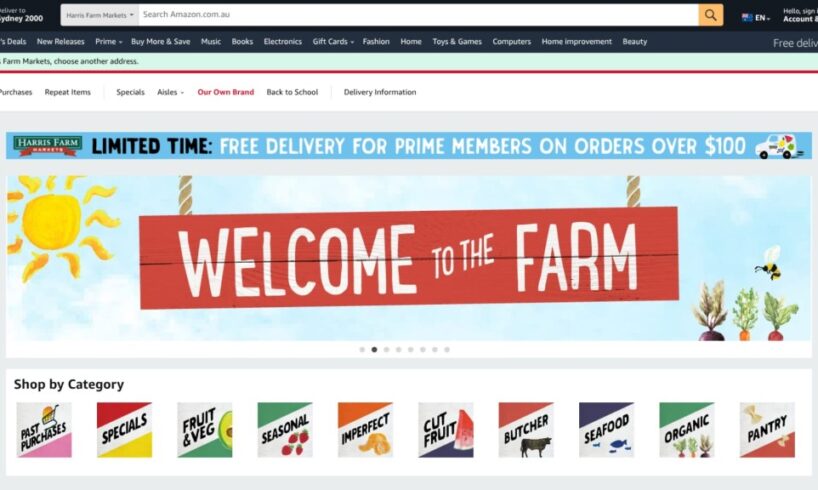
Upmarket grocer Harris Farm’s new same-day delivery service appears significantly more costly than those offered by Aldi, Coles, and Woolworths, unless shoppers subscribe to Amazon Prime.
The family-owned Harris Farm and Amazon announced their new partnership on Wednesday, declaring 80 suburbs across Sydney will soon have access to rapid fresh food orders.
Related Article Block Placeholder
Article ID: 321566
The partnership will pit Amazon against supermarket giants Coles, Woolworths, and Aldi, which offer their own same-day delivery services provided by partners Uber Eats and DoorDash.
But the initial pricing structure suggests Harris Farm shoppers are likely to face significant delivery fees unless they join Amazon’s holistic subscription program.
Fresh produce and grocery price comparison
To track prices, SmartCo Media compared a basket of eight fresh foods, fridge essentials, and pantry goods across Aldi, Coles, Woolworths, and Harris Farm.
Smarter business news. Straight to your inbox.
For startup founders, small businesses and leaders. Build sharper instincts and better strategy by learning from Australia’s smartest business minds. Sign up for free.
By continuing, you agree to our Terms & Conditions and Privacy Policy.
The basket included:
Three Cavendish bananas
Three heads of broccoli
1kg brown onions
500g beef mince
2l full cream milk
A dozen barn-laid eggs
A loaf of sliced white bread
A jar of basic tomato pasta sauce.
Where generic or home-brand items were not available, the cheapest available item was chosen instead. As some items differed between baskets, the base cost comparison is indicative only.
Those baskets were created through the DoorDash app in the case of Aldi and Woolworths, Uber Eats for Coles, and Amazon for Harris Farm.
Aldi proved the most affordable option, with the groceries themselves costing $32.48. Including bag fees, and DoorDash’s delivery and service fees, the total cost was $41.71.
Coles and Woolworths were the next cheapest options.
The Coles basket cost $41.51. Standard delivery through Uber Eats brought the overall cost to $49.88, before discounts from an Uber One membership.
Related Article Block Placeholder
Article ID: 325651
Woolworths was not far behind, with the grocery items costing $42.68. Bag fees and DoorDash delivery and service fees brought the cost to $52.29, before discounts from DashPass membership.
The Harris Farm basket cost $57.72, above the minimum order threshold of $50.
A $15 fee for same-day doorstop delivery brought the overall cost to $72.72.
Harris Farm orders are currently fulfilled from Harris Farm’s Leichhardt store, whereas same-day deliveries at competitors are sourced from stores closer to customers.
This means delivery costs could change as Amazon expands the partnership across the Sydney metro area.
Harris Farm benefits for Amazon Prime members
To mark the new partnership, Amazon and Harris Farm are currently offering a $10 discount for first-time orders.
But it appears Amazon Prime membership will offer more significant long-term benefits for Harris Farm delivery customers.
Delivery fees drop to zero for orders over $100 for Prime members.
By comparison, non-member shoppers must spend $200 per order before free delivery kicks in.
Through this lens, the partnership appears to be a value-add for Prime members as much as it is an expansion of Harris Farm’s operations.
While Amazon stands to benefit from the fresh produce offerings now on its platform, Harris Farm remains more than a simple plug-and-play addition to the American marketplace giant.
In a statement, Harris Farm called the partnership a “natural next step” and a “smart way to grow and compete in a tough grocery market, while staying true to what we’ve always done best”.
Fresh produce a long time coming
The Harris Farm partnership now plugs a significant hole in Amazon’s product offering, making good on its well-known ambitions in the fresh produce sector.
It bought US business Whole Foods Market in 2017, and introduced perishables to its US same-day delivery service last year, serving as a blueprint for its Harris Farm partnership.
Amazon has long challenged Australia’s incumbent supermarkets by selling non-perishable pantry essentials, with competition only heating up last year, when Woolworths called for Amazon to come under the mandatory food and grocery code.