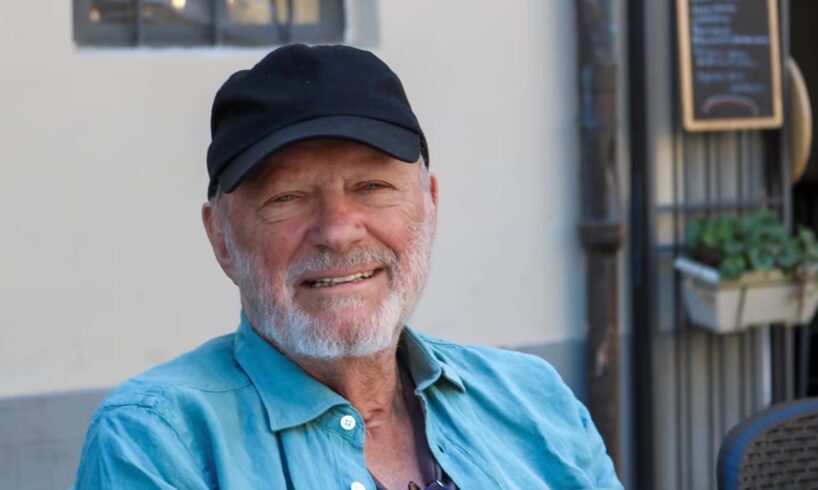
Open this photo in gallery:
Film director Ralph Thomas.Courtesy of Thomas family
Ralph Thomas, who died on Jan. 4 at the age of 86, was a journalist and filmmaker who began his career in documentaries at the CBC before moving into drama. His 1981 feature film Ticket to Heaven, which he wrote and directed, was nominated for 14 Genie Awards in 1982. It won four, including Best Motion Picture. The film, produced by his wife, Vivienne Leebosh, also won the Grand Prize at the Taormina Film Festival in Italy.
The film was about cults and fundamentalism – subjects Mr. Thomas knew about firsthand. His early life alone would have made a riveting documentary.
Ralph Thomas was born on Sept. 8, 1939 in São Luis, Maranhão on the edge of the Brazilian Amazon, where his parents were Baptist missionaries. They had gone to Brazil to set up a Bible school and convert Brazilians, especially Indigenous Brazilians, to Christianity. Young Ralph was brought up in a strict environment: no television, no films, reading restricted to the Bible and no contact with girls. His father, George, was born in Saskatchewan; his mother, Blanche Huxley, was a nurse from Australia.
“His father was very rigid,” said Ms. Leebosh. “He once beat him, he said, till he was unconscious because he saw him when he was about 10 or something, walking and holding a girl’s hand in Brazil. It’s a miracle that Ralph came from where he came from.”
“It was a harsh and punitive upbringing,” said Mr. Thomas’s son, Nye Thomas, a lawyer living in Toronto. “My dad and his brothers had a very, very difficult time, both in Brazil and later in Alberta, where they moved when my dad was 13.”
His parents never watched any of their son’s television programs or films. Late in his father’s life, the two men had a reconciliation of sorts. But Ralph Thomas rebelled against his strict upbringing.
“It stayed with him his whole life and, I think, led him to initially rebel against the church and against his family,” said his son. “It also led him to become a journalist and then a filmmaker.”
When the Thomas family moved back to Canada, Ralph attended a strict Christian school in Alberta. But when they moved to Toronto, his life began to change. Attending a public high school, Harbord Collegiate, for a couple of years and then enrolling at the University of Toronto opened up another world.
At U of T, he spent a lot of time reading, catching up on things he had missed. He directed plays at the university and worked on The Varsity, the student newspaper.
“He only stayed at university for two years but it transformed his life in ways he couldn’t imagine when he was in Brazil or at the Prairie Bible Institute,” said Nye Thomas.
While at U of T, Ralph Thomas wrote several plays and, according to Ms. Leebosh, Nathan Cohen, the culture critic at the Toronto Star, asked Ralph to write for the paper, on music and drama. It was 1962, and his first column was called “The Pop-Rock Scene.” He later moved on to writing about politics and that’s when his work attracted the attention of CBC executives, who at the time looked at newspapers as a kind of farm team for potential television talent and he was hired to work in current affairs on documentaries.
That somehow morphed into doing television drama; few people made that crossover. To do so meant Ralph Thomas was seen as having what it took to write and direct dramas of the type the CBC no longer produces.
John Kennedy, then head of TV Drama at the CBC, said the young Ralph Thomas wanted to write and direct stories with an edge.
“Let’s engage the audiences, let’s not piss them off. Let’s not disturb them too much – and Ralph did all of those things,” said Mr. Kennedy, long retired and living in Vancouver. “Ralph told stories that he thought ought to be told. Not everybody agreed. But the CBC let him do it.”
“Ralph was an incredibly intelligent man and an incredibly principled man, and he attracted some really smart people to work with him. He was not always wonderfully easy to get along with, because he had very strong opinions and loved a good argument,” said Mr. Kennedy.
Nye Thomas said his father hung around with a group of idealistic young film and documentary makers.
“They were coming out of the sixties. Their goal, my father’s goal, was to tell authentic Canadian stories from a Canadian perspective, not just remade American stories, starring Canadians, written by Canadians. At the time, that was something new.”
He said his father and his colleagues lived hard and drank hard. “I don’t think they were the happiest people in the world,” said Nye Thomas. In 1980, his father decided to give up drinking. “Because of that, he lived a longer, happier life than many of the people he worked with.”
“In 1975, Ralph produced the acclaimed docudrama series, For the Record, writing and directing numerous episodes. For the Record was a signal moment in Canadian broadcasting, bringing uncompromising, hard-hitting stories to Canadian television,” said Helga Stephenson, former CEO of the Toronto International Film Festival.
“The show became an incubator for a generation of young writers, actors and directors committed to telling difficult, off-beat and challenging Canadian stories. In 1977, the Canadian Film Awards – the precursor to the Genie Awards – bestowed an Award of Distinction on Ralph for increasing the stature of film drama on television in Canada.”
If he set out to stir controversy, he was often successful.
“Ralph and Peter Pearson produced a film on the tar sands. It showed once, and Alberta sued them,” said Ms. Leebosh. “They didn’t have to pay anything, but the settlement with the CBC was it couldn’t be shown again. Ralph was not happy because it was a very important film to hm.”
In 1983, Mr. Thomas directed The Terry Fox Story for HBO, the first movie ever made for the U.S. cable television market. The story of the famous Canadian won the Genie Award for Best Motion Picture in 1984 and earned Mr. Thomas the ACE Cable Award for best directing.
In the early eighties, Ralph and Vivienne moved to Los Angeles, where he continued his career in Hollywood – writing and directing television and films for HBO, CBS and other networks. For many years, Ralph also mentored screenwriting students as part of the Santa Barbara International Film Festival programs.
Ralph Thomas was married twice. He met his first wife, Dorothy Mikos, in 1962 at the Toronto Star, where she was an arts reporter. She shared his idealism. Dorothy Thomas – she always used her married name – served two terms on the Toronto City Council. He married Ms. Leebosh, a Montrealer, with whom he collaborated on many films. They met in Toronto in 1973 after Ms. Leebosh had finished organizing a fundraising festival for the Cree Nation of Waskaganish.
Mr. Thomas leaves his wife, Vivienne; son, Nye; stepsons, Jon and Derek; brothers, Paul and Ivor; and grandchildren, Mei, Eli and Nate.
You can find more obituaries from The Globe and Mail here.
To submit a memory about someone we have recently profiled on the Obituaries page, e-mail us at [email protected].