Shafaq News
Across Iraq, dozens of districts lie far
from provincial centers yet shoulder vast geographic responsibilities with
limited administrative authority and financial capacity. The result is a
persistent gap in basic services that incremental projects have failed to
close. Ain al-Tamr, west of Karbala, offers a clear case study of how local
development efforts collide with deeper structural constraints that continue to
shape daily life in many Iraqi districts.
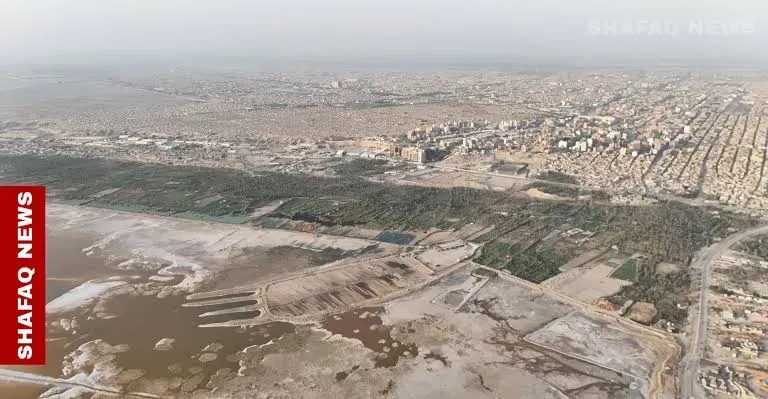
Covering nearly 1,955 square kilometers
and home to around 33,500 residents, Ain al-Tamr combines desert terrain with
agricultural land, a mix that makes infrastructure costly and logistically
complex. Local officials say recent years have brought visible progress, but
they acknowledge that the scale of needs still far exceeds the pace of
implementation.
District head Miqdad al-Tamimi told Shafaq
News that Ain al-Tamr has benefited from a series of service projects aimed at
easing long-standing shortages. These include new schools built under the
Chinese loan program, road paving inside residential neighborhoods, and the
extension of water pipelines to improve supply. Electricity services have also
expanded with the construction of a power substation and a transmission line
linking the district to the Mishkat power station. “The total cost of completed
projects exceeds 15 billion Iraqi dinars (about $11.5B).”
These steps have improved daily
conditions, but they also underscore a wider pattern seen across Iraqi
districts: development remains fragmented and reactive rather than guided by an
integrated, long-term plan. In Ain al-Tamr’s case, Al-Tamimi pointed to the
continued absence of a local hospital, vocational institutes, and sufficient
water resources as critical gaps that still undermine the quality of life.
Health care stands out as one of the
district’s most pressing challenges as residents must travel to Karbala city,
60-80 km, to access advanced medical services, a journey that is often
time-consuming and financially burdensome. “We proposed a 50-bed hospital with
an estimated cost of 28 billion dinars, but the project remains at the planning
stage,” Al-Tamimi said.
Another structural constraint in the Iraqi
districts is the water scarcity, which, in Ain al-Tamr, like many districts,
faces recurring drought conditions that affect both drinking water and
agriculture. Farming remains the primary source of income for much of the
population, making water shortages not only a service issue but also an
economic one.
Al-Tamimi said plans are in place to
construct a dam to harvest rainwater, in cooperation with Turkish companies,
“but for now, the problem persists.”
Agriculture itself highlights the
imbalance between local economic reliance and policy attention. Despite its
central role in Ain al-Tamr’s economy, support for farmers remains limited,
particularly in subsidies, irrigation infrastructure, and technical assistance.
Government data show that Iraq approved a nationwide agricultural support
package worth 500 billion Iraqi dinars (about $383.3B) in 2025, aimed at
strengthening food security and assisting farmers across all provinces. Yet
local officials say the impact of such allocations remains uneven on the
ground.
“Ain al-Tamr has not received its full
share of agricultural support,” Al-Tamimi said. “The funding has been
insufficient to address chronic water shortages and declining farm
productivity.”
“The district’s experience reflects a
broader pattern across Iraq, where national programs do not always translate
into tangible assistance at the district level, leaving farmers exposed to
long-term decline.”
A similar picture could be observed in the
education sector due to the absence of vocational institutes or technical high
schools, which forces students to commute daily to Karbala city, adding financial
pressure on families and increasing the risk of dropouts. Ministry of Education
data show that vocational and technical education remains heavily concentrated
in major urban centers. Baghdad hosts about 70 vocational schools, Basra around
35, and Nineveh roughly 30, while provinces such as Karbala, Diyala, and
Muthanna face notable shortages and weak infrastructure in this sector. This
imbalance highlights a national gap that directly affects small districts like
Ain al-Tamr, where young people have limited access to practical training tied
to local labor needs.
Experts say these service gaps are rooted
less in local performance and more in the way Iraq’s governance and budget
systems are structured. Federal funding formulas, prioritize population size over
geographic scale and development needs. In a recent interview with Shafaq News,
the spokesman for Iraq’s Ministry of Planning, Abdul Zahra Al-Hindawi, revealed
that around 80 percent of budget allocations are tied to population figures,
while only 20 percent are linked to poverty and other development indicators.
With census results now shaping funding distribution, sparsely populated but
geographically large districts risk remaining structurally disadvantaged.
Another problem in the districts that compounds
the problem is the administrative authority, because district administrations
operate under provincial governments with limited autonomy, restricting their
ability to prioritize projects or redirect funds in response to urgent local
needs. While decentralization has been a recurring theme in Iraq’s reform
debates, its practical impact at the district level remains limited.
Political analyst Abbas Al-Jubouri told
Shafaq News that the return of provincial councils has not led to measurable
improvements in local services. He argued that their role remains sharply
constrained, with provinces and federal ministries retaining effective control
over budgets and spending. “The councils exist on paper, but they lack the
tools to enforce decisions or directly shape service delivery,” undermining the
core promise of decentralization.
Al-Jubouri added that district and
provincial councils often have little real control over project execution,
leaving them unable to translate local priorities into funded action. This
administrative bottleneck, he said, explains why many districts continue to
rely on piecemeal projects rather than comprehensive development strategies.
In Ain al-Tamr, planned initiatives
—including a grain silo, a second access road, and new institutional buildings—
signal an effort to move beyond short-term fixes. Yet Al-Tamimi cautions that
without sustained funding mechanisms and clearer development planning, such
projects risk remaining isolated interventions rather than drivers of long-term
economic and social stability.
Ultimately, Ain al-Tamr’s experience
distills a wider reality across Iraq’s periphery that districts are often
managed as secondary spaces rather than as communities with their own economic
weight and long-term potential. The result is a cycle in which services arrive
in pieces, funding follows population rather than need, and local
administrations remain unable to turn priorities into action.
For Ain al-Tamr, the challenge is not the
absence of projects, but the absence of a coherent framework that connects
health care, water, agriculture, and education into a single development path.
Sustained financing and clearer authority at the district level, new roads,
schools, or facilities could ease the pressure only temporarily, without changing
underlying vulnerabilities.
For now, Ain al-Tamr shows that progress
is possible, but it also makes clear that lasting change requires more than
scattered investments; it requires a shift in how development itself is
conceived and delivered.
Written and edited by Shafaq News staff.