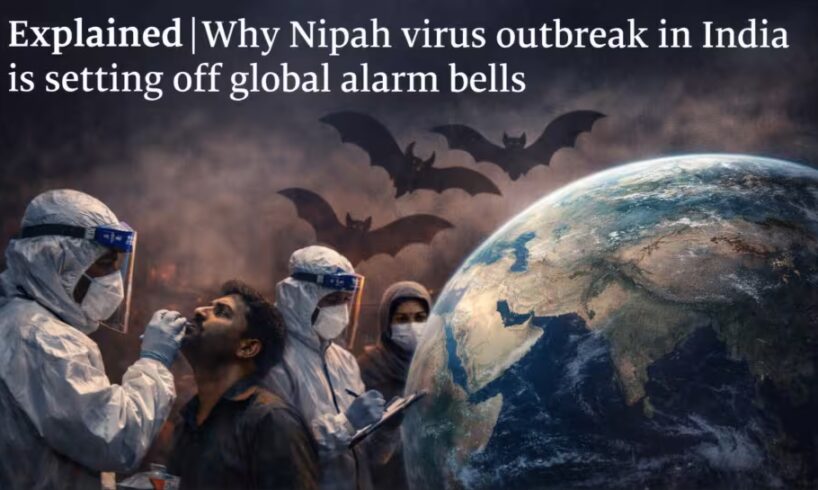
As millions across Asia prepare to travel for the Lunar New Year, a little-known but lethal virus has nudged its way back into the headlines. Two confirmed Nipah virus infections in India’s eastern state of West Bengal have been enough to prompt airport alerts from Bangkok to Kuala Lumpur, not because the outbreak is large, but because of what the virus can do when it slips through the cracks.
So how worried should the world be? Here’s a clear look at what’s happening and why governments are paying attention.
What’s happening in India?
Add Zee News as a Preferred Source
India’s health ministry said this week that two people tested positive for the Nipah virus in West Bengal in late December 2025. Both patients are healthcare workers being treated at the same hospital.
Authorities traced 196 contacts linked to the cases. “All traced contacts have been found asymptomatic and have tested negative,” the ministry said, adding that the situation is “under constant monitoring” and that “all necessary public health measures are in place”.
While officials have not identified the original source of infection, the fact that both patients worked at the same hospital suggests possible exposure to an infected but undiagnosed patient, a pattern seen in earlier outbreaks.
What is the Nipah virus?
Nipah virus (NiV) is a zoonotic disease, meaning it jumps from animals to humans. Fruit bats and flying foxes are its natural hosts, but humans can become infected through contaminated food, close contact with infected animals, or through person-to-person transmission.
The virus incubates for about five to 14 days. Symptoms often begin with fever and headache, but severe cases can escalate rapidly, leading to breathing problems and acute encephalitis, inflammation of the brain.
Patients may suffer convulsions, confusion, and coma within 24 to 48 hours in serious cases. The fatality rate is high, though the virus does not spread easily between people, which limits its pandemic potential.
Has Nipah caused outbreaks before?
Yes, and that history explains the concern. The first recognised outbreak occurred in 1998 among pig farmers in Malaysia, later spreading to Singapore. More than 250 people were infected, and over 100 died.
In 2014, cases in the Philippines were linked to slaughtering horses and eating infected meat.
South Asia has seen repeated flare-ups since 2001, particularly in Bangladesh and India. The World Health Organization (WHO) says outbreaks in Bangladesh were often linked to drinking raw date palm sap contaminated by bats, close contact with infected people, and caring for sick patients.
India recorded its first confirmed cases in West Bengal in 2007, although an earlier outbreak was later identified in Siliguri in 2001. That episode was largely hospital-based; 75 percent of cases involved hospital staff or visitors, according to the WHO.
Since 2018, several outbreaks in Kerala have caused dozens of deaths, making it one of the world’s highest-risk regions for Nipah.
Is this outbreak different?
What stands out is the long gap. West Bengal has not reported a Nipah outbreak for decades, and there is still no clear explanation for how the virus resurfaced. Some experts believe eating fruit contaminated by bat saliva or urine may trigger infections. India’s Council of Medical Research has said the virus mainly spreads through close contact but may also be airborne in certain settings, a concern in crowded hospitals.
Is there a vaccine or treatment?
There is currently no approved vaccine or specific treatment for the Nipah virus, according to the WHO. The University of Oxford is running vaccine trials in Bangladesh and began phase-two trials in December 2025.
In the meantime, doctors rely on supportive care and experimental use of antiviral drugs. Ribavirin was given to a small number of patients during a 1999 outbreak in Malaysia, though its effectiveness remains uncertain.
The US Centers for Disease Control and Prevention says Remdesivir has shown promise in preventing Nipah infection in exposed non-human primates. Kerala used the drug during a 2023 outbreak, which coincided with a lower fatality rate.
Why are other countries tightening airport checks?
Thailand, Indonesia, Nepal, and Malaysia have all stepped up screening at international airports.
Thailand’s health ministry said planes arriving from Nipah-affected countries are being parked in designated bays, with passengers required to complete health declaration forms. Thermal scanners have been installed at Bangkok’s Suvarnabhumi airport to detect fever and other symptoms. Similar measures are in place in Kuala Lumpur, Jakarta, and Kathmandu.
The timing matters. Heavy holiday travel raises the risk of infected passengers carrying the virus across borders before symptoms appear.
How worried should people be?
Social media anxiety has flared, especially in China. “It’s so scary, especially with the Spring Festival coming up. I don’t want to experience another lockdown,” one user wrote. Another asked, “Can’t we temporarily shut the travel channel with India?”
China’s state broadcaster CCTV reported that the country has not recorded any Nipah cases so far, but warned of the risk of imported infections.
Health experts stress that Nipah is not like COVID-19. It does not spread easily, and outbreaks are usually contained through tracing, isolation, and hospital controls. Severe cases can be managed “through intensive supportive care”.
How can the virus be prevented?
Beyond airport checks, public health advice remains straightforward: good hygiene, proper ventilation, avoiding crowds, staying home when ill, and seeking medical care early.
The WHO has also issued specific guidance aimed at stopping spillover from bats. In a 2018 report, it said “decreasing bat access to date palm sap and other fresh food products” is essential.
“Keeping bats away from sap collection sites with protective coverings [such as bamboo sap skirts] may be helpful. Freshly collected date palm juice should be boiled, and fruits should be thoroughly washed and peeled before consumption. Fruits with signs of bat bites should be discarded,” the agency said.
People handling sick animals should wear gloves and protective clothing. In hospitals, the WHO advises standard precautions alongside contact and droplet protection and, in some cases, airborne precautions.
“Close unprotected physical contact with Nipah virus-infected people should be avoided. Regular hand washing should be carried out after caring for or visiting sick people,” it added.
The West Bengal outbreak is small and under control, but Nipah’s deadly reputation, combined with peak travel season, explains why governments are not taking any chances.