2026-02-08T22:31:10+00:00
font
Enable Reading Mode
A-
A
A+
Shafaq News- Gaza
Farah Abduljabbar never imagined that months after her
wedding, her modern washing machine would vanish from her life, replaced by
plastic buckets and cold water inside a displacement tent. Before the war,
laundry was a routine task —quick, electric, and unremarkable. Today, it is a
draining chore that consumes time, strength, and scarce resources.
The war’s destruction of Gaza’s infrastructure has pushed
thousands of families into makeshift camps where electricity is sporadic and
running water is unreliable or absent altogether. In this environment, women
shoulder the heaviest burden of household survival, from cooking over firewood
and baking by hand to washing clothes without machines.
Farah says electricity is largely nonexistent inside the
camps. Those who own solar panels tend to reserve them for income-generating
uses, such as selling cold water or charging mobile phones. “Water itself is a
daily struggle,” she told Shafaq News. “My husband can barely secure enough for
drinking. When we use some for laundry, it feels like we’re taking it away from
essential needs.”
The hardship is compounded by the rising cost and scarcity
of detergents. Some women resort to hand soap; others wash with water alone,
leaving clothes inadequately cleaned. Even simple items like clothespins have
become costly, adding another layer to an already difficult task.
Water before Cleanliness
Obtaining water in the camps often means waiting hours for
tanker trucks or hauling jerrycans over long distances, sometimes on
animal-drawn carts, sometimes carried by children. With strict daily limits,
laundry becomes a painful choice between hygiene and hydration.
For Arwa Abu Hashem, washing by hand is physically
exhausting. Small buckets must be filled repeatedly and lifted again and again.
“It drains the body,” she said. Hours spent bent over have left her with
persistent back and joint pain. The work repeats several times a week, without
any tools to ease the strain.
Drying clothes presents another dilemma. Crowded camps force
many families to hang wet laundry inside their tents, where it remains damp for
long periods. Hanging clothes outside raises privacy concerns, particularly in
densely populated open areas. Either option carries discomfort and health risks
Read more: Sewage turns displaced Gazans’ lives into a fight for survival
Improvised Solutions
As the burden grows, makeshift solutions have emerged.
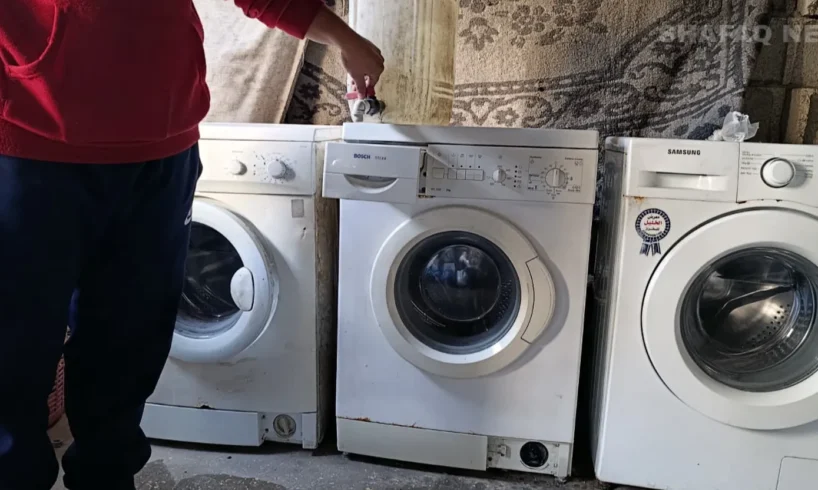
Yassin Abu Odeh launched a small laundry project using automatic washing
machines powered by solar energy, in partnership with others in the camp. The
biggest challenge, he said, is water. “We buy it at high cost, and customers
bring their own detergent,” he explained. To reduce consumption, he modified
how water enters the machines.
Maintenance is another obstacle. Spare parts are
unavailable, and many of the machines were salvaged from destroyed homes.
Still, the project offers a rare reprieve for families and a fragile source of
income for those running it.
In Al-Zahraa camp in Khan Younis, two young men, Mohammed
and Ali, operate a semi-automatic washing machine using electricity purchased
from a neighbor with solar panels. They charge a small fee per load. “This is our
only livelihood,” they said, describing the project as an emergency alternative
in the absence of work opportunities.
The Elderly Left Behind
At one washing point, an elderly woman arrives carrying a
small bag of clothes. She lost her two daughters in the war, while her son was
injured. Nowadays, she lacks the physical strength to wash by hand and can
barely secure drinking water. Her neighbors occasionally help with small
amounts for laundry.
A Quiet Health Crisis
Inside clinics at the Al-Awda Community Health Center,
health educator Ghada Aziz said the impact goes beyond fatigue. “What we are
seeing is continuous physical and psychological pressure on women due to hand
washing under these conditions,” she told Shafaq News. A large proportion of
female patients complain of lower back pain and joint inflammation caused by
prolonged bending and wringing out heavy clothes. Clinics are also documenting
tendon injuries in the hands from repetitive strain.
Water scarcity, she warned, poses a direct health threat.
Most of Gaza’s population now lacks access to safe water, as water services
have fallen to critically low levels. This forces families to use unsuitable
water or reduce washing frequency, contributing to rising cases of eczema,
contagious skin infections, and fungal diseases linked to damp clothing in
enclosed spaces.
“Treatment alone is not enough,” Aziz said, explaining that
“the problem is environmental. What’s needed is safe water and organized
washing points that reduce the burden and protect health.”
In Gaza’s tents, laundry is no longer a simple domestic
chore. It has become a daily struggle tied to dignity, health, and survival.
Behind every clean garment are hours of silent effort, small acts of endurance
in a reality where even the most basic routines have become tests of
resilience.
Read more: Against the cold: Gaza’s displaced face humanitarian peril in winter 2025