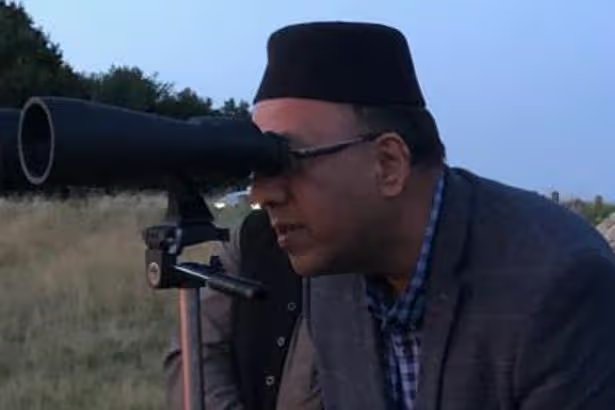
Dr Raja Zahid Nawaz, a regular commentator on sighting the moon that determines Islamic dates, says it’s important to stick to the established science and not make announcements based purely on convenience
Dr Raja Zahid Nawaz looks through a telescope to try to spot the new moon crescent from a viewing spot at Barr Beacon in a previous year
A moon-sighting expert has urged Muslims worldwide to ensure that the date of Ramadan 2026 – and all other key events in the Islamic calendar – is based on established scientific principles and not on conveniently falling in line with forecasts that may be wrong.
Dr Raja Zahid Nawaz, a regular commentator on moon-sighting and the Islamic calendar who shares analysis via social media and Birmingham-based broadcaster Noor TV, has warned that on February 17, 2026, the first faint crescent of the newborn moon will be impossible to sight from the UK, Saudi Arabia, Morocco or elsewhere due to well-established astronomical factors – including “low altitude, insufficient elongation, minimal illumination and inadequate lag time after sunset.”
In simple terms, the moon will not be visible, said Dr Nawaz. He is urging people not to simply repeat spurious or inaccurate announcements, as this risks creating a chain of false information.
READ MORE:
He told BirminghamLive: “As Ramadan approaches once again, so too does a familiar and frustrating cycle: premature announcements, questionable crescent claims and media outlets repeating statements that simply do not withstand scrutiny. The start of the Islamic month is not guesswork. It is not sentiment. And it should certainly not be shaped by convenience.
“Each year, Muslim communities across the UK wait for confirmation of the new moon. For some, this is determined through astronomical calculations; for others, through verified physical sighting of the crescent – either locally or in countries with established and credible moon-sighting systems. Both approaches have scholarly foundations. What does not have any foundation, however, is claiming a sighting when visibility is scientifically impossible.
“Yet, based on previous years, it would not be surprising if announcements are made regardless, often relying on pre-calculated calendars rather than verified sightings. What is even more concerning is what follows: media outlets across the world repeat the claim that ‘the crescent has been sighted’ without question, without context and without verification.”
He explained: “This domino effect does real damage. It undermines scientific credibility, creates confusion within communities and erodes trust. Experts who have read detailed astronomical assessments are left wondering how an ‘impossible’ sighting has suddenly become a confirmed one.
“If a country chooses to follow calculation-based calendars, it should say so clearly. If a decision is based on the birth of the moon, that too should be transparently stated. What must end is the practice of presenting calendar-based decisions as physical sightings. Accuracy is not a minor technicality – it is a matter of integrity.”
Dr Nawaz made a plea to all those involved in moon-sighting announcements: “Ramadan for millions is a month built on reflection, discipline and truthfulness. Announcing its start should reflect those same values.
“Communities deserve honesty about the criteria being used, not vague statements that blur the line between calculation and sighting. My call is simple: be transparent, be precise and stop making claims that science has already ruled out. As anticipation builds for Ramadan, clarity – not confusion – should guide the conversation.”