If you’re reading this on the web or someone forwarded this e-mail newsletter to you, you can sign up for Globe Climate and all Globe newsletters here.
Good afternoon, and welcome to Globe Climate, a newsletter about climate change, environment and resources in Canada.
Donald Trump isn’t Greenland’s only problem these days, warming temperatures are also a cause for growing concern. As well, a question in today’s edition: Who should own Greenland anyway?
Now, let’s catch you up on other news.
Noteworthy reporting this week:
Agriculture: How Canada’s grain gets to market is a lesson for exportersElectric vehicles: Ottawa’s EV charging expansion requires consistent messaging, proponents sayParenting: This summer, consider the phone-free, resilience-boosting benefits of wilderness camps for kidsEnvironment: Inside Canada’s most dangerous avalanche corridor and the effort to keep it safeFood and drink: After wildfires destroyed his home and vineyard, an Australian winemaker looks to rebuild
A deeper dive
Open this photo in gallery:
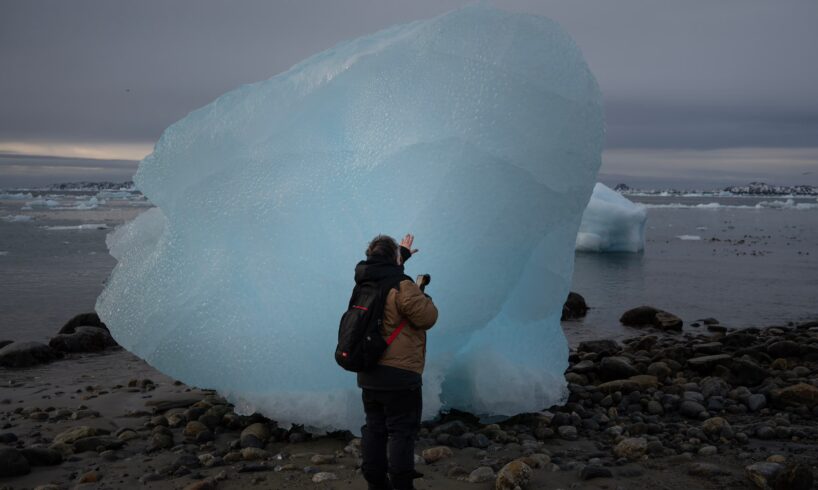
A tourist touches a marooned iceberg in the harbour of the capital, Nuuk, Greenland, on February 3.Siegfried Modola/The Globe and Mail
A strange winter
For this week’s deeper dive, a closer look at the island that has risen to new popularity this year.
The Globe’s and Mail’s Europe Correspondent Paul Waldie has spent some time in Greenland alongside photographer Siegfried Modola.
During a trip earlier this month, they saw that instead of bundling up from head to toe to ward off frigid temperatures typical of this time of year, people in Nuuk were enjoying brilliant sunshine and shedding their hats and gloves.
According to preliminary figures from the Danish Meteorological Institute, Nuuk just experienced its warmest January on record.
Open this photo in gallery:
The northern lights shimmer across the night sky over the capital Nuuk, Greenland, on February 8.Siegfried Modola/The Globe and Mail
“Climate change is already clearly visible on Greenland,” Jacob Hoyer, the head of Denmark’s National Centre for Climate Research, told Reuters. “From the records we can see that it is warming four times faster than the mean temperature hike in the world.”
And although all the new attention has brought a wave of tourism to the island, it has also brought new challenges. It is a place of raw beauty and hard logistics.
On the ground, Paul spoke to locals and heard that the warmer weather has already had an impact in Nuuk and across the island.
The unusual weather has forced some fishers to change how they catch cod, halibut and red fish. The bare ground has also meant some tour operators had to start cancelling snowmobile excursions. Outside the capital, the warm weather forced officials to postpone the annual Musk Ox hunt.
Open this photo in gallery:
Pedestrians walk on an unusually warm day for the time of year in the capital, Nuuk, Greenland, on February 4.Siegfried Modola/The Globe and Mail
Aside from the concerns of warming temperatures, the U.S. President’s threats about purchasing Greenland as a strategic asset continue to loom over residents. Denmark asserts its legal sovereignty over the island.
But nearly 90 per cent of Greenland’s 57,000 population are Inuit. And for the Inuit people, who have lived there for centuries, no one truly owns the Arctic land.
Open this photo in gallery:
An aerial view shows the fjords near the capital, Nuuk, Greenland, on February 8.Siegfried Modola/The Globe and Mail
The concept that ownership is shared collectively is central to the Inuit identity, they say. It has survived 300 years of colonization and is written into law: People can own houses, but not the land beneath them.
Rakel Kristiansen, from a family of shamanic practitioners, said Inuit people saw themselves as temporary guardians of the land. “In our understanding, owning land is the wrong question,” she said. “The question should be who is responsible for the land. The land existed before us, and it will exist after us.”
What else you missed
Opinion and analysis
Canada’s reliance on the U.S. for our food is a recipe for disaster
It’s easy to mistake our supermarkets’ well-stocked shelves for food security. But those bunches of broccoli and pints of strawberries hide the tenuous reality of our food system.
— Sarah Elton and Aden Fisher, University of Toronto’s Dalla Lana School of Public Health
Business and investing
Ontario Teachers’ Pension Plan reboots climate goals with $70-billion target
Ontario Teachers’ Pension Plan is aiming to double its portfolio of assets that are “aligned” with a net-zero transition by 2030, but dropping an emissions target that it set five years ago. The $270-billion pension plan announced a new goal to reach $70-billion of investments in climate-friendly assets over the next four years, up from $35-billion.
The new framework would count investments in privately owned companies that contribute directly to climate solutions, as well as large emitters that have credible plans to decarbonize. Companies that have expanded exploration, extraction or refining of fossil fuels since 2023 will be excluded.
The Climate ExchangeWe’ve launched the The Climate Exchange, an interactive, digital hub where The Globe answers your most pressing questions about climate change. We have been collecting hundreds of questions and posing them to experts. The answers can be found with the help of a search tool developed by The Globe that makes use of artificial intelligence to match readers’ questions with the closest answer drafted. You can ask a question using this form.
Cartoon of the week
Open this photo in gallery:
A weekly cartoon column called ‘News to me.’Illustration by Gabrielle Drolet
Winter Olympics are cool, but host cities have to be cold.
Guides and Explainers
Catch up on Globe Climate
We want to hear from you
Send us you questions and comments by e-mail. Do you know someone who needs this newsletter? Send them to our Newsletters page.
Source