Male E has called for a public inquiry to uncover whether authorities knew about Alan Harris’s offending before any official investigation
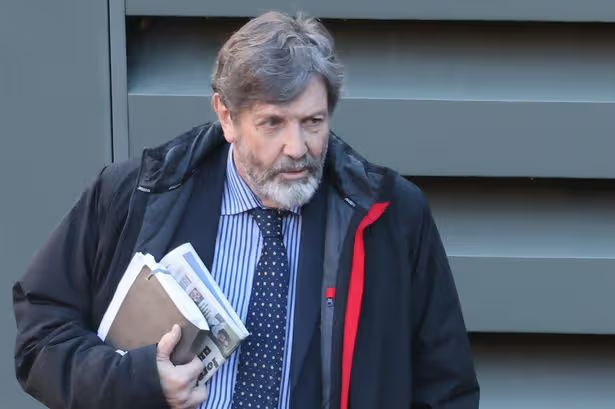
Alan Harris, 72, arriving at court(Image: Corin Messer)
One of the men targeted by former solicitor and sexual predator Alan Harris is demanding a full-scale inquiry to ensure it can never happen again.
Male E – as he was referred to by PlymouthLive during the trial of Alan Harris – understandably had mixed emotions as he sat in the public gallery while the jury returned their verdicts on Harris, who was convicted of 10 offences against seven victims – six men and one woman – following a five-week trial at Winchester Crown Court.
Harris committed the offences between 1988 and 2015 with the majority happening during private legal consultations at Plymouth Magistrates’ Court and Charles Cross police station as well as in a car and at a residential address in Plymouth. Yesterday he was jailed at Winchester Crown Court for 13 years.
The jury unanimous agreed with Male E that between April 30, 2004 and March 21, 2014 – on multiple occasions – Harris had sexually assaulted him in the police station and court cells.
However, they found Harris not guilty of a further count of sexual assault on more than one occasion upon Male E, also at a time when Harris was representing him as a defence solicitor.
Alan Harris, enjoying his last moments of freedom this morning [February 25, 2026] in a Winchester coffee house, before appearing at Winchester Crown Court for a sentencing hearing following his conviction for sexually assaulting vulnerable clients(Image: submitted)
Speaking exclusively to PlymouthLive, Male E – whose real identity is protected under the Sexual Offences Act – said: “It’s cost me my home, my business I’d built from scratch working day and night to build and support my family, it destroyed the voluntary work I’d done.”
He is adamant that Harris’s behaviour was well known among police and “higher ranking people” which he is determined must be “exposed” through an inquiry.
“There’s more to come out. He was given access to boys. From what was known back then, he should never been given a right to be involved in police station work.
“The slightest hint of his actions should have been flagged as not being safe to be around vulnerable people.
“We’re told now that police reported him to the Solicitor’s Regulation Authority in 2015 – what was done?
“He was given access to vulnerable people. He must’ve felt like a kid in a sweetshop, a sweetshop full of misfits.”
Charles Cross police station (Image: Al Stewart)
Male E said he has lost everything he held dear – his relationships, family, children, career and home. He fully recognises his own part in his losses which he says he deeply and bitterly regrets. His remorse is evident in the way that he talks about his children in particular.
He also referred to the regret he felt at the pain he had caused to other people in his life whom he loved and who loved him.
“I just wanted to not make the mistakes which my parents made, where I wasn’t loved,” he said.
Long term impact was wide ranging
He told Plymouth Live: “I can’t go to the toilet where there are men. I have use a disabled toilet and get bad looks when I come out again and I don’t look disabled. I don’t want men to ever hug me. I’m standoffish. I’ve no social skills to deal with men, I just get angry. I can never feel comfortable around men. I’m volatile – I’m getting better, but I’ll never trust a man again, as long as I live.
“It’s that damage [by Harris] that’s made it difficult for me to be around other people. You’re vulnerable, you’re damaged. I don’t like being in groups, I get paranoid. I’m scared and hurting. I put this angry shield around me – I don’t want it around me, I just want to be happy, not flare up, and live my life. I feel like I’m always going to like this.
“You end up hating yourself.
“Six years this has taken to bring to trial – and I’ve gone downhill over those six years. Six years of having to relive it, deal with it all and life, with no support, no counselling, nothing from mental health services – other than a diagnosis – but no support.”
Male E says he suffers from a “complex psychiatric history”, with diagnoses including emotionally unstable personality disorder versus antisocial personality disorder, generalised anxiety disorder and complex post-traumatic stress disorder.
Alan Harris’s former office in St Andrew Street, Plymouth (now a separate firm called A H Solicitors and a cafe/bar) – a few yards from Plymouth Magistrates’ Court(Image: CPS)
He has a long-standing history of severe mood instability, emotional dysregulation, irritability and past aggressive outbursts. He also has a history of serious suicide attempts, the last of which led to him suffering a serious injury requiring reconstructive surgery.
He remarked: “When I look at my [surgical scars] – where all my family thought I was normal, thought I was happy – but I went to a bridge where my intent was to not come back.”
Court experience left him in tears
Despite all this, Male E did agree to go to court to give evidence, an experience he found difficult. He explains he had not been into Crown court for many years and by comparison to Plymouth’s Crown Court, the Winchester Crown Court was far bigger.
There he saw the high-ranked judge, the barristers and the jury – and in the dock, sitting behind thick glass, was Alan Harris, older, but still recognisable. Looking up into the public gallery he said he could see a woman he later learned was Harris’ partner, former district CPS prosecutor Kathy Taylor.
He said: “It was hard. To stand in the witness box, a quivering wreck, you want to remain strong. I wore a shirt and chinos, I wanted to maintain my composure. You’re ridiculed – I was told ‘well, you’re a big strong boy, you could’ve forced him off.’ And Harris is looking on, with his menacing grin – that’s how he was, he was getting enjoyment at seeing us ridiculed and called liars. All I could do was hold my integrity and come out knowing that I had done my absolute best to give the truth. I think the jury could see that.
“When they [the jury] gave their verdict I was in the public gallery. When they filed out and a couple of them looked up at me just gave me a small nod, like they were saying ‘you were right’. I was crying by that point. I was the only one there, there weren’t any other victims.
“You could see during the trial some of the women jurors were wiping away tears and some of the men, there was shock and total dismay at what they were hearing during the trial.
“There are now the questions over whether there was any kind of conspiracy or a cover-up by other agencies, whether that’s the CPS, the court system or the police.
“I think he picked out and selected the ones he was going to abuse. You heard it in the trial – one of his staff would say ‘oh, you’re one of Alan’s boys’ when you walked into the office. So did his colleagues.
“He would go for the ones who were vulnerable and stressed. My crimes were petty, minimal violence, no drugs and I had a history of motoring offences. But he knew I was petrified of police stations, of being detained and incarcerated.
“He had ramped up the fear of me being jailed and I had to take diazepam to cope, went into the solicitor’s room at court and that’s when he molested me. Then in the court room I’m crying and he was making out to the court it was because I was so petrified of going to jail, but it was because he’d just molested me. I’ll never forget that, not as long as I live.”
Male E is convinced there are other men who may now come forward who have been too afraid to before.
“Alan wasn’t about money – Alan was about his own perverse gratification and his sexual desires and what he wanted. It wasn’t about money for him – but then he was getting paid by the legal aid system to abuse people.
“It sounds horrible, doesn’t it? But that’s what it is. He was a paid sexual abuser – he was being paid to represent us but ended up being paid to sexually abuse and molest us. How f***ed up is that?”
Alan Harris(Image: Corin Messer)
Male E urged other victims to come forward. “Be strong” he said. “If you can manage it – know you’re not alone. There’s strength in numbers but make sure it comes from your heart. Face your demons, but have your loved ones close to you.”
Calls for inquiry
He called for the minimum of an IOPC [Independent Office for Police Conduct] investigation and ideally a Government led inquiry to investigate how Harris could have offended for so long right under the noses of the entire judicial system in Plymouth. “People and organisations need to be held to account because otherwise it could keep happening to other vulnerable people.
“Are we really saying that over 30 years we were the only victims? What was known? What did other solicitors know? What did the CPS know? What did the police know?
“How many of his cases need to be looked at again to see they were dealt with appropriately?
“The MPs should be informed and this should be looked at by the Ministry of Justice.”
He feels recommendations should be made to prevent such incidents happening again in police and court cells, interview rooms and consultation rooms.
He said: “They’ve put CCTV in cells, so why not in interview rooms, without a microphone, so that the custody sergeant or head of court security can check the client is safe. There should be panic alarms in these rooms. We can’t just pass the buck to the Solicitor’s Regulation Authority and hope they can weed out the sex offenders. The only way we can change this, protect people, is a public inquiry.
“I look back to my suicide attempt, which I clearly failed, and the scar it’s left me. I had to face that turmoil, hit rock bottom, had to deteriorate more. But now, when I go to court, I go to court with a scar which is going to be with me for the rest of my life – that’s on Alan Harris, that’s his scar on me, not just mentally and emotionally, but also now physically, I’m left with that scar till the day that I die.
“The scar on me is a scar of what happened to me 30 years ago. That’s my closure. I’ve survived the worst that he can do to me. He’s broken me to my core.
“While we as victims, as survivors, have gone through hell, he’s been very lucky to live a privileged life, earning mega money, having a nice life – while we’ve gone through decades of trauma because of it.
“I’ve recently learned that I know one of the other survivors. I’ve known of him a long time and not to be rude, he was a b*****d, he was a nutcase – but at least now I understand why he is like he is, I really do.
“There were no winners to this sad story. It’s one of devastation.”
He feels he could have been better protected by the police and claims that while he was a victim, police still saw him as a criminal – and treated him as such.
Alan Harris, enjoying his last moments of freedom this morning [February 25, 2026] in a Winchester coffee house, before appearing at Winchester Crown Court for a sentencing hearing following his conviction for sexually assaulting vulnerable clients(Image: submitted)
Having been constantly referred to in court by Harris’s defence team as criminals, trouble-makers, thugs and addicts, Male E said he feels that’s how police have viewed him throughout.
“I’m sewage to them, I’ve always been sewage to them, going back years before Harris represented me. I was a pain to them, a problem, a mouthy teen. You’ve got police constables when I was 17 who are there now as sergeants and inspectors – they know me as a criminal and nothing more.”
He said he didn’t even want to be referred to as a victim – he was a “survivor”.
“We never stood a chance – we were already on the wrong side of the law. We were what they called ‘nominals’. Lower than life. They would say we were ‘oxygen thieves’ and ‘glue sniffers’ – those were the terms they used about us. We are people who are considered not good enough to be in society. We posed a risk and we can’t integrate with people.”
Chief Supt Roy Linden, now the police commander of South Devon, was a Detective Inspector in 2015 when police initially received several complaints about Harris.
Chief Supt Linden explained: “It remains a fundamental right in British law that someone arrested by the police or a defendant in a criminal trial can meet and speak in private to a solicitor.
“We now know that Harris exploited this system targeting victims when they were at their most vulnerable.
“We acknowledge that much of Harris’ offending happened during private legal consultations within the custody suite at Charles Cross police station and at Plymouth Magistrates’ Court.
“As soon as we were made aware of the allegations against Harris, the force made referrals to the Solicitors Regulation Authority who have the statutory responsibility for regulating solicitors working in police stations.
“The offences occurred prior to Devon & Cornwall Police rolling out the installation of CCTV across our custody suites.”
Chief Supt Linden, who has spent more than a decade leading the investigation in Harris, said that what was necessary was to “create a hostile environment for all predatory individuals and ensure all agencies put robust safeguarding measures in place”.
As to the rumours of past offending by Harris, police emphasised that there were “no limits” to their inquiry, which is understood to have gone back further than just 1988. Police have stressed that remaining archives have been examined and the inquiry saw investigators seeking out and interviewing retired officers of all ranks to glean every shred of evidence.
The official response from the force is “there is no record of Harris being arrested prior to Operation Tower” and as to the rumours of pre-1988 offences, the equally official response to questions from PlymouthLive is “we are unable to comment on speculation.”
Support for victims of rape and sexual assault
Support is available if you need help or assistance relating to sexual assault:
National Rape Crisis Helpline: 0808 802 9999Devon and Cornwall Sexual Assault Referral Centres (SARC): 0300 3034626Devon, Cornwall and Isles of Scilly Independent Sexual Advisor Service: 03458 121212Victim Care Unit: 01392 475900Devon Rape Crisis and Sexual Abuse Services: 01392 204 174
In an emergency, always call 999 and in a non-emergency please visit www.dc.police.uk/contact or telephone 101.