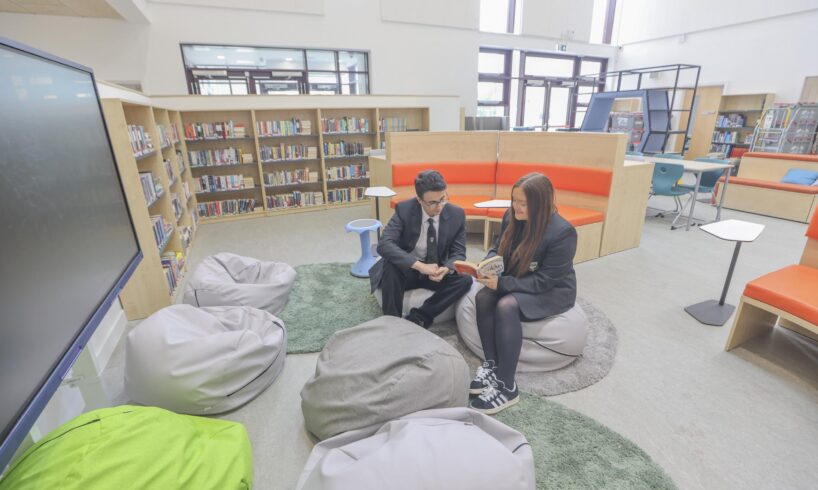
Chief executive Marc Lambert described the current situation as “shocking”.
“It is obvious that education and personal development are compromised without access to a good variety of books, and this acts in direct contradiction to the purpose of school and the interests of pupils both now and in their futures.
“We are therefore asking families and carers, teachers and school librarians to write to their representative to advocate for school libraries. We want as many voices as possible to show their commitment by opposing funding cuts to school libraries and the removal of school librarian positions.
“With appropriate funding, secure staffing provision and more public and management support, school libraries can allow all children and young people to thrive, whatever their background.”
Staff report strain within the system
The campaign draws on findings from “The Value and Impact of Scotland’s Secondary School Libraries”, produced by Scottish Book Trust in conjunction with the National Library of Scotland, the Scottish Library and Information Council (SLIC) and the Chartered Institute of Library and Information Professionals in Scotland (CILIPS).
The report found that:
59% of secondary school library workers reported restrictions on funding and resources.
Around 23% reported restrictions on the remit and hours of dedicated library workers.
21% cited restrictions on dedicated library space.
The charity says these findings reflect more than a decade of cuts, during which some local authorities have lost all school librarian posts, while others require librarians to split their time across multiple schools.
Separate national research suggests Scotland already trails other parts of the UK on provision.
A 2023 survey of school libraries found that 32% of Scottish schools have a dedicated librarian, compared with 41% across the UK. Meanwhile, 78% of Scottish schools have a designated library space, compared with 88% in England, and only 25% have a dedicated library budget, compared with 36% in England.
The report also highlights inequality in access. Schools where the majority of pupils are eligible for free school meals are less likely to have a designated library space and less likely to offer full-day access.
For the Scottish Book Trust, the concern is not only the existence of a library space but also whether it is properly resourced and professionally staffed.
Concerns legal gap leaves libraries exposed
Responsibility for school library provision currently rests with individual local authorities, and there is no statutory requirement for schools to provide a library.
Campaigners argue this leaves provision exposed to local financial pressures and creates inconsistency across the country. A national duty, they say, would establish a clear minimum standard and prevent school libraries from being treated as discretionary services when budgets tighten.
The campaign comes amid recent local authority decisions that have intensified concerns about the status of school libraries.
Read more:
In Glasgow, proposals were brought forward to remove all school-based librarians in order to save £100,000 per year, replacing them with library assistants overseen by area-based staff. Sixteen secondary schools began the academic year without a librarian while consultation on the redesign continued.
Other local authorities looked to remove school librarian positions and replace them with library assistant staff.
Chartered Institute of Library and Information Professionals Scotland described such moves as ‘de-professionalisation’, arguing that running libraries with lower-graded staff diminishes their educational impact and leaves staff doing more work for less pay.
One in ten libraries lost this decade
Although the Scottish Book Trust’s campaign focuses on a new legal protection for school libraries, recent cuts to library services have not been limited to in-school provision.
Research by SLIC has found that 58 public libraries have closed across Scotland since 2014. The data does not include branches that have relocated or merged into community hubs or shared service buildings. In some cases, such redesigns have brought newer facilities and closer integration with health, education and social services.
However, they can also mean the loss of a neighbourhood-based branch and changes in how communities access services.
The largest single year for closures was 2016/2017, which saw 16 closures in Fife, 4 in North Lanarkshire, and 2 in East Ayrshire. Since 2022, 24 branches have closed across 10 local authorities.
SLIC has also expressed concern about the concentration of reductions in certain areas, including Clackmannanshire, which saw provision fall from eight libraries to three over a seven-year period.
The total represents a loss of roughly 13% of Scotland’s libraries in the past decade, and sector representatives warn that ongoing funding uncertainties and council budget pressures mean further closures are possible