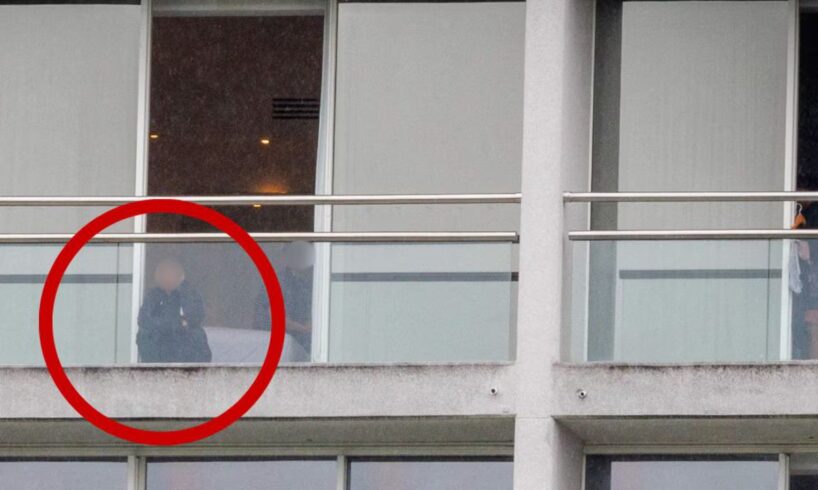
Inside the Gold Coast hotel where Iran’s female soccer stars were being closely watched, an Australian-Iranian woman tried to intervene.
“I was personally inside the hotel where the Iranian women’s football team is staying, and the atmosphere was extremely tense and heavily controlled,” she said.
Writing about the experience on social media this week, the woman — who news.com.au has chosen not to name — said the players were “under constant monitoring” and it was clear to see “the fear and pressure they are experiencing”.
“I tried to tell these players, who are essentially trapped, that this is Australia and they are protected here. I wanted them to know they are not alone. But instead, I was removed from the hotel. They even forced my husband and my young children to leave.”
It’s in that same hotel that a message smuggled out of Iran from a player’s family reached the players. According to The Australian, the note read simply: “You need to stay.”
Within hours, chaos was unfolding inside the lobby of that hotel — the Royal Pines resort — as five female players made a run from their handlers.
Members of the highly-secretive Islamic Revolutionary Guard Corps (IRGC) had arrived, running into the area in an attempt to track their countrywomen down.
In the intervening hours, the stakes were raised again. US President Donald Trump even weighed in, begging Prime Minister Anthony Albanese to do everything he can to grant them asylum.
The five escaping players included Zahra Ghanbari, the captain of the Iranian women’s national football team for the 2026 AFC Women’s Asian Cup in Australia, along with Fatemeh Pasandideh, Zahra Sarbali, Atefeh Ramazanzadeh, and Mona Hamoudi.
Attention now turns to what will happen to the rest of the team, many of whom are returning to Iran because they are worried about the safety of family members.
But it is not just those in Iran who have to worry.
Iranian women in Australia, particularly those who speak out against the hardline Islamic regime, are stalked, threatened and intimidated by shadowy figures who operate in Australia for the IRGC.
‘I know where you live’
When Iran’s female soccer stars refused to sing the national anthem last week, they exposed more than a shift away Iran’s authoritarian leadership that has ruled over them for decades.
The women — whose stance before their 3-0 defeat to South Korea on the Gold Coast last Monday made headlines around the world — also exposed a dark underbelly that controls women like them wherever they go, including Australia.
On streets around Australia are shadowy agents working for the Islamic Revolutionary Guard Corps.
Women who have been “stalked” by them in Australia say they are intimidating and imposing.
Sydney councillor and Iranian expat Tina Kordrostami told the media last week that the Iranian women’s football team hotel was “practically like a prison”.
She is one of the unlucky few who have come face to face with the IRCG outside Australia.
In 2022, when she was 28, Ms Kordrostami says she was harassed and folowed and threatened by a man who she described as large and “heavily-tattooed”.
“At that time I wasn’t an elected councillor, I was just an activist focused on uniting the community,” she explained to news.com.au.
“The reason I was followed was I had made significant headway and it was a threat to the regime.”
She says the man followed her in a van as she drove through Sydney before confronting her with the veiled threat: “I know where you live”.
It is straight out of the playbook from the IRGC, a group listed by Australia last year as a terrorist organisation.
Ms Kordrostami told the SMH recently that the IRGC has “tentacles everywhere”.
“We do see them engaged through media outlets, we do see them engaged within our cultural events even. And so there’s a lot of surveillance happening within the community.”
It’s a similar story shared by Nos Hosseini. She fled Iran as a small child in the 1980s with her father, who was at the time a lead of Iran’s union movement.
What happened when the family arrived in Australia was chilling.
She says she was the victim of a targeted surveillance campaign waged against many dissidents, one that included a disturbing incident during her primary school years.
Speaking to the ABC in 2023, she says she was picked up from the school gate by a Persian man who claimed to have been sent there by her parents.
“He convinced me that my parents organised for him to pick me up, so I hesitantly got into the car with him,” she said
“As we got close to my house, I remember my parents standing outside in the garden and they looked really puzzled. I got out of the car and he said to them: ‘Look at how easy it was for us to get to your daughter’, and that just terrified my parents.”
She told media separately that the family home in Melbourne was targeted when a decapitated chicken was found on the doorstep.
More Iranian diaspora have shared similar stories.
Artist Shahrzad Orang, who creates artwork in collaboration with Iran’s political prisoners, received a message on Instagram from a person who suggested they were part of the regime.
“I’m going to make such a nightmare that you’ll want to kill yourself,” the message read.
Dr Kylie Moore-Gilbert, who spent 804 days locked inside Tehran prison by the IRGC, says diaspora spend years “looking over their shoulders” in fear of the regime coming for them.
“We know that there are a number of agents of the IRGC and of the Iranian regime here in Australia, as well as sympathisers and informants, people who might not be paid, trained agents, but who are feeding information back to Tehran on the Iranian-Australian community,” she told The Guardian.
In an open letter to the Prime Minister last week, the Australian Iranian Community Alliance wrote that Australian-Iranians, including refugees, “continue to fear (the Islamic Republic’s) reach”.
It’s why those members of Iran’s football team were so adamant about not returning home. The threats were clear after their national anthem protest when Iranian state TV presenter Reza Shahbazi said “Traitors during wartime must be dealt with more severely.”
“For you to go there and not sing the national anthem — this is the pinnacle of dishonour and lack of patriotism,” he said.
“Both the people and the officials should treat these individuals as wartime traitors.
“The stigma of dishonour and betrayal must remain on their foreheads, and separately they must be dealt with properly.”
On Tuesday morning Home Affairs Minister Tony Burke has revealed the five Iranian women chanted “Aussie Aussie Aussie” after being granted humanitarian visas overnight.
He said the same offer was on the table for the rest of the squad that remains on the Gold Coast.
“A lot of work has been going on in recent days to ensure we had the maximum number of opportunities for these women to know they could seek assistance if they wanted to,’’ Mr Burke said.
Mr Burke confirmed the five women said they were happy for their names and faces to be reported.
Prime Minister Anthony Albanese said the offer of a visa was there for any other players who wanted protection.“We wanted to make it clear to the athletes that support was available to them and do it in a way that did not present any danger to them or to their families or friends back home in Iran,” he said.
The Australian Iranian Community Alliance had a simple message for the IRGC.
“No athlete should face intimidation, persecution, or violence simply for exercising personal choice.”