2026-03-15T10:33:13+00:00
font
Enable Reading Mode
A-
A
A+
Shafaq News- Baghdad
War and unrest across the Middle East have overshadowed the
Parwanaya, or Creation Festival, one of Iraq’s most important religious
celebrations for the Mandaean Sabaeans. This year, the community has restricted
observance to core rituals, skipping public gatherings and festive events.
Also called the “Five White Days,” the festival coincides
with the Muslim holy month of Ramadan for the third year in a row. During this
time, Mandaean Sabaeans fast strictly, avoiding meat, bread, eggs, and other
foods, many of which must be prepared at home.
The Sabaean faith, among the world’s oldest monotheistic
religions, traces its spiritual roots to the prophet John the Baptist (Yahya
ibn Zakariya). Rituals are conducted in Aramaic, a language dating to the tenth
century BC, preserved in the community’s sacred text, Ginza Rabba.
The Ginza Rabba, or “The Great Treasure,” contains writings
attributed to the prophet Adam. Its first section recounts creation, the
teachings of Eternal Life, and the struggle between good and evil. The second
part details the soul’s journey after death, describing its passage to the
World of Light and the reward or punishment that follows.
Speaking to Shafaq News, Sheikh Sattar Al-Hilu, Spiritual
Leader of the Mandaean Sabaeans in Iraq and worldwide, framed Benja, or
Parwanaya, as central to Mandaean belief.
“The festival reflects the Creator’s power and divine
attributes revealed over five days, marking the beginning of the creation of
the upper World of Light,” Al-Hilu explained. “On the first day, the Great
Living God revealed himself as the Lord of Greatness, followed on the second by
the Most High Lord, on the third by the All-Knowing, on the fourth by the Lord
of Truth, and on the fifth by the flowing waters from which life emerged.”
Samer Naim Hanzal, representative of the Mandaean Sabaean
community in Dhi Qar province, described Benja as a commemoration of the
creation of the Worlds of Light, commonly understood as paradise.
The festival begins after five days of fasting. “Mandaean
Sabaeans observe two types of fasting: the greater fast and the lesser fast.
The lesser fast involves abstaining from anything that has life, such as
chicken or eggs,” Hanzal noted.
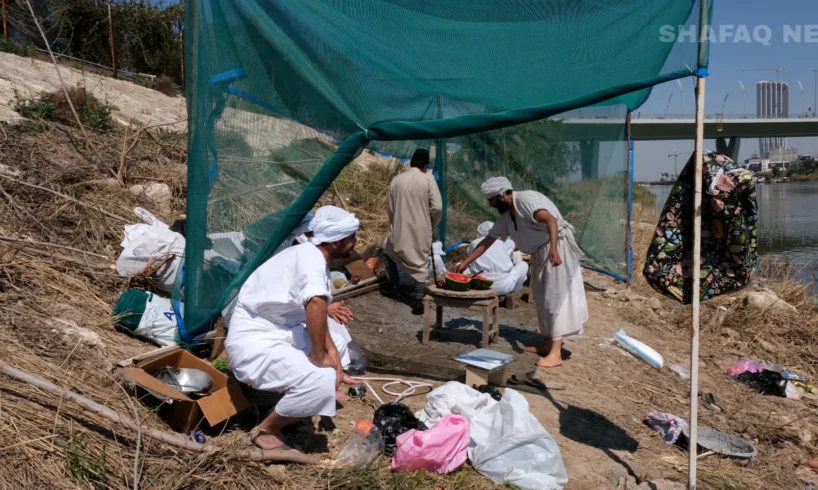
Parwanaya is also a time to honor ancestors. Families pray
for deceased relatives through a meal known as Lofani, or the meal of
forgiveness, while baptisms in flowing water take place on the festival’s first
day.
Normally, religious services and gatherings take place
inside the Mandaean Sabaean temple, or mandi, bringing families together. But
Hanzal stressed that security concerns have led the community to limit
celebrations to essential rituals only.
Meanwhile, Osama Al-Badri, a former lawmaker representing
the Mandaean Sabaean community, noted that families traditionally spend
Parwanaya at baptism sites in Baghdad and other provinces, performing ritual
immersion, sharing the Lofani meal as charity, and offering alms in memory of
the deceased.
The Mandaean population in Iraq is now estimated to be
significantly smaller than its pre-2003 figure of up to 70,000, with current
estimates often ranging from 3,000 to 15,000 people, and they are primarily
located in southern Iraq (especially in Basra, Dhi Qar, and Maysan), as well as
in smaller numbers in Baghdad and the Kurdistan Region.
Following migration waves that began in the late 1990s,
Mandaean communities have spread to countries such as Sweden, Germany,
Australia, and the United States, where they have established mandis (temples)
and received official recognition to freely practice their religious rites and
traditions.
Read more: Five days to eternity: inside the Mandaeans’ sacred Brunaya