Iran was accused of holding the world’s economy hostage as ministers from more than 40 countries, including Australia’s Penny Wong, met to discuss reopening the Strait of Hormuz.
Iran has virtually closed the strait to marine traffic since war broke out, impacting global supplies of oil, gas and fertiliser which has led to skyrocketing prices.
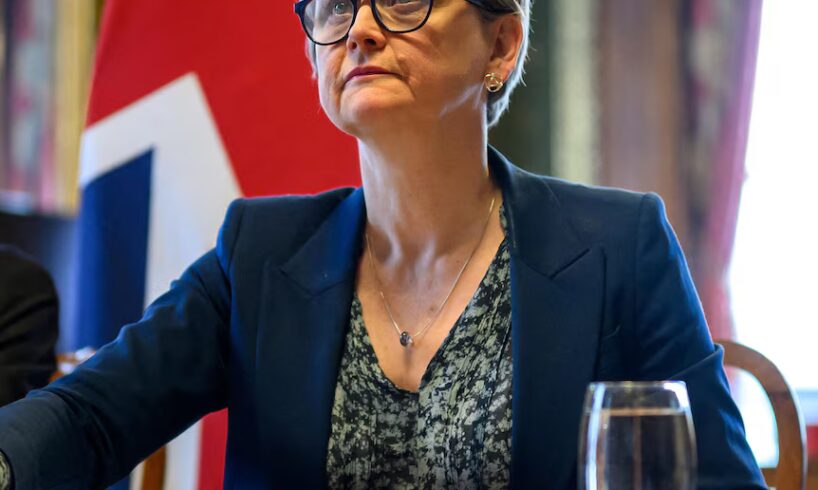
UK foreign secretary Yvette Cooper, who convened the talks from London, said there were still 20,000 seafarers and about 2,000 ships trapped in the strait.
She said the virtual summit, which did not include a US representative, showed “the strength of our international determination” to re-open the vital oil route.
“We have seen Iran hijack an international shipping route to hold the global economy hostage,” she said at the start of the meeting.
She said “unsustainable” spikes in oil and food prices were “hitting households and businesses in every corner of the world”.
She went on to say 25 vessels had passed through the strait in the 24 hours leading up to the meeting, on Thursday UK time, despite the passage usually recording about 150 vessels a day.
Fuel shortages have caused economic issues across Asia, with it expected to hit harder in Australia and Europe soon.
Italy’s foreign minister Antonio Tajani said his country, along with The Netherlands and United Arab Emirates, called for a “humanitarian corridor” for fertiliser and other essentials through the strait to avoid a food disaster in Africa.
Ms Cooper said while this summit was about political and diplomatic measures, military planners from several countries would later meet to plot ways to ensure security of the strait once the fighting ended.
Foreign leaders from 40 countries met virtually to discuss reopening the Strait of Hormuz. (Reuters: Leon Neal)
The UK’s Ministry of Defence confirmed the meeting would take place in the United Kingdom next week “to discuss diable options to make the Strait of Hormuz accessible and safe for navigation”.
The United States did not attend the meeting, after president Donald Trump said securing the Strait of Hormuz was not America’s job and allies should “go get your own oil”.
Military operation ‘unrealistic’, Macron says
Meanwhile, on a visit to South Korea, French president Emmanuel Macron said it was “unrealistic” to reopen the strait through military operation.
“There are people who advocate the idea of the reopening of the Strait of Hormuz by force, through a military operation, a position that has at times been expressed by the United States,” he said.
French President Emmanuel Macron, center, with his wife Brigitte Macron, left, and South Korean Minister of Patriots and Veterans Affairs Kwon Oh-eul, right, in South Korea. (AP Photo/Lee Jin-man)
Mr Macron is pushing for an international mission involving European and non-European nations to escort oil and gas tankers and reopen the strait after the most intense phase of the conflict is over.
He said the reopening of the strait “can only be done in coordination with Iran”, through negotiations that would follow a potential ceasefire.
Iran was drafting a protocol with Oman to monitor traffic in the strait, according to state media.
Asian nations respond to energy crisis
Some countries have managed to negotiate passage of goods through the strait, including the Philippines, which last week declared a state of emergency in the country.
The country’s Department of Foreign Affairs said on Thursday night it had got an assurance from Iran’s foreign minister that its ships, fuel and seafarers would be allowed to pass safely.
UN issues stark war warning
As the summit wrapped up, the United Nations chief issued a warning the Middle East conflict risked spiralling into a wider war.
“We are on the edge of a wider war that would engulf the Middle East with dramatic impacts around the globe,” UN secretary-general Antonio Guterres said while calling for an immediate halt to US-Israeli strikes on Iran and Iranian attacks on its neighbours.
“When the Strait of Hormuz is strangled, the world’s poorest and most vulnerable cannot breathe,” he said.
“We see it in the daily lives of people struggling with rising food and energy costs from the Philippines…to Sri Lanka…to Mozambique… to communities far beyond.
“My message is clear, to the United States and Israel, it is high time to stop the war that is inflicting immense human suffering and already triggering devastating economic consequences.
“To Iran, to stop attacking their neighbours.”
The warning came as drones were intercepted across the United Arab Emirates, Qatar and Kuwait with strikes also reported in Israel.
Earlier, strikes hit the Iranian cities of Karaj and Tehran.
International talks about the war in Iran have also been talking place between China, Europe and Saudi while Russian President Vladimir Putin spoke with Saudi Crown Prince Mohammed bin Salman.