Updated April 3, 2026 — 7:53am,first published 7:18am
Save
You have reached your maximum number of saved items.
Remove items from your saved list to add more.
Save this article for later
Add articles to your saved list and come back to them anytime.
Got it
AAA
Washington: The Trump administration is imposing a 100 per cent tariff on imports of patented drugs, with Australian-made pharmaceuticals subject to the highest possible rate despite carve-outs for other countries.
The Albanese government and the opposition expressed concern about the impact on Australian drugmakers and the US government’s shift away from free trade.
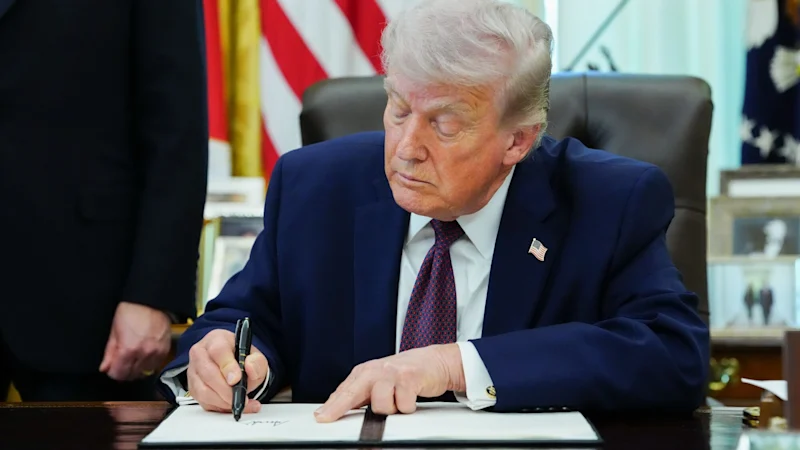
Donald Trump signed an executive order to impose 100 per cent tariffs on foreign pharmaceuticals.Bloomberg
However, Australia’s largest biotech firm, CSL, could face a lower tariff rate or be exempt from the new duties, which will not apply to products derived from blood plasma in certain circumstances.
President Donald Trump signed an executive order on Thursday afternoon (Washington time) enacting a long-signalled intention to impose tariffs on foreign pharmaceuticals in a bid to re-shore production in the US and reduce prices for American consumers.
The standard rate is 100 per cent, although several countries received a discount as part of broader trade deals, with the European Union, Japan, South Korea and Switzerland all subject to a 15 per cent tariff, and the United Kingdom even lower.
“While we are always working with our trading partners and close allies like Australia, Australia does not have a special pharma tariff rate,” a White House official told this masthead.
CSL headquarters in Melbourne. The manufacturer of plasma-derived therapies is set to be exempt from Trump’s new tariffs.Bloomberg
Trump’s executive order reduces the tariff to 20 per cent for companies that move production to the US.
ASX-listed biotech giant CSL – which has plants in the US, Australia and Europe – last year announced a $US1.5 billion ($2.17 billion) expansion of its American operations. Workers broke ground last month at the company’s manufacturing facility in Kankakee, Illinois – with the expansion set to be completed by 2031.
A White House official said CSL would need to submit its plan to the US Commerce Department, which has the discretion to grant exemptions.
The text of Trump’s executive order said the tariff will be set to zero for plasma derived therapies if they come from a country with a current or forthcoming trade deal with the US, or they meet an urgent US health need.
US Trade Representative Jamieson Greer briefly commented on the new tariffs at the White House.Bloomberg
Australia is yet to sign a trade deal with the Trump administration, but the US and Australia have a long-standing free trade agreement.
During a brief appearance at the White House, Trump’s trade tsar Jamieson Greer said the executive order was focused on deals that had “already been made” with companies making drugs in countries such as Australia, Austria and France. He did not take questions.
CSL did not immediately respond to a request for comment.
Appearing on Channel Seven’s Sunrise on Friday morning, Health Minister Mark Butler said the government would study Trump’s latest announcement. He was “pretty confident” CSL would be exempted, but had serious concerns for other exporters.
He also indicated Australia was not for turning on the Pharmaceutical Benefits Scheme, about which the US administration has also raised concerns.
“There’s no way we’re negotiating about those fundamental elements of the PBS that have served Australia so well for 80 years,” Butler said.
Opposition Leader Angus Taylor said the Coalition believed in free trade. “This is obviously not welcome news, we don’t want to see it,” he told Sunrise.
“We’ll work with the government to do anything we have to [do] to get it overturned or get an exemption for Australian exporters.”
Related Article
Senior Trump administration officials, speaking on a briefing call to reporters, said large companies would have 120 days until the new tariffs kick in. Smaller companies will have six months.
They said any new facilities must be completed by the end of Trump’s term in January 2029.
“In those 120 days, our expectation is they will announce re-shoring plans which will reduce [the tariffs] to 20 per cent,” one senior administration official said.
“We expect the lion’s share of the world’s patented pharmaceuticals to be building in America. This was not a secret, we’ve been talking about this endlessly over the past six months. Everybody knows it’s coming.”
Related Article
These sectoral tariffs are imposed under Section 232 of the Trade Expansion Act, rather than the president’s emergency powers, and so were not ruled unlawful by the Supreme Court’s decision in February.
Trump has also adjusted tariffs on steel, aluminium and copper, which are currently set at 50 per cent and involve complex formulas for the steel component of various products.
Officials said that if a product has less than 15 per cent steel, the additional tariff will now be set to zero – but other tariffs still apply. If the product exceeds 15 per cent steel, the steel tariff will be 25 per cent on the total value of the product.
There are also moves to reduce what US officials said was an attempt to “fool the tariff process” by claiming the products were worth less than their real value.
Get a note directly from our foreign correspondents on what’s making headlines around the world. Sign up for our weekly What in the World newsletter.
Save
You have reached your maximum number of saved items.
Remove items from your saved list to add more.
Michael Koziol is the North America correspondent for The Age and Sydney Morning Herald. He is a former Sydney editor, Sun-Herald deputy editor and a federal political reporter in Canberra.Connect via X or email.