
A Story of the 2026 Oil ShockIn the spring of 2026, the world looked out its windows and saw nothing apocalyptic. No Mad Max caravans. No empty highways. Just the familiar grind of a slightly worse economy: gas at four dollars a gallon in the U.S.—the highest since the early days of the Ukraine war—higher heating bills, and the occasional canceled flight.
Yet beneath that surface calm, something enormous was moving.It began on February 28 when U.S. and Israeli strikes hit Iranian targets. Iran retaliated by effectively closing the Strait of Hormuz, the narrow chokepoint through which roughly one-fifth of the world’s seaborne oil and significant LNG volumes once flowed. Ship traffic slowed to a dribble. Tankers were attacked. Flows that normally averaged 20 million barrels per day collapsed. The International Energy Agency called it the largest supply disruption in the history of the global oil market.
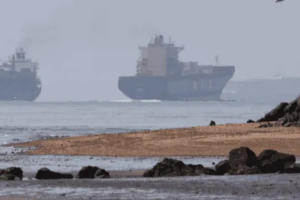
But the pain did not arrive instantly. The reason was as simple as it was overlooked: oil moves slowly.A Very Large Crude Carrier (VLCC) is longer than four soccer fields, carries two to three million barrels, and weighs more than a skyscraper. At a cruising speed of 10–15 knots—roughly the pace of a bicycle on a flat road—the journey from the Persian Gulf to distant ports takes weeks. A tanker leaving Dubai before the strikes might round the Cape of Good Hope, cross the Atlantic, and finally reach Louisiana 35 to 50 days later.
J.P. Morgan’s commodities team mapped the rolling shock. Red lines of pre-war Middle East oil still flowed across the globe on paper. By early March, those cargoes were only reaching parts of Asia. Europe felt the pinch around mid-April. The United States would see most Gulf deliveries dry up around April 15. Africa and parts of Asia were already hurting by late March.
newsweek.comIn those early weeks, countries drew on emergency stockpiles. Gas lines appeared in South Africa, Pakistan, and Vietnam. Laos closed schools one day a week to cut road traffic. Sri Lanka mandated mid-week work holidays. Airlines canceled flights. Air-conditioning was curtailed in government buildings. These were not yet true shortages of physical fuel everywhere, but the first tremors of a global market under strain.The world oil market functions as one vast pool. When Gulf supplies vanished, importers who lost their usual cargoes bid aggressively for oil from elsewhere—Russia, the U.S., Brazil, whatever remained. That bidding war pushed prices higher for everyone, even nations still burning pre-war tankers. Brent crude, which had hovered near $70 before the strikes, surged past $110 and briefly touched $120. U.S. gasoline climbed more than 30 percent in weeks.
A strange lull settled over richer economies. President Trump repeatedly suggested peace talks were advancing, saying a deal could come “soon” or that U.S. objectives were “nearing completion.” Each optimistic statement caused speculators in the futures market to sell, temporarily capping the price rise. Oil futures traders bet on an early end to the fighting.
cnn.comEven more important was the International Energy Agency’s unprecedented response. On March 11, its 32 member countries unanimously agreed to release 400 million barrels from emergency reserves—the largest coordinated drawdown in the agency’s history. The United States alone contributed a massive share. Some sanctioned Russian and even limited Iranian volumes were quietly allowed onto the market. Together, these measures offset roughly half the lost supply for a time.
iea.orgIt was like a city running out of water yet encouraging residents to take longer showers. Consumption continued almost normally while the real reserves drained. The lull felt almost reassuring. But the tricks were temporary. Stockpiles cannot be released forever. Futures markets cannot talk their way out of physics.The scriptwriter’s metaphor held: a bomb had exploded far away. The flash was visible—higher pump prices, nervous headlines—but the shock wave was still bicycling across the oceans. When it arrived, it would not come as a gentle rise in costs alone.Economists call the deeper consequence demand destruction. In past shocks—the 1973 Arab embargo or the 1979 Iranian Revolution—sharp supply losses forced permanent behavioral and structural changes. People drove less. Factories idled. Industries contracted. Global economic activity that depended on cheap, abundant energy simply withered.
This time the loss was larger: up to 20 percent of global supply offline for an extended period. Infrastructure in the Gulf—refineries, terminals, loading facilities—had been damaged by missiles from multiple sides. Rebuilding would take years, not months. Even if fighting stopped tomorrow, the oil would not return quickly.Already the ripples were visible. Airlines grounded routes, citing unsustainable fuel costs. European governments urged citizens to skip summer vacations abroad. Semiconductor plants in Asia shuttered, starved not only of power but of helium, a natural gas byproduct now in short supply. Fertilizer components that once flowed through the Persian Gulf grew scarce, threatening future harvests. Shipping costs for everything from lumber to off-season produce climbed, slowing construction and raising grocery bills.The hidden damage was slower but more profound. Less travel. Fewer factories running at full capacity. Reduced global trade. Slower technological progress. A quiet contraction of the energy-intensive activities that had defined modern life. Standard of living would slip—not in a dramatic collapse, but in a thousand small erosions: higher prices, fewer choices, postponed dreams.The first big test would come with winter.
Spring and summer are normally when nations rebuild stockpiles for heating. Instead, governments were burning through reserves to keep the lights on and the economy from seizing up. By December, a billion people across the Northern Hemisphere might turn up their thermostats only to find insufficient natural gas and heating oil. Another wave of the shock would hit.The architects of the conflict insisted the current discomfort was temporary, that high gas prices were the worst of it. But the lull was artificial—a mirage created by slow tankers, strategic optimism, and one-time releases of stored oil. When those buffers ran dry, the 100-foot tidal wave the narrator described would no longer be distant. It would break.Yet the story was not one of inevitable apocalypse. Societies had weathered oil shocks before. The 1970s brought stagflation, long lines, and a painful reckoning, but innovation, conservation, and new supply eventually followed. This crisis, too, would force adaptation: accelerated renewable investment, efficiency gains, perhaps even renewed diplomacy to secure energy routes.For now, though, most people still saw only the surface. They filled their tanks, paid the higher bill, and went about their days. Out the window, the world looked roughly normal. Beneath it, the slow bicycle of history was delivering its cargo. The shock wave was coming. When it landed, the question would not be whether the economy had been “blown up,” but how much of the old way of life would survive the impact—and what new shape the world would take once the waters receded.