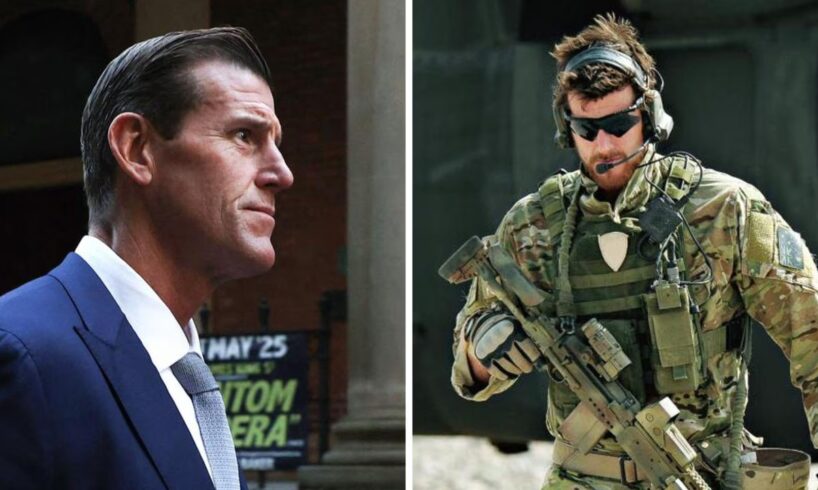
A former special operations commando says the Ben Roberts-Smith trial will shine a spotlight on the harsh realities of modern warfare in the face of an enemy bound by “absolutely no rules”.
Wes Hennessey, who served seven tours in Afghanistan, contends that judging battlefield actions years later from airconditioned rooms is unrealistic.
Without making any comment on the details of the prosecution’s case against the VC recipient, he says many other veterans feel the same way.
“There has not been a conflict in the history of mankind where the rules through extended conflicts were not on occasion broken,” Hennessey said, speaking generally, and not about the specifics of the war crime allegations levelled at Roberts-Smith.
“I’m not saying that’s right, but what I will say is if you’re fighting an enemy that has absolutely no rules whatsoever, and hypothetically on occasion if you need to move your rule book to achieve a mission and give the man to the left of you and the man to the right of you the upper hand, to get your a*se home — then by f*** every man I know will do that on every occasion.”
Want the news delivered to your inbox every morning? Sign-up to our daily newsletter
Hennessey was part of the Australian Special Operations Task Group known as TF66 deployed to Afghanistan, responsible for high-risk counter-terrorism and counterinsurgency operations against Taliban and al-Qaeda forces. Its purpose was to conduct “kill or capture” missions, intelligence gathering, and specialised strikes in Afghanistan, specifically in Uruzgan province.
“Special Operations Task Group also known as TF66 was in Afghanistan for almost 20 years fighting against an undescribed enemy who had no uniform, no rules and absolutely no boundaries, using barbaric tactics involving women, children and anything else they could get their hands on,” Hennessey said.
“And what we did was we used surprise, shock, stealth and anything else we could do to defeat, kill or capture that undefined enemy. Now as I have said before, to be judged on those actions many years later … it doesn’t sit well with me and I know it doesn’t sit well with the community.”
Speaking generally about the Afghan conflict, Sam Bamford, an Australian Army Combat Veteran and former Paratrooper who deployed to Afghanistan in 2012, took aim at the Federal Government for sending Australia’s “best most courageous men within our society to go fight in a foreign conflict and then judge us when we get home for what happened over there”.
“The Government doesn’t get to send us into a war zone where the enemy blend in with the general population and go unseen,” Mr Bamford said on his Instagram account.
“You don’t get to send us into a war zone where they use IEDs and women and children are human shields.
“You don’t get to send us into a war zone where they strapped 13kg worth of explosives to 14-year-old boys and blow them sky f***ing high. It happened on my trip.
“You don’t get to send us into a war zone on the 29th of August where they get Taliban soldiers to infiltrate the Afghan National Army which partnered with the Australian Defence Force over there and turn around and shoot my mates, killed three in one night.
“You don’t get to send us into that kind of war zone and then judge us on what happened over there when we get home.”
While veterans express their frustration over the analysis of historical battlefield decisions, lawyer and former army officer Dr Glenn Kolomeitz raises different concerns about the time frame of the investigative process and the accountability of senior leadership.
“We cannot ignore allegations of war crimes made against our defence members, regardless of who they are or what positions they hold,” Dr Kolomeitz said.
“To do so is to place Australia in no better position than many of the despotic regimes we, as a country, have criticised over the years. We as a country hold adherence to the rule of law as a key value.
“A proper investigation of allegations of criminality is just that – a criminal investigation. The internal ADF inquiry into allegations arising from Australian operations in Afghanistan, headed by Major General Justice Paul Brereton, was not a criminal investigation – far from it.
“It was a coercive inquiry designed to establish facts to a far lesser standard of proof than any criminal process by compelling testimony from potential witnesses.
“The question begs asking, how long should such inquiry be allowed to continue before any suspicion of criminality is referred to a criminal investigative body?”
The Brereton Inquiry commenced in 2016 and was completed in 2020. A specialist investigative body was established in 2021 and continues to this date.
“That’s 10 years during which the spectre of some potential criminal action has been hanging over the heads of some former ADF members and, indeed, the Australian public more broadly,” Dr Kolomeitz said.
“There should not, of course, be a statutory time limitation period attached to offences in the nature of war crimes, but the Australian public is right to ask whether Brereton could have suspended his inquiry sooner – on reaching a suspicion of criminality – and allowed any allegations to be referred for criminal investigation.
“This is especially the case considering the coercive nature of the inquiry meant that much of the information obtained cannot be used in a prosecution or to advance a criminal investigation.
“The upshot being, the criminal investigators needed to start from scratch to a significant extent thus delaying the process further.”
Dr Kolomeitz said the lack of attention on military leaders, under whom Australia’s forces were operating, was causing consternation among many in the veteran community.
“No higher commanders were referred for criminal investigation and none have been investigated. Does this not fly in the face of the Australian value of adherence to the rule of law? Or to our broad egalitarian ethos of a fair go?,” he said.
“The Australian public is entitled to say, ‘hang on, you can’t have it both ways. You can’t get a gong for distinguished command whilst concurrently having insufficient command and control’.”