‘People unprompted brought up their respect for Starmer for standing up to Trump’
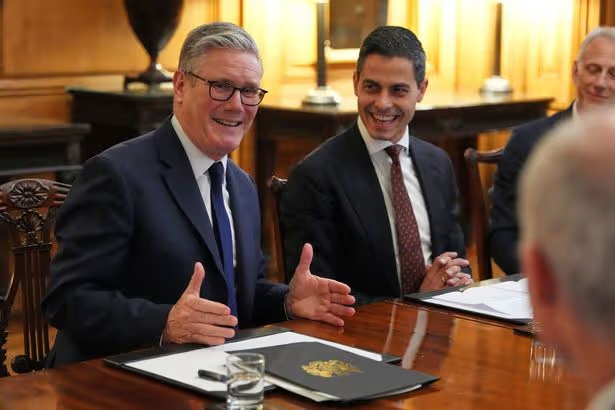
Keir Starmer has a role to play to reassure voters in uncertain times, think tank More in Common say(Image: PA)
“Poor”, “struggling”, and “broken” are some of the words used by people to describe Wales in 2026. Groups of voters all around Wales have been sharing their thoughts on politics and politicians as part of focus groups and they resoundingly show people are increasingly disappointed with Labour in both Wales and London.
More in Common, a think tank, runs focus groups across the UK and its recent ones in Wales give an idea how people really view the state of politics right now.
Panellists are recruited based on their voting history and voting intention in a way that reflects the politics of the area – for example Labour voters turning to Plaid or first-time Reform UK voters. They are paid for their time answering questions on a range of topics.
Over the weekend More in Common carried out focus groups across in Cardiff, Merthyr Tydfil, Port Talbot, and Pembroke Dock. The organisation’s UK director Luke Tryl summed up the mood. “Above all else we heard deep pessimism about the state of Wales, the UK, and the wider world.”
He said the main worry was the cost of living crisis. “Top concern for almost every group was the cost of living and it making life too difficult for people, not just sapping joy but making things generally miserable and the sense they would ‘never get off the hamster wheel’ with ‘no light at the end of the tunnel’,” he said.
In a long X thread detailing his thoughts from the focus groups Mr Tryl said, however, there was some good news for Keir Starmer. “Reviews of Starmer were generally low, though less anger than we hear in some groups and more disappointment that he hadn’t delivered change and was too weak/lacking a backbone. The sheer number of U-turns had cut through and winter fuel was still a sore point.
“That said in every single group people unprompted brought up their respect for Starmer for standing up to Trump and ‘stopping us being dragged into a war’. For some it was the first time they had seen Starmer fight for Britain. Some others thought he needed longer to prove himself.”
WalesOnline also spoke to Louis O’Geran, a senior researcher at More in Common who was at this past weekend’s focus groups. The issues he said were most frequently coming up were the cost of living, petrol prices, public services, and NHS waiting times.
Asked for his overriding summary of how voters feel now he said: “The atmosphere isn’t massively dissimilar to before the general election in 2024 – this real kind of sense of anti-incumbency.
“I think in Wales it’s kind of a double incumbencies because as well as obviously 28 years in the Senedd Labour are now in Westminster so it kind of feels like there’s this double layer of dissatisfaction but actually not a huge amount of enthusiasm for other options.”
There are, broadly, different camps. Labour voters are in many cases, he said, “not angry but disappointed”. There is good support for Plaid Cymru though contributors weren’t drawn to a particular policy but wider feelings about the party’s motivations.
For Reform UK Nigel Farage’s relationship with Trump is affecting even their own voters. The choice of candidates brought in from outside the local area is also something counting against support.
“We’ve seen huge swings to Reform in Wales and I think that, in a way, will be one of the big stories of the election. But speaking to Welsh Reform voters on the ground there are definitely electoral liabilities or concerns.
“You’ll hear, kind of, these doubts about Reform – the sense that Reform’s connection to Trump is a really big question for people. That comes up a lot in focus groups,” he said.
He said candidates being “parachuted in” had come up too. “We’ve been in a couple of focus groups where that’s really contrasted with Plaid. There was this quote from somebody who said: ‘It feels like everybody knows a Plaid candidate’. They’re local – they feel like they’re in touch in a way that Labour doesn’t and that Reform definitely doesn’t.”
While a shift from Labour is palpable “it doesn’t feel like people are enthusiastic about other options”, More in Common found.
“Among progressive voters in Wales there seems to be a lot of energy behind Plaid Cymru. However it’s kind of a vibes-based kind of thing – a sense that they are local and in touch, a sense that they’re the only party that will actually stick up for Wales, whereas Labour and Reform are kind of seen as very English and disconnected.
“But actually, kind of a question, over whether Plaid are ready for government, even if people really sympathise with them or root for them, questions over competence, whether they’ve got a real plan.”
The war in Iran and impact on day-to-day costs is now featuring heavily, he said. At the weekend’s focus groups in Wales petrol prices were discussed.
“Energy bills have always been the really big element of the cost of living crisis. There’s this really interesting quote from somebody who said they’d become obsessed with the price of petrol.
“A mum told a story about driving her kids to school and on the way out it was £1.56 and when she drove back it was £1.59.
“There’s a feeling it was spiralling out of control and one man said: ‘The fighting might have stopped but petrol will never be £1.26 again’.”
A lack of control from both Senedd or Westminster to be able to resolve the issues that matter is consistently emerging.
“NHS waiting lists are really salient. This is just anecdotal but it feels like in England, we’ve seen that in focus groups the stories about the NHS have got less dire over the past couple of years,” said Mr O’Geran.
“A woman told us about her dad who was in hospital after having a heart attack and spent two days lying in a chair and ended up just going home. There’s this sense that waiting lists are not improving that maybe some of the the few things that people point to in England as progress that Labour is working just don’t seem to be there in Wales in the same way.”
For Labour what will be a worry is not only the switch to Plaid Cymru but the apathy for their leader. Eluned Morgan has not, Mr O’Geran said, “managed to really cut through” but he said there isn’t hostility to her as such.”
Transcripts of focus groups from February shared with WalesOnline of a group in Colwyn Bay featured disillusioned Labour voters who are considering Plaid Cymru. “I think Labour have burned their bridges,” a male contributor said.
A male panellist said: “My own view is that change is always good. Anything to give Labour a bloody nose right now I think will be a good thing.”
Labour voters broadly say they are ‘not angry but disappointed’ at Welsh and UK Labour(Image: John Myers)
Mr O’Geran added: “If you’re a progressive Labour voter who’s more sympathetic to the Senedd you might say it hasn’t had the power to really achieve those impacts but if it’s Reform voters it’s just a sense that, like, the Senedd doesn’t work at all.
“When we came out of one of the groups we did in Cardiff with progressive voters the sense we came away with was actually: ‘I’m not angry – I am just disappointed’.
“The word ‘lacklustre’ would kind of sum it up.
“There’s just this sense, not vitriol that you get towards the Labour government in some groups, particularly in England, but just the sense that they haven’t delivered and it’s been a bit of a let-down.
“Wales kind of feels like it has become some extent a referendum on this UK Government.”
Given people have little awareness about Reform UK’s Welsh leader Dan Thomas Mr O’Geran said: “It’s 100% a referendum on Starmer and Farage.
“One of the big themes ahead of these like elections generally, even in England where it’s people voting for their council, is that Iran is going to play a huge role.
“The big test for Starmer at the moment is playing a role as reassurer. The public feel incredibly insecure about Britain’s place in the world. We feel like we can’t rely on our closest ally and we’re feeling the effects of that and looking at petrol pumps as an example. Starmer’s role to kind of show that he’s being assertive will really kind of shape how people view Labour and that will affect Labour in the Senedd 100%.”
One male panelist said during a panel in Colwyn Bay: “I think the Labour have done lots of good over the years in Wales. They haven’t had enough decentralised power. However I think behaviour of Gething smacked of corruption – I thought a lot of the trust between the electorate and Labour has been broken. They become complacent and there’s also the fact that it’s all about Cardiff.”
A female panellist said: “It’s been far too easy for Labour to always blame the UK Government. “Anything that goes wrong: ‘It’s not our fault – the UK Governments haven’t given us enough money’.
“The whole system is really is difficult. So unfortunately, and I think Labour’s done a lot of that, lots of complaining about, but the fact that they haven’t been able to do this and that and they have been in power for very long time and there’s lots of things, education for instance, they’ve been there but they haven’t done a very good job of that unfortunately.”
Plaid will take heart in the support for them but not that their policy messages don’t seem to be getting through. “There isn’t a particular policy that people can identify from Plaid,” said Mr O’Geran.
“Free universal childcare came up as something that somebody liked, but generally it was vibes-based – that Plaid will stick up for Wales, they’re not Reform, they’re not Labour, and just the sense that they’re kind of nice aligned with their values.
“One of the drivers towards Plaid Cymru is a fear of Reform. Before Caerphilly it was assumed that a fear of Reform would play into Labour’s hands but, actually, it looks like Plaid could be the beneficiary of that.
Plaid supporters don’t have a particular affinity to the party’s policy but do want change, More in Common has found(Image: PA)
“One thing that really surprises me is when we talk to Plaid Cymru voters who firmly support Plaid [they] feel like Wales is being neglected, that Westminster has no interest in Wales, that Welsh Labour is just like the Wales branch of Westminster. It’s so interesting how in focus groups in Scotland all those feelings translate into strong support for independence but when you speak to people in Wales, even those who really passionately support Plaid Cymru, they tend to say: ‘Wales just isn’t ready’.
“And in fact they even make the comparison with Scotland a lot of this time and say: ‘Scotland is ready for it. Wales isn’t yet – we don’t have the economic independence, we don’t have the businesses, we’re just not ready for yet’ even if they would actually quite like that at some point in the future.” For our free daily briefing on the biggest issues facing the nation, sign up to the Wales Matters newsletter here.
Despite the change from first past the post to a form of proportional representation there are questions about whether tactical voting will play into results. More in Common is being told in focus groups by some people: “I would just vote for whoever it takes to keep out Reform.”
Turning to Reform Mr O’Geran said people who are sympathetic to Reform UK, who agreed with them on migration and were angry at Labour, are increasingly voicing concerns about Nigel Farage’s relationship with Donald Trump.
Initial concerns about whether his ICE immigration crackdown would come to the UK have grown into people seeing costs rise due to the Iran war.
“The Trump problem has just become more and more salient,” said Mr O’Geran.
“These conversations about petrol prices and this kind of terrifying sense that it’s just spiralling out of control and always links back to Trump. People really clearly make that link and it does reflect badly on Reform in some cases.”
Immigration features too but not in as prevalent way as in England.
“It’s kind of assumed that Wales is totally distinct in attitudes,” said Mr O’Geran. “Our polling suggests that actually Welsh people are roughly in line with England in that the majority want to reduce net migration and say that they’re concerned about small boats the difference is it’s just not as salient an issue.
The leader of Reform in Wales, Dan Thomas, does not have big recognition in Wales(Image: Rob Browne/WalesOnline)
“They’re far less likely, when we ask what are the biggest issues facing the country, they’re about 20 points less likely to say immigration and small boats.
“That was reflected in the focus groups that came up in some of the Reform voter groups but actually quite late in the conversation whereas often you talk to Reform voters in England and it’s the first thing that comes up.”
For those more broadly interested interested in how the election will go and parties trying to sway undecided voters this quote from a potential voter stood out. “I’ve always advocated to my children: ‘Make sure you use your vote, make sure you use your vote’ and this is the first time that I really, really don’t know who to vote for.
“I will need to read up before I will vote because I feel I should vote.
“I feel it’s really important that we use our vote but I don’t know,” the woman said.