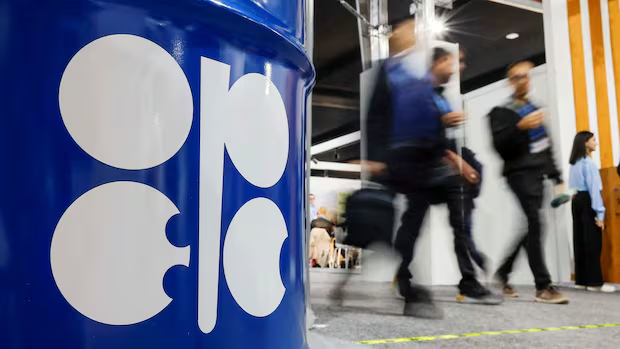
The United Arab Emirates says it is leaving the Organization of the Petroleum Exporting Countries (OPEC) and OPEC+ as of Friday, as an unprecedented energy crisis triggered by the Iran war exposes disagreement among Gulf nations.
The U.A.E. has been a longtime member of OPEC — a cartel of leading oil-producing countries — first through its emirate of Abu Dhabi in 1967 and later when it became its own country in 1971. OPEC+ is an alliance with other oil-producing countries created in 2016.
The stunning loss of the U.A.E. could create disarray and weaken the group, which has usually sought to show a united front despite internal disagreements over a range of issues from geopolitics to production quotas.
U.A.E. Energy Minister Suhail Mohamed al-Mazrouei told Reuters on Tuesday the decision was taken after a careful look at the regional power’s energy strategies.
Asked whether the U.A.E. consulted with Saudi Arabia, he said the U.A.E. did not raise the issue with any other country.
“This is a policy decision, it has been done after a careful look at current and future policies related to level of production,” Mazrouei said.
The U.A.E. has had increasingly frosty relations with Saudi Arabia, OPEC’s largest producer, over political and economic matters in the Mideast, even as both came under attack by fellow OPEC member Iran.
Fire and plumes of smoke rise after a drone struck a fuel tank near Dubai International Airport, in United Arab Emirates, on March 16. The U.A.E. has criticized other Arab states for failing to prevent attacks from Iran. (The Associated Press)
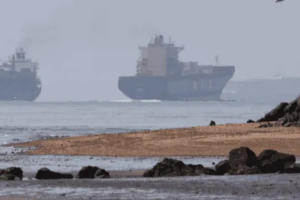
OPEC Gulf producers have already been struggling to ship exports through the Strait of Hormuz, a narrow chokepoint between Iran and Oman through which a fifth of the world’s crude oil and liquefied natural gas normally passes, because of Iranian threats and attacks against vessels.
Mazrouei said the move would not have a huge impact on the market because of the situation in the strait.
But the U.A.E. exit from OPEC represents a big win for U.S. President Donald Trump, who has accused the organization of “ripping off the rest of the world” by inflating oil prices.
Trump has also linked U.S. military support for the Gulf with oil prices, saying that while the U.S. defends OPEC members they “exploit this by imposing high oil prices.”
The move came after the U.A.E., a regional business hub and one of Washington’s most important allies, criticized fellow Arab states for not doing enough to protect it from numerous Iranian attacks during the war.
Anwar Gargash, the diplomatic adviser for the U.A.E. president, criticized the Arab and Gulf response to the Iranian attacks in a session at the Gulf Influencers Forum on Monday.
“The Gulf Cooperation Council countries supported each other logistically, but politically and militarily, I think their position has been the weakest historically,” Gargash said.
“I expect this weak stance from the Arab League and I am not surprised by it, but I haven’t expected it from the [Gulf] Cooperation Council and I am surprised by it,” he said.
The U.A.E. made the announcement via its state-run WAM news agency.
The decision reflects the country’s “long-term strategic and economic vision and evolving energy profile, including accelerated investment in domestic energy production, and reinforces its commitment to a responsible, reliable, and forward-looking role in global energy markets,” it said.
“Following its exit, the U.A.E. will continue to act responsibly, bringing additional production to market in a gradual and measured manner, aligned with demand and market conditions.”
The departure had been rumoured as a possibility for some time, as the U.A.E. pushed back in recent years against OPEC production quotas it felt had been too low — meaning it wasn’t able to sell as much oil to the world as it had wanted.
This exit comes as global spare capacity hovers at historically low levels, leaving the oil market increasingly tight.
“Having invested heavily in expanding energy production capacity in recent years, the bigger picture is that the U.A.E. has been itching to pump more oil; it ultimately feels that being outside of its OPEC+ ‘obligations’ will give it more ‘flexibility,”‘ Capital Economics wrote in an analysis.
“Today’s move fits with our existing view that the ties binding OPEC members together have loosened,” it said, particularly after Qatar withdrew from the cartel in 2019.
WATCH | U.A.E. leaving OPEC:
‘New geopolitical era’: U.A.E. to leave OPEC
The United Arab Emirates has announced its withdrawal from the Organization of the Petroleum Exporting Countries (OPEC) and OPEC+. Heather Exner-Pirot, an energy expert with the Macdonald-Laurier Institute, says it’s just one more sign of the changing international order.
The withdrawal isn’t expected to have any immediate effect in markets because world oil supplies are constrained by the war on Iran. On Tuesday, Brent crude, the international benchmark, traded above $111 U.S. a barrel, or more than 50 per cent above its prewar price.
That means there’s no immediate impact for Canada specifically either, according to Heather Exner-Pirot, an energy expert with the Macdonald-Laurier Institute. But in the long run, she says this move could mean less stability in oil markets, and more supply than demand once the supply crunch in the strait is over and if the U.A.E. is producing more oil.
“Overall, for me, this is just one more sign of this new geopolitical era we’re in, where multilateral organizations and alliances don’t matter as much. It’s really, you know, kind of a Hunger Games, dog-eat-dog world out there, everyone doing it for themselves,” Exner-Pirot told CBC News Network.