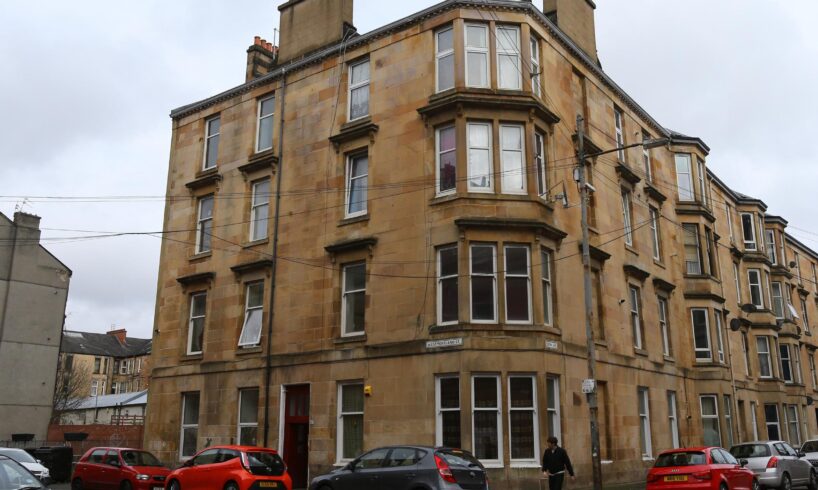
The Southwest Govanhill Property Acquisition and Repair Project began in 2015, with funding from the Scottish Government and Glasgow City Council, to buy and repair substandard properties.
Govanhill Housing Association (GHHA) has now approved a £1.36M refurbishment contract for 97 Westmoreland Street, one of the area’s most neglected tenement blocks.
Read More:
Photos of 97 Westmoreland Street taken in 2019 show the condition of the block of flats
The contract, awarded to Morris & Spottiswood, is the final phase and is in partnership with Glasgow City Council and supported by funding from the Scottish Government.
Govanhill Housing Association chair and local resident, Keith Kintrea, spoke about the refurbishment. He said: “This new contract with Morris and Spottiswood represents one of the final pieces of the puzzle of the South West Govanhill project to acquire, repair and re-let properties that have fallen into disrepair after years of neglect in the private sector.
“We know that there is still work to be done in Govanhill; nonetheless, the Association has made incredibly significant improvements to housing conditions over the last decade.”
Inside one of the flats in 97 Westmoreland Street as GHHA are set to refurbish them (Image: KATHLEEN LITTLE)
When national improvement funding ended around the millennium, many properties in South Govanhill fell into the hands of private landlords operating at the lowest end of the market. Exploiting new migrants unfamiliar with their housing rights, this contributed to severe overcrowding, unsafe living conditions, and widespread disrepair.
By the early 2010s, Govanhill had become Scotland’s most densely populated neighbourhood, with some homes unfit for habitation and many owner-occupiers trapped in negative equity. Media coverage at that time highlighted the scale of decline, with some tabloids branding the area “Govan‑hell”.
Amid the need for urgent intervention, Govanhill Housing Association, supported by Glasgow City Council, petitioned the Scottish Parliament, leading to the creation of Enhanced Enforcement Areas (EEAs) under the Housing (Scotland) Act 2014, which granted strong powers to address properties in the private rented sector.
The current condition of one of the flats (Image: KATHLEEN LITTLE)
Duncan Thomson, private sector group manager at Glasgow City Council, admitted that while the milestone marked a major achievement in the area, there’s still work to do.
He said: “The refurbishment of the tenement property at 97 Westmoreland Street will be welcomed by all parties who have played a part in the regeneration of Govanhill.
“This contract will bring back into use a building which was a focus of attention for many people and agencies, for all of the wrong reasons, over a period of too many years.
“Albeit there may still be work to do in the area, the restoration of this tenement is a major achievement and will provide more high-quality social housing for the local community.”
A photo of a previous refurbishment by GHHA shows how they hope the flats at 97 Westmoreland Street will look after the refurbishment (Image: KATHLEEN LITTLE)
Govanhill became Scotland’s first EEA in 2015, enabling unprecedented action against rogue landlords through a ground-breaking partnership between Glasgow City Council, the Scottish Government and the Association.
Almost £50 million of public investment, supplemented by significant GHHA funding, has since been directed into acquiring, repairing and re‑letting formerly substandard homes. A total of 394 properties, 69% of which were formerly in the private rented sector, have been refurbished to a high standard and brought into social ownership.
This investment also included work with owners on common works to the buildings’ external fabric. The Association also assumed factoring responsibilities in 80 closes, tackling long‑standing issues such as defective roofs, structural instability, rot, unsafe stairways and the absence of secure entry systems.
Another glimpse at what the flats should look like upon completion (Image: KATHLEEN LITTLE)
It’s widely accepted that some environmental challenges remain in Govanhill; however, property values have risen, and the housing association believes that the area has re‑established itself as a desirable place to live. Despite these improvements, 97 Westmoreland Street has stood as one of the last reminders of the physical decay present at the start of the project.
Once described as a “notorious slum”, the tenement at 97 Westmoreland Street has long been emblematic of the challenges facing the area. Years of neglect by private landlords led to severe deterioration, prompting Glasgow City Council to approve compulsory purchase orders for seven flats, four of which were eventually carried out. All eight homes are now owned by Govanhill Housing Association, enabling full redevelopment to proceed.
The refurbishment will address long‑standing safety concerns, including historic access routes to the rear courtyard, particularly via the basement, which were reported to have encouraged crime and unhealthy living conditions. Redesigned access will improve safety, security and usability for future residents.
2019 photo of 97 Westmoreland Street shows drug paraphernalia littering the floor of the close
Pictures taken by our photographers in 2019 show that from the outside, the block looks similar to many others in the area. However, inside the close, the signs of squalor and decay quickly became visible.
Steel padlocked doors were the entrances to some of the flats; the entrance to the back stair had a sign stating “Hazardous Area. No unauthorised access”; and the top-floor stairs and landing were littered with pieces of silver foil stained with brown streaks, apparent evidence of drug taking.
Paul Beaton, operations and development director at Morris & Spottiswood, said the company is “proud” of its partnership with the housing association and looks forward to transforming 97 Westmoreland Street.