Shafaq News
When Abu Ali delivered his wheat
harvest to government warehouses in Najaf province this season, he received
what the Iraqi state offers every farmer who completes the handover: an
official receipt confirming the transaction.
Weeks passed, and his visits to the
relevant authorities produced a familiar rotation of deferral — “come back
next week,” “the file is under review.” To cover the costs of
the new agricultural season, he sold his wife’s gold jewelry. “We worked
the land for a full year,” he told Shafaq News. “Plowing, irrigation,
heat, cold, all just to reach a harvest that would cover our debts.”
Abu Ali’s situation is the
prevailing condition of Iraq’s wheat and barley farmers this harvest season,
and it points to a contradiction at the heart of the country’s agricultural
policy: a state that depends on domestically grown wheat to manage its food
security cannot —or will not— pay the farmers who grow it on time.
Read more: Discover Iraq: Najaf, a city of dust and divinity
Strategic Crop And Unpaid Bill
Iraq designates wheat as a strategic
commodity. The government purchases it at subsidized prices, maintains a
national stockpile, and uses it to stabilize flour prices for a population of
more than 42 million. The procurement system, in theory, is a pillar of the
country’s food framework.
In practice, the system functions by
transferring financial risk downward. Farmers deliver their crop, receive
documentation, and then wait, sometimes for months, while their payment moves
through layers of administrative review, budget allocation, and ministerial
approval. During that waiting period, they still owe their suppliers, laborers,
and equipment creditors.
Mahdi Dhamed Al-Qaisi, an adviser to
Iraq’s Ministry of Agriculture, acknowledged the problem without ambiguity.
“Farmers’ dues are like a government employee’s salary,” he told
Shafaq News. “If it is delayed, they are harmed.” He confirmed that
the government has issued directives following official meetings with the
Federation of Farmers’ Associations, and that the Cabinet has passed
resolutions designating these payments as a disbursement priority.
The gap between Cabinet resolution
and farmer payment is where the crisis lives.
Read more: Rooted in soil: An Iraqi farmer holds on as the land changes
Protests Across The Grain Belt
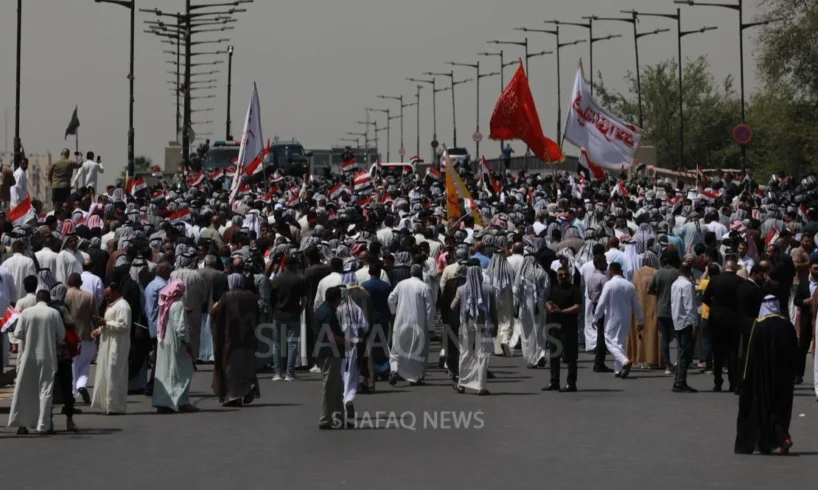
In recent weeks, farmers from Najaf,
Karbala, al-Diwaniyah, and Babil —provinces that form the core of Iraq’s
central grain-producing belt— traveled to Baghdad to demonstrate publicly.
Their demands went beyond overdue payments, calling for upward revision of the
official wheat purchase price, the elimination of certain marketing procedures
they regard as obstacles, and compensation for crop losses caused by flooding
and drought.
Some of those protests were
reportedly dispersed by force. The government subsequently opened
investigations and issued instructions to follow up on the farmers’ demands.
This sequence suggests official recognition of the pressure, if not yet a
resolution of its causes.
The protests matter as evidence of
scale, because when farmers from four provinces organize coordinated
demonstrations in the capital, the problem has moved well beyond seasonal
administrative friction and into the terrain of a political file that Baghdad
can no longer defer.
Read more: Discover Iraq: Al-Diwaniyah, a province of untapped potential and neglect
Structural Mismatch, Not
Bureaucratic Accident
Parliament is beginning to frame it
in those terms. Lawmaker of Khadamat bloc, Uday Al-Zamil, who has followed the
agricultural file closely, told Shafaq News that farmers represent “the
fundamental pillar of the economy” but face what he described as the
systematic undervaluing of their rights. “The state does not cooperate
with the farmer as it should…even though he is the foundation of domestic
market activity.”
Al-Zamil situates the payment crisis
within a longer arc of agricultural decline. Iraq was once a significant
producer of dates, vegetable oils, and cotton. Those sectors contracted over
decades as import dependency expanded, a pattern familiar across rentier
economies where oil revenues (about 90%) make domestic production feel optional
until a crisis makes it urgent. Wheat held on as a strategic exception,
shielded by government purchase guarantees. But those guarantees are only as
reliable as the budget that backs them.
And that is precisely the problem.
Al-Zamil identifies the causes of delay as the country’s broader fiscal
pressures, the chronic lateness of annual budget approval, and the
administrative complexity of Iraq’s procurement verification and disbursement
mechanisms. None of these causes is new, nor have they been structurally
resolved.
Cost Of Delayed Payment Compounds
For Iraqi farmers, harvest revenues
are operating capital for the following season. Seed, fertilizer, labor,
irrigation, transport, and equipment maintenance must all be financed before
the next crop can be planted. When the state delays payment, farmers borrow to
cover these costs, typically at higher rates and with greater personal exposure
than if they had been paid on schedule.
The Ministry of Agriculture adviser
confirmed that production input costs —seeds, fertilizers, energy, transport—
have risen significantly in recent seasons, while farmers argue that official
purchase prices have not kept pace with actual operating expenditures. Even
when the price is technically adequate, delay erodes its real value: a farmer
who borrows at interest to cover the gap between delivery and payment receives
less, in effective terms, than the stated price suggests.
Delayed payment forces borrowing,
borrowing raises the cost of the following season, higher costs narrow margins,
and narrower margins quietly erode the incentive to plant —until the supply the
state depends on to manage food prices begins to thin from the bottom up. The
farmer, in this arrangement, functions as an involuntary short-term creditor to
the state’s food security policy, absorbing the liquidity risk that the
government cannot or does not manage itself.
Harvest Is Strategic, Payment Is
Optional
What the wheat payment crisis
ultimately reveals is a misalignment between Iraq’s food security rhetoric and
its fiscal framework. At the level of official statement, wheat is
irreplaceable and non-negotiable because it is considered a strategic, sovereign
issue. but at the level of budget execution, payments to the farmers who
produce it are treated as a residual claim, disbursed when liquidity allows
rather than when obligation falls due.
This misalignment is familiar across
the Middle East and North Africa, where countries that rely on subsidized
domestic procurement to manage food prices frequently struggle with the working
capital demands of that system, particularly when oil revenues contract or
budget cycles slip. But Iraq’s version of this tension carries specific weight:
the country imports a substantial share of its food requirements, and the
domestic wheat sector represents one of the few agricultural activities the
government has explicitly committed to sustaining.
Read more: Discover Iraq: Karbala, where memory breathes and future beckons
If payment delays become structural
so that farmers cannot reliably count on timely disbursement, the rational
response is to reduce exposure to the system. Plant Less. Sell Informally.
Exit. The government’s food security calculus depends on farmers not making
that calculation. But every delayed payment makes it more tempting.
Al-Qaisi insists the government is
moving to address the backlog and that wheat procurement will continue at
supported prices. The Cabinet resolutions are real. The political attention,
following the protests, is genuine. But resolutions and intentions have
appeared before, and the harvest season arrives every year regardless.
The farmers of Najaf, Karbala, and
al-Diwaniyah are presenting a receipt. That it has gone unanswered for weeks,
with debts mounting and a new season already pressing, says more about the
state’s priorities than any policy document could.
Written and edited by Shafaq News
staff.