If you were driving through Cork’s busiest roundabout this morning, you probably saw a large group of National Ambulance Service (NAS) staff marching with posters and flags held high – but what is the protest about, and how does it affect coverage?
NAS employees say they have been asked to upskill significantly in recent years but have not received a commensurate pay increase, and that current staffing levels are far below what they need. They are now demanding that the HSE implement the recommendations of the Roles and Responsibilities review.
The review, dating back to 2020, recommended updating pay scales for NAS staff to better reflect changes in their qualifications, responsibilities, and workloads. NAS staff are also asking the HSE to bolster recruitment to meet recommended levels, which are currently around
SIPTU organiser Natasha Linehan Tracey told CorkBeo that the standard of care provided by NAS staff has improved significantly over the last 15 years, a change she says has undoubtedly saved lives. The union rep highlighted that 15 years ago, NAS staff may have been able to administer only 3-4 medications during an incident, whereas today they can administer more than 80.
NAS staff at the protest this morning(Image: Daire Fitton)
While there was strong public support for today’s protest at the Kinsale Roundabout, as evidenced by passing cars honking their horns almost constantly, concerns have been raised about the work stoppage’s impact on patient care. However, NAS staff say emergency care arrangements have been agreed with the HSE to ensure coverage for critical calls, and this morning, two NAS ambulances left the depot with blue lights flashing as they passed the picket lines.
Priority will be given to patients who are facing medical emergencies like heart attacks, respiratory arrest and serious injuries. Those calling the ambulance for non-critical incidents are expected to face delays and have been advised to consider alternative options, such as local injury units, their GP, or making their way to the hospital with the help of a friend or family member.
You could hardly go 30 seconds without a horn blaring at the Kinsale Road Roundabout this morning(Image: Daire Fitton )
This week, NAS personnel will be conducting a 24-hour work stoppage from 8 am this morning until 8 am on Wednesday. From there, they will seek to restart negotiations with the HSE, and if no deal can be reached, 48-hour protests will be carried out next week, followed by a 72-hour work stoppage the week after if no progress has been made.
CorkBeo spoke with staff on the picket line this morning, all of whom emphasised that they would rather be working than out marching, but that they feel they’ve been given little choice in the matter. This morning, more than 80 staff were protesting at the Kinsale Road Roundabout, many of them on their day off.
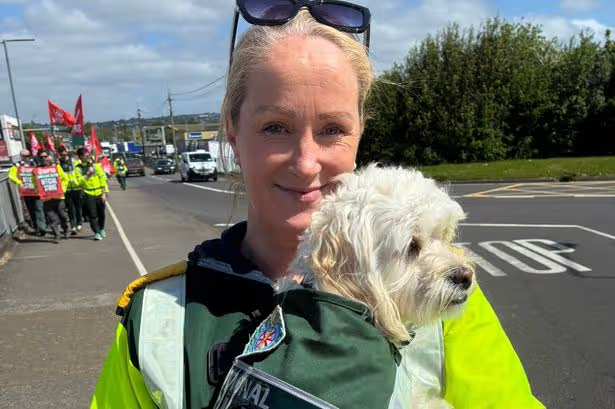
Denise and Nell at today’s protest(Image: Daire Fitton )
Denise Forde, who is pictured above with her uniformed canine companion, Nell, says that NAS personnel hope that this dispute is resolved before it escalates any further.
She told CorkBeo: “We’re here today as we feel we’ve been backed into a corner and that we have no other option. Since I started [23 years ago] with the ambulance service, it has become unrecognisable.
“Back in the day, you’d have two stretchers in the back of a vehicle, and we were essentially ambulance drivers; we took patients to the hospital and provided a small bit of care, but every year since then, we’ve taken on extra skills to provide care to patients in our communities, and we haven’t received the recognition for it.”
Denise said that while the HSE agreed to implement the conditions outlined in the review, they came with preconditions that would ultimately ‘dilute their working lives.’ These include changes to ambulance crewing models and sweeping changes to base pay and overtime conditions, among others.
NAS staff at this morning’s protest(Image: Daire Fitton)
Addressing concerns about how the work stoppage could affect patient care, Denise continued: “We have essential cover here today, we have provided vehicles, and there are vehicles on duty. We also have plans for if certain situations were to arise, people will come off the picket line, jump into an ambulance and respond
“Most people today here are actually on a day off; we’re not being paid, we’re just here to fight for what we feel like we’re rightfully due.
“We care; these are our family and friends in the community who are at risk today. It’s not just everybody else; everybody is at risk today, unfortunately, but it’s something we have been driven to do. It’s two days next week, three days the week after, if it’s not resolved, so we’ll just have to see how things go, but hopefully it’ll be resolved before it escalates.
Labour TD Marie Sherlock has called on the Government to work with both the HSE and SIPTU to end the strikes.
Deputy Sherlock said: “It is imperative that the Minister steps in now and works to end industrial action by NAS workers. The Minister is not merely a commentator in this dispute — she has a responsibility to both the public and NAS workers to address their concerns. The Minister and her Department must engage urgently to ensure continuity of service across the country and implement the recommendations of the independent Roles and Responsibilities Report. Our National Ambulance Service is creaking at the seams because of chronic understaffing.
“We know from figures provided to my office that staffing shortages are contributing to almost 40% of ambulances missing response time targets when responding to life-threatening cardiac or respiratory arrest calls. Ambulance crews are under severe strain and are being asked to provide increasingly complex care under growing pressure.
“The Independent Review of Roles and Responsibilities Report recommended, among other measures, updated salary scales to reflect the substantial changes in roles, responsibilities, and clinical skills now required of personnel delivering increasingly complex care. Yet those salary changes have still not been implemented. This is a fundamental question about how we value our ambulance service.”
Deputy Sherlock urged the Minister for Health and the HSE to come to the table and ‘meaningfully engage’ with the unions to resolve the dispute and put plans in place to increase staffing levels across the NAS.