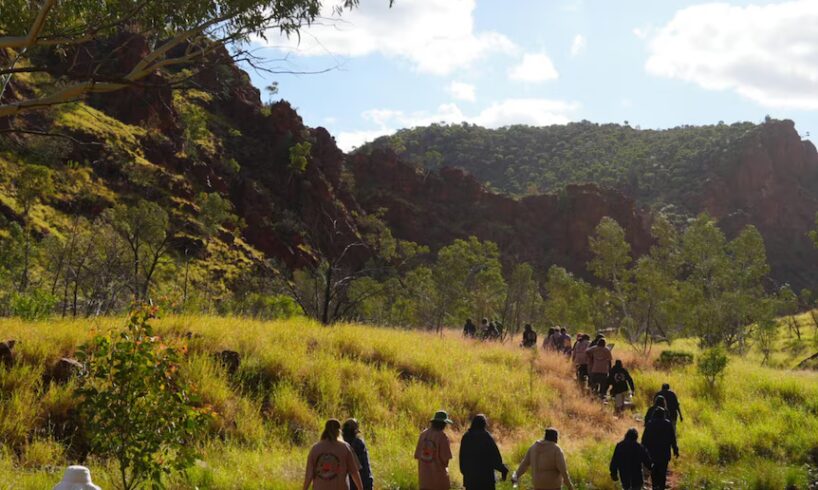
Aboriginal women rangers hiking into N’Dhala Gorge on Eastern Arrernte country. Taken in Central Australia (NT), May 2026.(ABC News: Elsie Lange)
Among the desert landscapes and the magnificent rock formations iconic to Central Australia are the Aboriginal rangers who care for the land.
It is a vocation that has historically been male-dominated, but a recent women’s ranger camp has helped encourage more women to get involved in the protection of sacred sites and stories.
At the base of the towering boulders of N’Dhala Gorge on Eastern Arrernte country, where bright green spinifex climbs the ochre-red rocks, Adrina Williams grinds leaves into a thick pulp using two stones.
The leaves are called arrethe in her language, and she is using them to make bush medicine, which can help soothe skin.
Aboriginal rangers use rocks to grind up the leaves.(ABC News: Elsie Lange) The leaves are used as a type of bush medicine to help soothe the skin.(ABC News: Elsie Lange)
The Eastern Arrernte woman from Harts Range works the leaves like a grandmother might knead bread — back and forth, hitting, pulling and pushing the green against the grey stone.
Ms Williams is one of dozens of Central Land Council (CLC) Aboriginal rangers who gathered at Ross River, east of Alice Springs, last week for the 2026 Women’s Ranger Camp.
The rangers are employed by the CLC, to care for and protect the desert landscapes of their ancestors.
A group of Aboriginal women rangers from Central Autralia strip leaves from twigs, to be used in traditional medicine.(ABC News)
They play a crucial role in environmental and cultural conservation, particularly for the Northern Territory’s women-only sacred sites and practices.
“My grandmother, and my mum and dad, and the elders showed me and taught me how to collect and how to make [bush medicine],” Ms Williams says, the younger woman rangers at her side.
Northern Arrernte woman and CLC women’s land management facilitator, Lille Madden, says the ranger camp is a chance for women from across central Australia to upskill, teach and learn about the work of their counterparts in other regions.
Workshops for the women at this year’s camp included digital storytelling, as well as data collection, surveying and recording.
“Historically in the land management [area], it’s been a very male dominated space — but there are women’s sites, there’s women’s lore and culture and we have to look after and uphold that,” Ms Madden says.
“That’s why we are encouraging more women to join us, to get on board with our ranger teams, to continue to care for our mothers’, grandmothers’, our great-grandmothers’ sites and stories, because that’s ultimately what our rangers do.
“We’re going out to sacred sites, we’re putting up fences, protecting them, checking water, controlling pests, burning country the right way.”
Lille Madden says the camp is a chance for Central Australia’s Aboriginal rangers to share knowledge.(ABC News: Elsie Lange) Rangers will become upskilled through what they learn at the camp.(ABC News: Elsie Lange) Beyond upskilling the camp is a chance for the Aboriginal rangers to focus on their wellbeing and seek support.(ABC News: Elsie Lange)
The ranger camp is also centred around wellbeing, with doctors, lawyers and counsellors onsite to answer questions and provide support, with yoga and nail painting also part of the activities.
It has been a welcome reprieve from the heaviness that has shrouded Central Australia in recent weeks following the search and recovery of Kumanjayi Little Baby’s body.
“The last few weeks have been really intense for our communities and at the beginning of today, we had a minute’s silence [for Kumanjayi Little Baby], to take that time, because especially as women, we are holding a lot in our community,” Ms Madden says.
Josephine Grant (left) was the first Aboriginal woman to coordinate a ranger group.(ABC News: Elsie Lange)
Former ranger Josephine Grant was the first Aboriginal woman to coordinate a ranger group, leading the Anmatyerr rangers based at Ti Tree — she wants to see more women rangers take part in the program.
“Woman power, we want that — to be game, not shame,” she says.
“Coming together [for the camp] is for me a good opportunity to learn from other rangers or [traditional owners].
“We all look after country, we represent our ancestors, and ourselves, our rangers and our community, that’s the whole point of being a ranger — to take care of your country.
“It’s also your identity — your culture is who you are and what you believe in.”
The camp for Aboriginal women rangers was held in the East MacDonnell ranges in Central Australia.(ABC News: Elsie Lange) Danisha Gallagher and Camilla Young were among the Kintore rangers in attendance at this year’s event.(ABC News: Elsie Lange)
There is something especially intimate about the East MacDonnell ranges — they are not as appreciated as their western counterparts, but they do open up, revealing colours and layers the longer you drive and the further you look.
N’Dhala Gorge is part of Helena Buzzacott’s country and as she walks through the ancient, immense formation filled with thousands of petroglyphs, her sense of pride glows.
As Helena Buzzacott stands on her country and looks across the landscape she is filled with pride.(ABC News: Elsie Lange)
“[The ranger camp] is very important, [to give] other ladies who haven’t had the chance, the opportunity to sit down and do bush medicine to watch and learn from the Elders and which plants to use,” she says.
“I feel so proud, it’s really beautiful country, I always have a good feeling coming out here, how my mum used to say, I’m getting those feelings — I can feel the presence of the Elders.
The N’Dhala Gorge where the women spent time during the camp is located at the East MacDonnell ranges on Eastern Arrernte country.(ABC News: Elsie Lange)
Source