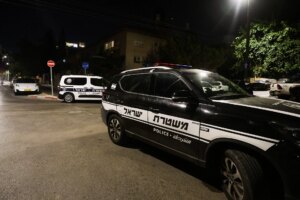
Last month, tempers flared in Haifa’s Western Carmel neighborhood. As reported by Channel 12 News, gunshots rang out across the area. One resident, hearing animal cries outside her home, stepped into her yard to find a row of wild boars lying in pools of blood. One of the carcasses was quickly taken away; the others remained until neighbors called the municipal hotline.
The incident soon reached the Israeli animal welfare group Let the Animals Live and, according to attorney Roni Ben David from its legal team, joined a growing list of recent reports involving boar encounters and shootings in Haifa.
To see whether the apparent rise in boar shootings was backed by data, staff at Let the Animals Live checked the Haifa municipality website for the monthly reports issued by the Israel Nature and Parks Authority documenting a joint culling program. The latest report posted, however, dates back to last year.
When Let the Animals Live asked INPA for updated figures, the group learned that the joint culling program with the municipality had ended at the start of 2026 and that responsibility for the issue now rested solely with the municipality.
Attorney Ben David has filed a Freedom of Information request with the municipality seeking updated 2026 data, but has yet to receive a response.
If the Israel Nature and Parks Authority is no longer involved, and the public and animal welfare groups lack access to information, what oversight remains over the municipality’s actions — and over the boar hunters carrying out the shootings?
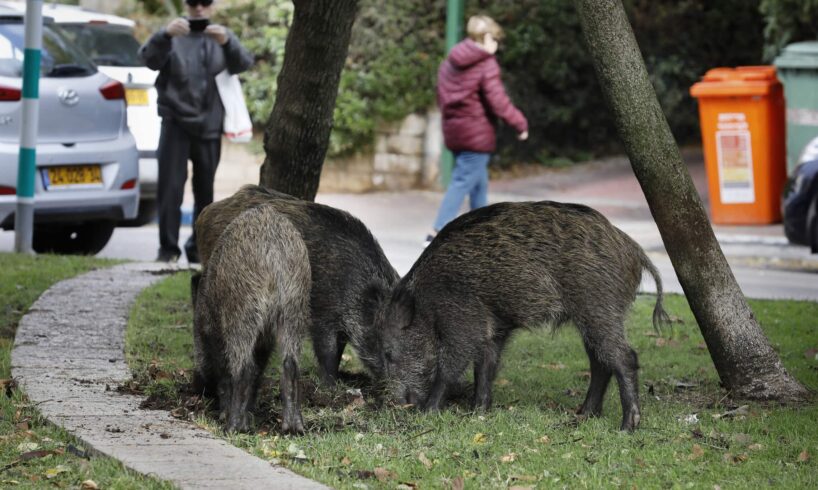
Wild boars in a residential area in the northern city of Haifa on December 5, 2019 (Menahem Kahana / AFP)
Going hog wild
Haifa, built on the heavily forested slopes of Mount Carmel, has long struggled with wild boars venturing out of the natural ravines and into residential neighborhoods to forage for trash and pet food — often tearing up public parks, blocking roads, and terrifying locals in the process.
The joint project of the INPA and the Haifa municipality to reduce friction between residents and the city’s boars was launched in the summer of 2021, during the term of the previous mayor, Einat Kalisch-Rotem. It was supposed to run for five years, but in practice ended after a little more than four.
The ambitious project sought to implement an interdisciplinary approach to solving the problem, based on the understanding among professionals that only a combination of several measures could reduce the friction between people and wildlife.
The work plan included blocking wild boars’ access from the wooded ravines into neighborhoods using fences and gates; increasing garbage bin collection and securing the bins so that the boars could not turn them over; banning the public from feeding boars; and also changing the way cats were fed (since the boars had become their dining partners).
A wild boar trying to access a garbage bin in a public garden in Haifa, April 2, 2024 (RnDmS/iStock)
The final component of the plan, and the most explosive one, is shooting boars defined as “rogue,” meaning those that have already become accustomed to human surroundings and are not afraid of people.
During Kalisch-Rotem’s tenure, the emphasis was on the initial parts of the plan, but implementation was weak, and so were the results. During his election campaign in 2023, current Haifa Mayor Yona Yahav threw around promises of a “total victory,” declaring that within 90 days of taking the mayor’s seat, he would make the boars disappear from Haifa.
And indeed, from the moment Yahav returned to office in early 2024, he charged into the task. His project manager on the issue, David Luria, was appointed the municipality’s director general. But according to a state comptroller’s report published last year, the municipality under Yahav focused mainly on one line of action: shooting boars.
According to the comptroller’s report, while in 2022 the municipality issued 410 fines to residents for feeding boars or feeding cats in violation of the guidelines, in 2024, under Yahav’s rule, only 126 such fines were issued.
The ombudsman further found that, despite the municipality’s commitment to the INPA to increase the frequency of emptying garbage bins, since Yahav took office in April 2024, “the rate of garbage bins that were not emptied was considerably higher than in comparable periods in previous years — 1,592 bins in April–July 2024 compared to 886 in the corresponding period in 2023.”
At the same time, the number of boar shootings soared.
Whereas under the previous city administration, the number of boars killed each month was in the single digits, in May 2024, 204 boars were shot dead in Haifa’s streets. In June, that number was 104. From then on, the pace gradually moderated, down to 10–12 in the final months of 2025.
In the short term, the shootings, combined with the infrastructure work already carried out in the previous term, proved effective.
But at the end of 2025, the INPA withdrew from the project, and the Haifa municipality was alone on the frontline against the boars, which some find very worrying.
A decision to ‘move on’
The dedicated inspector preferred not to be interviewed.
Dr. Amit Dolev, the Northern District ecologist for the INPA, who accompanied the project, believes the concern is unfounded: “The entire project was defined as a five-year project. It turned out that at the end of December, we had completed almost four and a half years, and we reached the conclusion that we had exhausted the process and ended it by mutual understanding.”
A Haifa resident interacting with a wild boar in a public garden, in Haifa, March 30, 2024 (RnDmS/iStock)
“This project was intended to give the municipality backing and tools to work correctly so that it could continue on its own, and we reached a reasonable situation — I won’t say excellent — in terms of friction with the boars, which allowed us to move on,” he said, adding that, “The only thing we can do is make sure they are shooting in accordance with the permits. On all the other components of the project, they said they would continue, but we cannot hold their hand.”
Some residents and animal welfare activists have claimed that the shooting is indiscriminate and that there is no way to make sure only “rogue” boars are being shot.
Dolev claims that, “There is no basis to the claims that things have spun out of control. Indeed, we are no longer compiling a detailed report every month as we did before, but I am not aware that the overall picture has changed,” he added.
Wild boars that were poisoned to death in Nesher, on the outskirts of Haifa. (Oren Chen/Israel Nature and Parks Authority)
Asked if he views the five-year project as a success, Dolev said: “We have reliable indicators that point to an 80-90 percent decline in friction, and to major improvement in the sanitation components as well. What did not take off was public internalization regarding the need to stop feeding them.”
“In the ecological aspect, we achieved decent results, but not in the public aspect,” he said. “The municipality’s hardest task is dealing with the public, and this is not easy for them. In my opinion, that is the weak point that could bring everything down and return the situation to a bad place. This sort of friction exists in many places – in Barcelona, Warsaw and Hong Kong — and in Rome, the mayor is said to have lost the election because of the boars. We are not alone in this.”
A source in the field of nature conservation, who spoke with The Times of Israel on condition of anonymity, sees things differently.
“When the mayor changed, the policy changed,” he said. “Under Kalisch-Rotem, there was much talk and little action. Yahav made it very clear that, as far as he was concerned, the solution was shoot-shoot-shoot, and everything else was less important. But it must be understood that if all the other components of the plan are not carried out, there will be no solution, and there will be a need to keep shooting all the time.”
Protest against culling of wild boars outside the municipality building in Haifa, June 19, 2024 (Omer Sharvit/ Times of Israel)
“In conflicts between humans and wildlife, there is no ‘total victory,’” he continued. “There is no reason to kill thousands of animals for nothing, but when human beings do not know how to make decisions and do not handle the problem systemically and properly, the animals pay the price. That is what happens when people do not want to tell the public the truth and instead hide behind empty slogans.”
Attorney Avital Ben Nun, a veteran Haifa animal welfare activist, is convinced that without the INPA as a balancing and restraining force, and without public transparency, the municipality’s conduct toward the boars will spin out of control. “They are supposed to shoot only rogue boars,” she says, “but in practice, that is not what is happening, and there is no supervising body.”
“We have testimonies of more than 30 boar shooting incidents in which no representative of the INPA was seen in the field, so how can they supervise?” she continues. “Instead of fencing properly and dealing with waste, they shoot and shoot, but all the studies prove that shooting only causes reproduction. I am convinced that the INPA inspector, who was an amazing guy, left because he could not accept what was happening.”
The last report written as part of the joint project ended with these words: “This project is the first of its kind in the world to deal with very high-intensity friction with wild boars in the space of a large city… The results of the work brought about a dramatic change in the intensity of the friction in Haifa, and showed that this is an achievable task that can change reality.”
“The project proved that only” — emphasis in the original — “the inclusion of all the relevant officials and bodies, alongside close cooperation by the public in reducing available food, will lead to a long-term reduction in friction between wild boars and residents.”
Haifa Mayor Yona Yahav attends a Finance Committee meeting in the Knesset in Jerusalem, November 25, 2024 (Yonatan Sindel/Flash90)
‘Sharp drop in the number of complaints’
Asked for comment by The Times of Israel, the Haifa municipality sent the following statement: “The municipality continues to operate professionally, consistently and responsibly in accordance with the policy formulated by the Israel Nature and Parks Authority and in full coordination with it, intending to return the wild boars to their natural habitats in the wadis and forests.
“As part of this, the municipality is working to increase cleanliness in the public space, reduce garbage and feeding hotspots, enforce the law against those who feed wild animals, and fence off and block entry routes into residential neighborhoods, alongside dealing with ‘rogue individuals’ that pose a danger to the public.
“Thanks to this policy, the number of wild boars currently seen in the city’s residential neighborhoods has declined very significantly, alongside a sharp drop in the number of complaints received by the municipal hotline and in the damage they cause.
“Accordingly, there has also been a drastic decline in the number of wild boars killed, which currently stands at only about 10 boars a month. In total, 32 wild boars have been culled over the past three months.
“The Israel Nature and Parks Authority inspector who worked in the city was recalled in coordination with the municipality, among other reasons due to the significant decline in the scope of wild boars observed in residential neighborhoods. At the same time, the INPA continues to guide the municipality and regularly supervise its activity in the field.”