The Nottinghamshire trust was responsible for discharging triple killer Valdo Calocane months before his brutal attacks
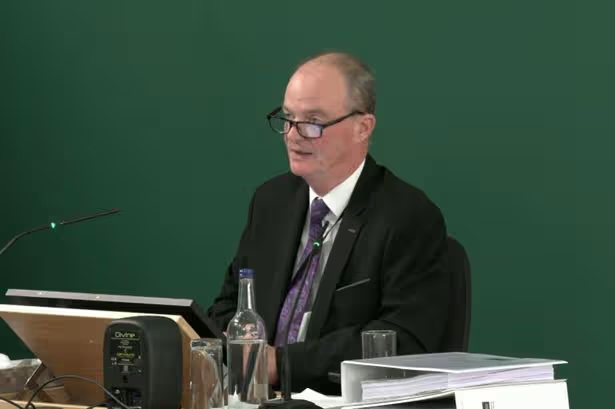
Dr John Brewin, the former Chief Executive of the Nottinghamshire Healthcare NHS Foundation Trust (Image: Nottingham Inquiry)
Nottinghamshire’s mental health services were in such a bad state in the years before the Nottingham attacks that its boss feared they would be ‘threatened with closure’.
The Nottinghamshire Healthcare NHS Foundation Trust (NHFT) sectioned triple killer Valdo Calocane four times in the run-up to his brutal crimes of June 13, 2023.
Yet the trust made the decision to discharge Calocane back to his GP in September 2022 – just months before the attacks – because healthcare staff ‘lost’ him.
An inquiry into the killings of Barnaby Webber, Grace O’Malley-Kumar and Ian Coates has now been told about the ‘crisis point’ that NHFT reached whilst Calocane was in their care.
A key email was referenced at the Nottingham Inquiry’s hearing on Monday (May 18) in which Dr John Brewin, NHFT’s boss between 2018 and 2022, described how unsafe services were.
Dr Brewin said in the October 2021 email that he and colleagues “met with some ward managers this lunchtime and had a very sobering and at times harrowing conversation about their concerns”.
The email said: “We have reached a point where the services are not safe and we need an immediate response to support them.
“There is a sense of despondency that, despite flagging this since at least June, nothing has happened. If the CQC arrived, we would be threatened with closure.”
The regulator ended up threatening the trust with urgent enforcement action just months ago after an unannounced inspection.
The January 2026 inspection took place at Highbury Hospital in Nottingham and Sherwood Oaks Hospital in Mansfield.
Documents about that inspection, published in March, said: “Following the visit, the CQC raised a number of concerns and informed the Trust that it was considering urgent enforcement action under Section 31 of the Health and Social Care Act.”
Section 31 of the Health and Social Care Act says that if the CQC believes that, unless they act, any person will, or may be at risk, of harm, it can vary or remove a condition of an operation or suspend an operation entirely.
The CQC’s concerns related to risk management, including the handling of patient property, incorrect records of what they had in their lockers and a lack of knowledge of how at risk patients were of tying ligatures around their necks.
The trust said that, after the CQC inspection, the regulator had not taken the threatened action.
The official report from the regulator, with explicit details of what was found and the concerns, is still pending.
Although Ifti Majid was the Chief Executive of NHFT at the time of the Nottingham attacks, Dr Brewin was the chief executive for the bulk of Calocane’s contact with the trust, including his four hospital admissions.
Nottinghamshire Healthcare NHS Foundation Trust is based at Highbury Hospital in Nottingham (Image: Joseph Raynor/ Nottingham Post)
Dr Brewin left the trust in August 2022, meaning he was not in post when the critical decision was made to discharge Calocane back to his GP.
Dr Brewin wrote in his witness statement to the inquiry about his first impressions of NHFT upon joining in 2018, writing: “Internal processes and bureaucracy were impeding progress, with an over-reliance on discussions about cost improvements, compliance, efficiency and processes rather than patients, quality and outcomes.”
The former NHFT boss said there was already a feeling when he took on the role in 2018 that the trust was “in decline” and that the programme of improvements he wanted to roll out would have taken “four years minimum” to implement.
The key issue raised by Dr Brewin was around staffing and how that impacted upon NHFT’s ability to do proper risk assessments in terms of its decisions around patients.
The inquiry was told about the improvement plan that was brought in following the October 2021 email from Dr Brewin that described critically unsafe services.
One of the elements of the improvement plan was that ward managers should stop undertaking investigations into serious incidents until April 2022.
“This was a crisis point. This wasn’t just done on a whim. We needed to free up senior experienced clinical time to help keep the clinical wards viable, and this is what we did,” Dr Brewin explained.
Craig Carr, a key member of the Nottingham Inquiry’s legal team, asked Dr Brewin: “The downside presumably is if you’re not investigating serious incidents, then you’re losing the ability to monitor the safety of the service that you’re providing?”
Dr Brewin replied: “Not necessarily losing the ability, but reducing the ability. There will be other people continuing to do investigations, not just the ward managers. This was decreed by NHS England at the start of the pandemic, in terms of what governance could be stood down or slowed.”
Another element of the improvement plan was the “increased use of discharge”.
Mr Carr asked if the improvement plan brought in after October 2021 essentially boiled down to “trying to reduce the patient load”, to which Dr Brewin replied: “Yes.”
A senior consultant psychiatrist at NHFT previously told the Nottingham Inquiry that the decision to discharge Calocane back to his GP in 2022 was “the wrong decision”.
Mr Majid repeatedly resisted calls to resign over his trust’s failings in relation to Calocane, before eventually announcing his retirement in November 2025.
The chief executive will officially end his time at NHFT in June and Mark Axcell will take over.