2026-05-18T19:27:55+00:00
font
Enable Reading Mode
A-
A
A+
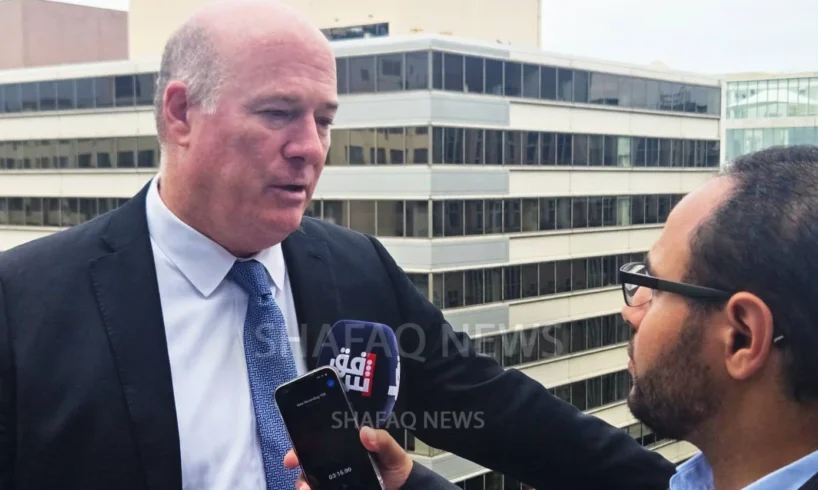
Shafaq News- Washington
The United States’ main concern in
Iraq is the possibility of the country becoming “a subordinate state of Iran,”
former Pentagon official and Near East South Asia Center for Security Studies
associate professor David Des Roches told Shafaq News on Monday, warning that
such a trajectory could turn Iraq into “basically an Arab province of Iran with
a UN seat.”
Iraq’s Ties with Tehran
Des Roches described the Iraqi
government’s effort to balance relations with Washington and Tehran as “the art
of governance,” while arguing that Iraq’s dependence on Iranian electricity
gives Tehran continued leverage over Baghdad.
“Iraq should have its own
electricity; it should not need to import electricity from any other country,”
he said. “If they can keep Iraq from developing its own electricity grid,
they’ll always have a way to get hard currency, even under American sanctions.”
He also claimed that armed groups
aligned with Iran continue to influence Iraqi politics and security decisions.
“There are people with guns in Iraq who take orders from Iran,” he remarked,
while expressing confidence that Iraq would ultimately preserve its
independence. “You cannot keep a nation as great as Iraq subordinate.”
Trump and Regional Policy
Discussing US policy, Des Roches
portrayed President Donald Trump as more pragmatic than ideological in his
approach to regional issues. He pointed to Trump’s rapid lifting of sanctions
on Syria’s new leadership after the fall of Bashar al-Assad.
“I was shocked by how quickly he
lifted sanctions,” Des Roches said, explaining that he had expected a gradual
easing tied to political benchmarks. “But instead, he’s just wiped them all
out.”
According to Des Roches, Trump views
economic development as beneficial to both the United States and Iraq. “I think
President Trump wants to see Iraq succeed,” he added, noting that sanctions
could still be reimposed if Iraq’s leadership failed to meet expectations.
Gulf States and the Iran Conflict
Des Roches said Gulf Cooperation
Council (GCC) countries denied US and Israeli forces access to bases and
overflight routes during military operations targeting Iran. “If we had been
able to launch from bases in the GCC, we could have dropped twice as much
ordnance on Iran,” he explained.
Tehran, he argued, sees Dubai’s
economic model as a challenge. “Why is this place prosperous? Why is this a
global center of learning, of culture, of commerce, and we’re not?” he said,
describing what he believes is Iran’s perspective. He added that Tehran seeks
“control” over neighboring countries, calling it “the action of a conqueror,
not a neighbor.”
Washington and Tel Aviv
Des Roches rejected suggestions that
Israel requires US approval before launching military operations, citing
previous Israeli strikes in Lebanon, Iraq, Syria, and Tunisia as examples of
unilateral action based on Israeli calculations.
“When Israel sees a security
interest, they don’t wait for a green light from the United States,” he said.
Still, he argued that Washington and
Tel Aviv may diverge politically after achieving their current military goals
against Iran. While both countries seek to weaken Iran’s offensive
capabilities, Des Roches said the United States prefers political change driven
internally by Iranians themselves rather than externally imposed regime change.
For Shafaq News, Mostafa Hashem,
Washington, DC.