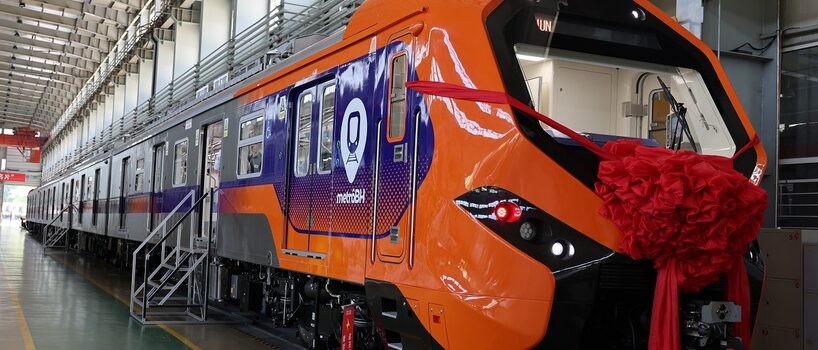
The Brasília metro, in Brazil’s capital, has launched the bidding process to purchase 15 trains, under a contract estimated at around 1 billion reais (US$195 million), which is likely to generate yet another chapter in the fierce competition between Chinese manufacturers and other international players already established in the country.
“METRÔ-DF hereby makes public the holding of an in-person bidding process, with an open competition mode and lowest-price evaluation, aiming at the integrated contracting of specialized engineering services for the development, manufacturing under technical specifications, integration, testing, commissioning, and operational delivery of 15 (fifteen) EMUs – Electric Multiple Units, each consisting of four cars, with an A+B+B+A arrangement, intended for operation in the metro system of the Companhia do Metropolitano do Distrito Federal – METRÔ-DF”, said the subway operator of the country’s capital, through the Official Gazette.
Interested companies may submit their respective proposals until September 15, at 10 a.m.
The purchase of trains is taking place amid plans to expand the metro. Currently, the DF metro is carrying out expansion works on Line 1, while preparing a tender for an extension to Ceilândia, adding 6 km to the current network and building new stations.
In addition, the Federal District government announced progress in the studies for the construction of the future Line 2, with an estimated value of 20.4 billion reais. Line 2 should be about 60 kilometers long.
Disputes with China
The tender for the purchase of trains in Brasília is expected to generate yet another chapter in the intense dispute the sector has seen between Chinese manufacturers and others that have been established in the country for longer.
In recent tenders held by other subway and passenger train system operators in Brazil, companies such as the Chinese CRRC have been gaining traction, increasing competition for other companies in the segment, such as the French Alstom, the Spanish CAF and the Brazilian Marcopolo, among others.
In the most recent episode of the dispute between the companies, at the beginning of this year, CRRC Changchun had won a tender to sell 10 trains to the Salvador subway, offering a price of 490.4 million reais, lower than the proposal submitted by Alstom, of 614.4 million reais.
In June of this year, the bidding commission announced the disqualification of CRRC, alleging non-compliance with a requirement in the tender notice related to accreditation with the National Bank for Economic and Social Development (BNDES), which would result in Alstom’s victory in the contract.
However, after appeals filed by the Chinese company, Salvador’s subway system published CRRC Changchun’s victory in this week’s Official Gazette.
As part of the efforts of companies that have been operating in Brazil for a longer time, the Brazilian Railway Industry Association (Abifer) argues that the bidding process in Brasília should take place in person rather than via electronic auction.
“We are talking about a contract that involves a large volume of resources and sophisticated equipment. That is why we have to ensure complete transparency in the process. In electronic tenders, it is often not clear who is actually behind the proposals submitted,” Vicente Abate, president of Abifer, told BNamericas.
In recent years, Chinese companies have expanded their operations in several areas in Brazil, generating criticism from manufacturers already established in the country, amid suspicions that such companies enjoy favorable conditions in terms of loans, taxes, and labor costs, supported by the Chinese government, which would place them in an advantageous competitive position.
One of the segments that has suffered the most from Chinese competition is steel, which has seen high levels of imports affect local production.
In addition, in the vehicle segment, electric automobiles produced by Chinese companies have been taking to the streets of Brazil. Recently, Anfavea, the association of motor vehicle manufacturers in Brazil, issued a manifesto asking the federal government not to renew the benefits for the import of pre-assembled electrified vehicles, a measure that would favor Chinese manufacturers, including BYD; however, the federal government renewed these benefits.
Local companies view with reluctance the growing potential of Chinese participants in the Brazilian market, since such companies tend to subcontract only other Chinese companies.
On the other hand, despite pressure from local companies and other countries, the Brazilian government sees limited room for action, seeking to avoid diplomatic tensions with China.
Currently, China is Brazil’s main trading partner and, thanks to Chinese appetite for Brazilian products, Brazil has so far managed to mitigate problems in its trade balance amid the constant tariff threats posed by the administration of United States President Donald Trump.
“The Chinese presence in various contracts in Brazil has indeed generated discomfort among local companies, but the scope of action for the Brazilian government is very limited. Today, from a commercial standpoint, Brazil depends on a good relationship with China to counterbalance the constant tariff threats coming from the United States,” André Pereira César, political analyst at Hold Consultoria, told BNamericas.
(The original version of this content was written in Portuguese)