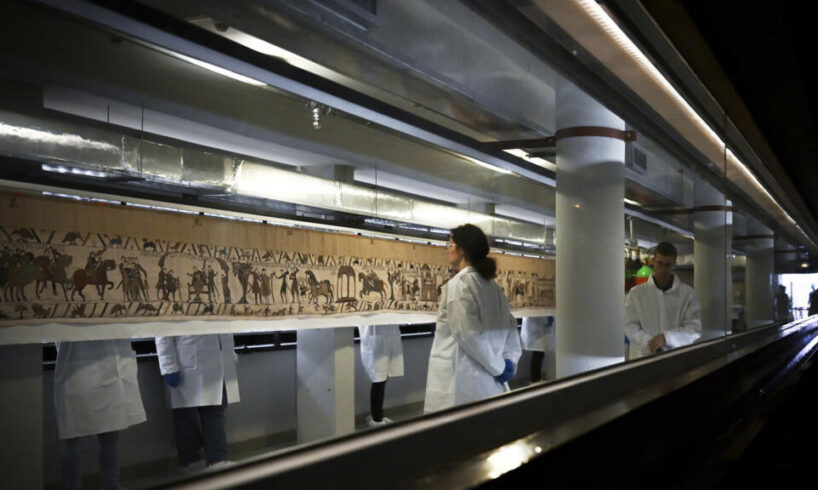
Under cover of darkness and heavy police guard, the Bayeux Tapestry – a 68-metre embroidered chronicle of the Norman conquest of England, stitched in wool not long after the events it depicts – is set to cross the Channel within days, the official overseeing its move to London has revealed.
Issued on: 09/07/2026 – 13:17
3 min Reading time
Peter Ricketts, the UK’s Bayeux Tapestry envoy, would not be drawn on exactly when the nearly 1,000-year-old “incredibly fragile” embroidery would leave its home in Normandy for the British Museum.
“We don’t want any untoward incidents happening. And so that’s why we’re keeping the exact details and date confidential,” he said of the tightly guarded operation surrounding the 11th-century artwork.
Millions of visitors expected
Once it does go on show, though, he wants as wide an audience as possible: “When it’s ready to be exhibited, we want millions of people to see it.”
The loan was first unveiled exactly a year ago, on 8 July 2025, when Keir Starmer and Emmanuel Macron announced it during a state visit to Britain. The UK government’s press release at the time called the piece “one of the most treasured artworks in the world.”
France to return iconic Bayeux Tapestry to Britain for first time in 900 years
That anticipation has already shown in ticket sales: the museum shifted 100,000 on the first day of booking alone, a figure Ricketts said did not surprise him. The show runs from 10 September to 11 July 2027.
Few episodes of English history are as well known as the one the tapestry records: every schoolchild learns the date 1066, when William the Conqueror’s Norman forces defeated King Harold at Hastings, a victory stitched across the work’s length. Fewer people, Ricketts noted, have actually seen the tapestry, or visited Bayeux, where it normally hangs.
Death of King Harold during the Battle of Hastings- Tapestry of Bayeux, Scene 57. © Myrabella, Public domain, via Wikimedia Commons
Historians have long puzzled over exactly who made it, and why. Its London appearance will be a first: it has never before left France for public display abroad.
Moving it safely required rolling the fabric “like a curtain” into a purpose-built case fitted with climate and vibration controls, Ricketts explained.
From there the route is straightforward: “It will come on a truck, and it will come under the Channel tunnel on the shuttle service, and then it will be driven straight to London, to the back of the British Museum.”
Concerns about the risks did not shake his confidence, he said, crediting conservation specialists who spent months working through the logistics rather than ruling the move out.
Bayeux leave? 45,000 sign petition to halt tapestry’s loan to British Museum
The tapestry is covered by an £800 million (roughly €937 million) “indemnity scheme” that functions as insurance policy underwritten by the Treasury, though Ricketts stressed the goal is to ensure that cover is never needed.
In London, visitors will see the tapestry lying flat for the first time, inside a custom glass case, the product of what Ricketts called a carefully choreographed effort involving some 80 conservators.
He likened the anticipated impact to that of the British Museum’s 1972 Tutankhamun exhibition, which pulled in 1.69 million visitors and reshaped public fascination with ancient Egypt.
Queen Elizabeth II inaugurates the exhibition The Treasures of Tutankhamun on March 30, 1972 at the British museum of London. AFP – –
“I think the tapestry will have the same effect,” he said, predicting the show would leave visitors with a lasting impression – and shift how they think about the past.
(With newswires)