Open this photo in gallery:
Edward Regan/The Globe and Mail
In 2011, Canadian country music icon Tommy Hunter performed at the Memorial Centre in Red Deer, Alta., part of a long farewell tour that wrapped a bolo tie around six decades of show business. A local disc jockey whose wardrobe typically consisted of a radio station T-shirt, blue jeans and Converse sneakers made sure to wear a suit, tie and his lone pair of sophisticated shoes to introduce Mr. Hunter to the full house.
But when the two met backstage preshow, Mr. Hunter looked the radio host up and down with a furrowed brow of disappointment. The veteran entertainer briefly disappeared before reappearing with a white napkin, which he deftly manipulated as he told the younger man that one should always have a pocket square to complete one’s look, and that a properly folded serviette could substitute in a pinch.
“Mr. Hunter was so welcoming and exuded the same type of electric aura I experienced meeting Kenny Rogers,” said Greg Shannon, one-time morning-show host and pocket-square-lacking personality with CKGY-FM. “He was incredibly astute, with high standards and an inherent ability to entertain, and a class act who was always impeccably dressed.”
Mr. Shannon had received a pro tip from a consummate professional known as Canada’s Country Gentleman. Mr. Hunter, who hosted CBC’s The Tommy Hunter Show weekly from 1965 to 1992, died on July 2 of natural causes in a retirement home in his hometown of London, Ont., according to his long-time business manager, Brian Edwards. He was 89.
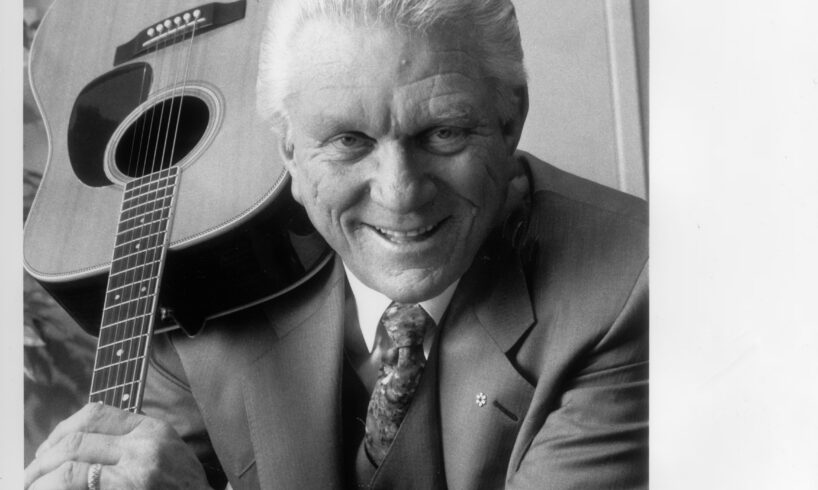
Mr. Hunter was a smooth-singing guitarist and a strapping man of 6-foot-3, with a pompadour that added an inch to his height at least. His deep-set blue eyes twinkled and his broad face broke easily into a smile as he showcased stars such as Johnny Cash and introduced Michelle Wright, Garth Brooks, the Judds and a teenaged Eilleen Twain (later known as Shania) to Canadians.
At one time he was managed by Saul Holiff, a fellow Londoner who counted Mr. Cash among his clients.
Mr. Hunter signed off his shows with, “Be the good Lord willing, I’ll see you next week.” And for an extraordinary run of 27 years, Mr. Hunter was a reliable presence whose prime-time career began in black and white and ended in colour, spanning five prime ministers.
Like Hockey Night in Canada, doilies and rabbit-ear antennas, The Tommy Hunter Show was a fixture on Canadian television sets, first as a 30-minute country-and-western program on Sundays at 7 p.m., then as an hour-long show on Fridays at 9 p.m.
Open this photo in gallery:
Denise Grant/The Canadian Press
The young star Anne Murray appeared on the variety show for the first time in 1972, when her recording of Danny’s Song was high on the U.S. and Canadian charts. The Nova Scotian singer spoke on CBC Radio’s As It Happens after Mr. Hunter’s death.
“In those days, Maritimers were painted with the same brush: bumpkins. But he wasn’t like that at all. He took me under his wing and treated me like a queen.”
Mr. Hunter’s career in country music television began in 1956 when he joined CBC’s Country Hoedown as a guitar-playing cast member and then a featured singer. The Tommy Hunter Show was a five-days-per-week radio show in the early 1960s before it moved to television in 1965.
Mr. Hunter was raised on Saturday night broadcasts of the Grand Ole Opry from Nashville. The country music heroes of youth, including Hank Snow, Ernest Tubb, Roy Acuff, Eddy Arnold, Roy Rogers, Dale Evans and others, would appear on his television show.
“I was like a kid in a candy shop,” he told CBC Television’s George Stroumboulopoulos in 2012. “I had the best seat in the house.”
Despite his status as Canadian TV’s biggest draw for a time (3,116,000 viewers a week in 1970), the son of a railway man wore his stardom lightly. He was the same on air as he was off it. “It’s easier that way,” he said in 1971.
Ms. Murray remembered Mr. Hunter as genuinely warm. “You can’t fool an audience, certainly not for that long,” she said. “He was truly a gentleman.”
Country music television was in vogue in the late 1960s and into the early 1970s. But where CBS’s Hee Haw relied on cornball humour and sets adorned with haybales, Mr. Hunter resisted barnyard imagery, wore a city suit and sang without a mannered twang.
“My competition, I always felt, was The Perry Como Show and The Andy Williams Show,” he told The Globe and Mail in 2011. “I was always hitting that kind of professionalism, the slick-looking show.”
Mr. Hunter released LPs on Columbia Records and its Harmony label, as well as RCA Records. Although he performed at the Grand Ole Opry in Nashville and won the RPM Gold Leaf Award (a precursor to the Juno Award) as Canada’s top male country artist in 1970, he concentrated on his television career and touring dates.
“I’m not comfortable in a recording studio,” he told The Globe in 2007. “Some artists can walk in. They’ve sung [a song] on the road, and they performed it, phrased it and changed it. And pretty soon they say, ‘That’s one I’ve got to record.’ So, they go into a recording studio and they paint pictures, wonderful pictures. I was not that kind of performer.”
Still, a number of his singles cracked the Top 10 of the Canadian country chart between 1967 and 1975: Cup of Disgrace, The Battle of the Little Big Horn, Half a World Away, Walk With Your Neighbour, Wait for Sunday, Bill Jones’ General Store, Born to Be a Gypsy and Mary in the Morning (a modest hit in the U.S.).
Through his own label, Edith Records (named after his mother), he released albums including the 1995 gospel LP, Songs of Inspiration Vol. 1.
CBC cancelled The Tommy Hunter Show in 1992. The national broadcaster sent a junior executive to Mr. Hunter’s part-time home in Florida to deliver the bad news over lunch, according to his business manager. “It was a shock to him,” Mr. Edwards said. “And the way it was handled bothered him.”
Sacking him after the season deprived Mr. Hunter of the chance to thank the people he worked with and say goodbye to his television audience. He got the opportunity with 2003 CBC special, Tommy Hunter: Talk About the Good Times.
“It isn’t everyone who gets a chance to live out their dream in life,” he said, his voice cracking with emotion as sentimental music played. “I’m one of the lucky ones.”
He then sang his theme song, Travellin’ Man, written by Al Rain: “I am a travelling man, following the breeze / Travelling here and travelling there, gathering memories / So let me wander…”
Thomas James Hunter was born in London on March 20, 1937, the only child of Canadian Pacific Railway worker James William Hunter and homemaker Edith Gwendoline Mary Hunter (née Stunden).
As a boy he saw a newspaper advertisement for a concert at the London Arena by Roy Acuff and His Smoky Mountain Boys and Girls. He pestered his father for a ticket to a performance that proved to be a revelation.
“From the moment Roy Acuff and the other performers came onto that stage, I was completely and totally mesmerized,” he wrote in his 1985 biography, My Story, written with Liane Heller. “I was nine years old, and I’d just found my best friend: country music.”
He took $1 guitar lessons from Edith Hill Adams, whose squawking parrots were a distraction. His first public performance, a class recital at a church on Hamilton Road at the age of 10, was a disaster. He barely played a note of the pop hit Drifting and Dreaming.
“I was just so petrified with fear that I just stood there in my white pants, suit and bow tie, clutching my guitar for dear life,” he wrote.
He quit H.B. Beal Secondary School at 16 to pursue a musical career. He regularly appeared on the live show, Main Street Jamboree, which aired on CHML-AM radio in Hamilton. Moving to Toronto and waiting for his union membership to transfer from the London local, he lived at the West End YMCA, sold paint at Eaton’s for $33 a week and survived on bread, milk and peanut butter to pay for publicity photos.
Mr. Hunter’s life in country music television began in 1956 when he joined CBC’s Country Hoedown, which also featured a pre-fame Gordon Lightfoot in the early 1960s as a member of the Singin’ Swingin’ Eight. Mr. Lightfoot was one of the many guests to appear on The Tommy Hunter Show, one of the most durable and endearing music programs in North American TV history.
Essentially a Canadian version of the Grand Ole Opry, the show was carried for a time in the United States on the Nashville Network. Mr. Hunter diversified his show’s appeal by using music that was outside the country field. “We don’t radically follow modes,” he told The Globe in 1970.
After being told in the Florida lunch meeting that his show had been cancelled, Mr. Hunter returned to Canada wearing sunglasses at the airport because he was ashamed. “I felt like I had failed,” he said later.
Free of network commitments, he toured Canada and the northern United States with his band. He gave the final concert of his lengthy farewell tour at the John Labatt Centre in London in 2012 on his 75th birthday.
One of those in attendance was CBC television and radio journalist Tom Harrington, who actually appeared on The Tommy Hunter Show as a member of the St. John’s singing group the Sanderlings as a boy in the early 1970s.
“Because he’s been out of the national spotlight for so long, many people don’t recall the impact Tommy Hunter had on Canadian music,” Mr. Harrington said in an interview. “Shania Twain made her national TV debut on his show as did many others. I’m stunned he never got his spot on Canada’s Walk of Fame, and I nominated him twice. It is a dreadful oversight.”
Mr. Hunter was made a Member of the Order of Canada in 1986.
He leaves behind his second wife, Andrea Hunter; children, Jeff Hunter, Greg Hunter and Mark Hunter; and four grandchildren and one great-grandchild.
You can find more obituaries from The Globe and Mail here.
To submit a memory about someone we have recently profiled on the Obituaries page, e-mail us at [email protected].