Listen to this article
Estimated 4 minutes
The audio version of this article is generated by AI-based technology. Mispronunciations can occur. We are working with our partners to continually review and improve the results.
Canada’s economy added 18,000 jobs in June, continuing the momentum in the job market seen the month before.
According to data from Statistics Canada released Friday, the moderate addition of jobs helped edge down the unemployment rate slightly to 6.5 per cent, matching where the rate was in January.
Analysts polled by Reuters had forecast a net of 10,000 job gains, following a big jump of 87,800 jobs in May, and they had estimated the unemployment rate at 6.6 per cent.
Statistics Canada said the job gains in June were largely concentrated in part-time work and in accommodation and food services and wholesale and retail trade.
Given the concentration of jobs in part-time work and industries like food service and retail trade, BMO chief economist Doug Porter says the figures shouldn’t be taken as too much of a positive sign as the hiring might be temporary around the World Cup.
“While an encouraging result overall, one shouldn’t mistake this as a show of strength,” Porter wrote in a note to economists.
Given the possible FIFA-related impact, CIBC economist Andrew Grantham says its possible the recent employment growth could stall once the event is in the rear-view mirror.
On the other side of the ledger, job losses in the manufacturing sector to the tune of 17,000 positions were a drag on the figures. That industry is down some 61,000 jobs since a recent peak in January 2025 as U.S. tariffs continue to weigh on the sector, Statistics Canada said.
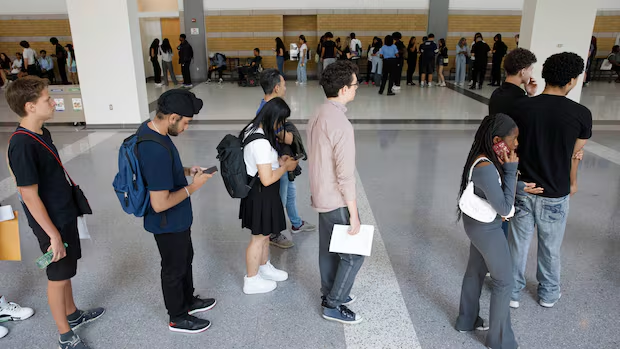
Despite trouble faced by young workers in recent years, the figures for June proved positive overall for young job seekers.
The unemployment rate among youth fell 0.7 percentage points to 12.7 in the month, as 33,000 positions were added for workers between the ages of 15 and 24.
While the unemployment rate in this category has improved in the last two months, Statistics Canada said it still remains higher than the pre-pandemic average of 10.8 per cent observed during the period from 2017 to 2019.
Jobs data also indicates a better student summer job market than last year. The unemployment rate for students planning to return to school in the fall was 15.3 per cent last month — down 2.1 percentage points from June 2025. But in this category, too, the rate was still higher than the pre-pandemic average of 13 per cent.
WATCH | What’s behind Canada’s youth unemployment?:
Why young people are having trouble finding a job
Young workers are finding it harder and harder to get a job. New numbers show Canada has lost around 95,000 jobs so far this year; almost half of those were held by people aged 15 to 24. What’s behind our persistently high youth unemployment?
Returning students mostly found employment in the retail trade, accommodation and food services, and information, culture and recreation sectors in June.
Average hourly wages of permanent employees, a metric closely tracked by the Bank of Canada to gauge inflation expectations, also grew 3.7 per cent in June, a rise from 3.2 per cent in May.
In all, BMO’s Porter noted that Canada churned out some moderate job growth in June after a rocky start to the year, in which Canada lost a net 112,000 jobs in the first four months of 2026.
“In other words, it doesn’t take a lot of new jobs — up just 0.5 per cent in the past year — to pull down the jobless rate when the population is ebbing,” Porter wrote.
CIBC’s Grantham and Porter both said the mild report likely won’t do much to encourage the Bank of Canada to move interest rates.
The next interest rate decision is on Wednesday, and Friday’s jobs report was the last major look at the state of the economy for the central bank before then.