[SINGAPORE] Singapore Airlines (SIA) said its investment in Air India gives the national carrier access to growth opportunities that cannot be fully realised through a single hub model, where flights connect only through one airport.
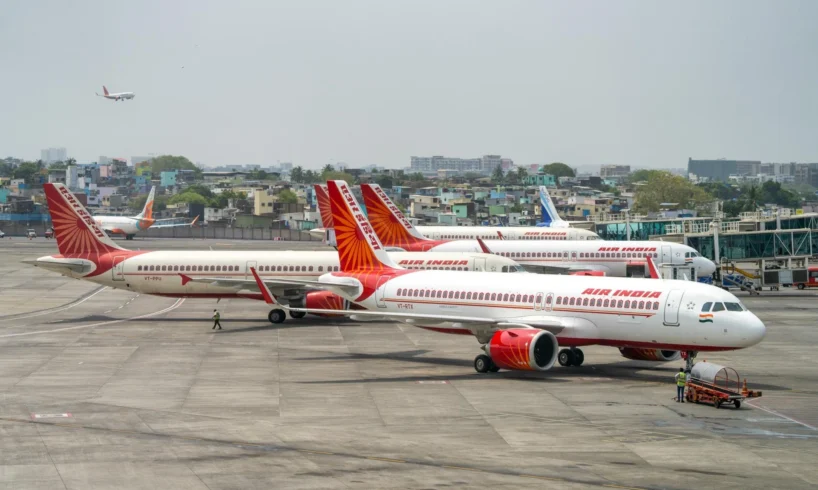
SIA, the only non-Indian airline group with a direct stake in India’s aviation market, owns 25.1 per cent of the enlarged Air India following its merger with former associate Vistara in November 2024.
“The Air India investment provides direct access to India’s domestic market and international flows via Indian hubs, complementing the Singapore hub and supporting growth opportunities that cannot be fully realised through a single-hub model,” SIA said.
The group was responding to questions from the Securities Investors Association (Singapore) – or Sias – on Friday (Jul 17), ahead of its annual general meeting on Jul 24.
Sias had asked the airline to elaborate on the role it expects to play in Air India’s turnaround.
It also sought clarification on how the investment differs strategically and operationally from SIA’s earlier investments in Air New Zealand, Virgin Atlantic and Virgin Australia.
In its reply, SIA acknowledged that Air India continues to face well-publicised challenges. These include high fuel prices, the depreciation of the Indian rupee against the US dollar, supply chain disruptions, the closure of Pakistani airspace to Indian carriers, as well as the Air India Flight 171 accident in June 2025.
But the group defended its investment, noting that Air India has made “tangible progress” in its transformation across the customer journey and experience, fleet and network growth, on-ground and in-flight products and services, and operational performance.
SIA said these efforts have resulted in “significant improvements” in Air India’s net promoter score, a widely used measure of customer satisfaction, and added that the carrier has also received several independent industry awards.
SEE ALSO
As a significant minority shareholder, SIA said it remains committed to supporting Air India’s transformation alongside its partner, Tata Sons.
Its support includes strategic oversight, with SIA CEO Goh Choon Phong serving as a non-executive, non-independent director on Air India’s board. This allows SIA and Tata Sons to provide strategic guidance to the airline’s management.
SIA contributes aviation expertise to support Air India’s transformation programme as well.
Goh previously said the Air India investment fits into the group’s multi-hub strategy to compensate for the lack of a domestic market.
Investment limits
Sias also asked whether SIA’s board has established clear capital allocation parameters or investment limits for Air India, and under what circumstances it would consider approving additional capital.
The association noted that SIA’s share of losses from Air India amounted to S$945.2 million, while the group’s operating profit rose 39 per cent to S$2.4 billion, for the financial year ended Mar 31, 2026.
At the end of the fiscal year, the carrying value of SIA’s investment in Air India stood at S$1.1 billion, down from S$2 billion the year before. Air India reported net liabilities of S$1 billion after posting a net loss of S$3.8 billion for the year.
In response, SIA said the group’s capital allocation follows a “disciplined evaluation process” that takes into account operating cash flow, investment requirements for new aircraft and products, as well as strategic investments such as its stake in Air India, to support sustainable long-term growth and returns.
Forward guidance
Sias asked whether SIA had considered adopting a structured forward guidance framework for FY2027, in line with Singapore Exchange Regulation’s encouragement of such disclosures and its view that they can enhance investor confidence and credibility.
SIA responded by clarifying that it does not practise a formal quantitative forward guidance framework, citing uncertainties in the highly cyclical and volatile aviation industry.
The group’s financial performance “can be materially influenced by external factors such as jet fuel prices, foreign exchange movements, demand conditions, and evolving geopolitical and macroeconomic developments”, it added.
Nevertheless, SIA said it remains committed to transparency through regular disclosures such as monthly operating results, quarterly financial announcements, as well as annual reports and updates on business performance and capital expenditure plans.
On board renewal and succession planning, Sias asked about the continued appointments of Dominic Ho and Simon Cheong as non-independent, non-executive directors after they cease to be classified as independent directors due to their tenure.
It also queried how the nominating committee balances board continuity with progressive renewal, and whether there was a formal board renewal road map.
SIA replied that its nominating committee concluded that the institutional knowledge of both Ho and Cheong remains valuable as the group navigates a dynamic operating environment.
“Board renewal is therefore approached in an orderly manner, balancing continuity with progressive renewal, ensuring changes are made thoughtfully and with due regard to the long-term interests of SIA and its stakeholders,” it said.
Shares of SIA closed Friday 0.5 per cent or S$0.04 higher at S$7.65.