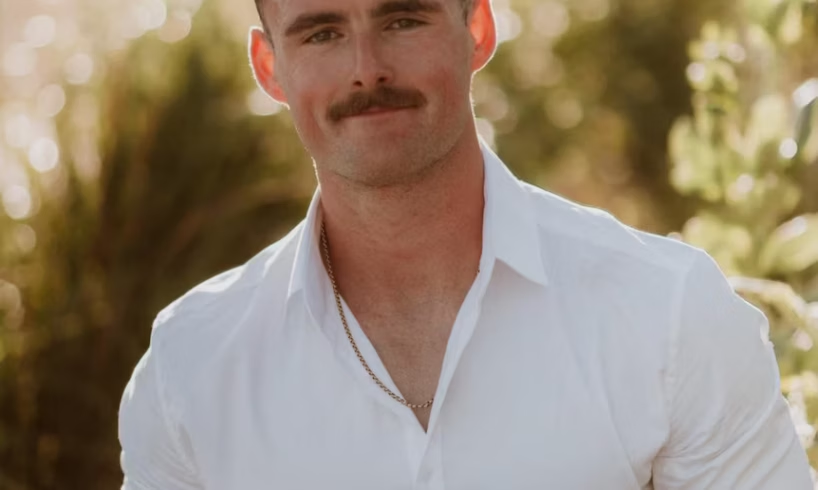
Alec White-Cheshire knows too well the damage an eating disorder can do.
First diagnosed at 10 years old, he has been living with anorexia for almost two decades.
If you or anyone you know needs help:
Suicide Call Back Service on 1300 659 467Lifeline on 13 11 14Aboriginal & Torres Strait Islander crisis support line 13YARN on 13 92 76Kids Helpline on 1800 551 800Beyond Blue on 1300 224 636Headspace on 1800 650 890ReachOut at au.reachout.comMensLine Australia on 1300 789 978QLife 1800 184 527
It has, he tells the ABC, affected every part of his life: his thoughts, his relationships, even the way he understands the world.
“I have 20 years of living with it,” he says.
“I developed as a child with an illness, which has now become entwined into who I am.
“And that’s the hardest part to come to terms with.
“You want to feel like this never existed or that you’ll never have these thoughts again. But I think the harsh reality is there are certain things you’ve learned over the years … which will be there forever.”
Rather than feeling sadness over his diagnosis, he says, he feels something entirely different.
He feels annoyed.
“When I was 10, [the perception of eating disorders] was quite bad,” he says.
“[Now] there are differences. Don’t get me wrong, there’s a lot of companies and charities and things like that which are doing incredible work.
“But in local communities, it’s still very much lacking understanding. Being male, I’ve experienced dismissiveness.
“People still just don’t really understand the impact that any sort of eating disorder has on somebody … it just still seems to be portrayed as more of a choice rather than the illness it is.”
Men four times more likely to go undiagnosed with eating disorders
About 365,000 men are living with an eating disorder around Australia, according to the Butterfly Foundation.
On average, just under 2,500 men have been diagnosed each year since 2012.
And men are four times more likely to go undiagnosed for their disordered eating, and less likely to seek help.
Boys aged 16 and under are increasingly reaching out to support services, says Jackson Rose, a counsellor and supervisor for the Butterfly Foundation’s helpline.
One of the biggest drivers of disordered eating helpline workers hear about, he says, is pressure from influencers “pushing an ideal around masculinity”.
“[It’s] very tied into looking a certain way, having that very muscular physique,” he says.
“That’s also being transferred into a lot of other areas, we’re seeing it in television, in movies … that masculinity is presented a certain way.”
Stigma remains a frustrating hurdle when it comes to offering real help, Mr Rose adds.
“We see a lot more early intervention around female presentations of eating disorders … but we don’t really have as much of that on the male side,” he says.
“So when there’s a lot more pressure around certain body image types … we’re seeing males be a lot more susceptible to that.
“Men make up 33 per cent of the diagnoses of eating disorders.
“But they make up less than 1 per cent of the empirical research [on] eating disorders and eating disorder treatment.”
According to the Butterfly Foundation’s most recent BodyKind Youth Survey, published last year, 84 per cent of boys aged 12 to 18 reported a desire to be more muscular.
Boys aged 15 to 17 showed the highest prevalence of body dissatisfaction in males, with 48 per cent of those in the 12 to 18 age bracket saying they never or rarely speak positively about their body.
Body image dissatisfaction in men has tripled over the last 25 years, rising from 15 per cent to 45 per cent, according to the Australian Psychological Society.
Former AFL player’s off-field battle with bulimia
Former AFL player Brock McLean played 157 games over his 11-year career, during which he became known as a commanding presence on-field with the Melbourne Demons and Carlton Blues.
In private, he was struggling with bulimia nervosa.
“It was back in 2010 when I developed an eating disorder, based on what the coaches were asking me to do,” he says.
Brock McLean’s professional career spanned more than a decade. (Getty Images: Lucas Dawson)
“I was spending so much time on the sidelines due to an injury, I was desperate to get back and play and I was willing to do anything for it.
“That included compromising my physical health and mental health.
“Eventually, it just took hold of me and I struggled with it for a good five or six years.”
For athletes, the line between healthy and unhealthy behaviours can become blurred, according to eating disorder research institute InsideOut.
A study of Olympic athletes in 2019 found up to 19 per cent of male athletes experienced some kind of disorder.
Sports environments can leave men feeling they have to perform “ideals of masculinity”, according to Mr Rose.
“I personally have spoken to some young men who are involved in sports and will often change eating habits,” he says.
“[Things like] very strict regimented eating styles, the clean and cut eating and bulking and cutting and cheat meals, all these kind of words people use are often covers for patterns of disordered eating.
“That’s often what we see when we look past them.”
Loading Instagram content
Now recovered and raising two children with his partner Stephanie, Mr McLean says admitting he needed help changed everything.
“Getting on top of my issues [meant] accepting myself for who I was and finding I could stop blaming myself for things that were outside of my control,” he says.
“I was a human being and I was prone to mistakes and I wasn’t perfect.
“Men struggle to talk about our emotions. We struggle to talk about our feelings.
“There’s still this ingrained toxic culture that talking about our issues or our struggles or our mental health somehow emasculates us.
“But I’ve learned from experience that in fact, it’s the total opposite. It’s a huge sign of strength.”
Eating disorder programs ‘primarily female’
Eating disorders are one of Australia’s deadliest mental illnesses.
As many as a third of those diagnosed will attempt suicide, according a 2023 study published in scientific journal Molecular Psychiatry.
Despite this, a recent Butterfly Foundation Community Insights Report revealed nine in 10 people were not confident spotting the signs of an eating disorder.
More men are getting eating disorders
“We’re already [trying to get] people more aware of male presentations of eating disorders, how to spot those signs in your friends,” Mr Rose says.
“But [we need] preventative programs aimed at males, educating parents specifically, because they’re probably going to be the first ones who will notice these struggles.
“People don’t think about it, but eating disorder programs in Australia are primarily female.
“If you’re a male … and you have to go into an inpatient or outpatient program, 90-plus per cent of the people who you will go into that program with will be female.
“So there’s no dedicated male eating disorder programs in Australia.
“We really need to … make males feel safe to come forward in the eating disorder space [to] get them back to the lives and the futures they deserve.”
Overcoming ‘manipulative’ mental illness
Alec White-Cheshire now considers himself stable in his recovery, but he knows anorexia is a manipulative disease.
Alec White-Cheshire is in recovery from his eating disorder. (Supplied)
“There’s a difference [from] being in a current state of watching everything you do and feeling like, ‘Oh my God, is this the illness taking effect?'” he says.
Loading Instagram content
“The illness is very clever in being able to manipulate you into doing certain things and doing new things you may not have before.
“You have to be aware to be able to spot them before they become like a new habit that causes more distress again.”
He hopes sharing his story will let other men know they can ask for help, despite the mental and social pressure to hide.
“The hardest part really is that for so long you’ve been dismissed, and that’s really hard to get over,” he says.
“Even once you get to the point where maybe someone is willing to listen or give the right support, it’s still hard to break that barrier mentally.
“Because you’re still not very sure whether that person’s genuine.
“[But] you’re not alone. No matter how much you feel like that right now, you can get to a point you will feel content and you will actually have your life back.
“And you can see it right now that we’ll be there for you.”
Source