One country, one family, one defining divide: two brothers reflect on the Springbok tour that changed New Zealand.
Kiwi brothers divided by the Springbok tour
The Detail
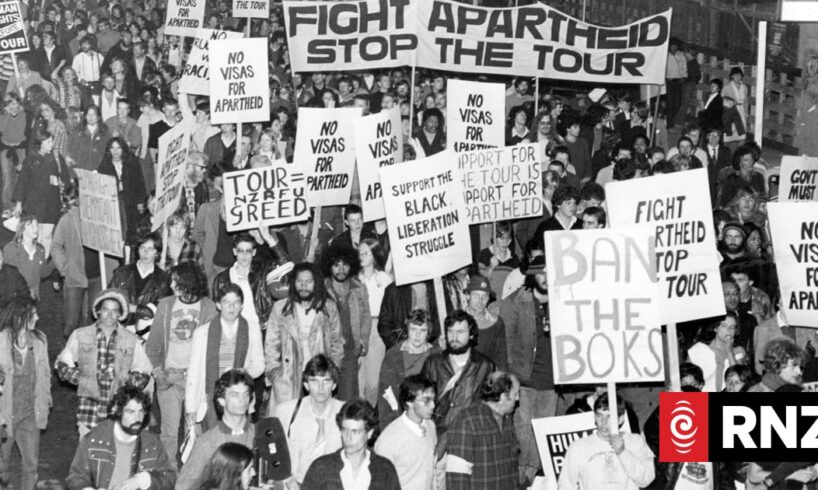
Forty-five years ago, New Zealand found itself at war with itself – it was a battle fought not with guns or armies, but with placards, batons, rugby boots and deeply held beliefs.
The 1981 Springbok tour remains one of the most divisive events in this country’s history. Over 56 days, more than 150,000 New Zealand protesters took a stand in more than 200 demonstrations, as apartheid in South Africa collided head-on with this nation’s love affair with rugby.
The battle lines ran through streets, stadiums, and even families.
In Hamilton, when protesters stormed Rugby Park on 25 July, 1981, teenage brothers Lindsay and Bryce Amner found themselves standing on opposite sides of history.
Sixteen-year-old Lindsay had paid four dollars to watch Waikato take on the Springboks.
“I was quite into rugby at the time… I really liked the idea of going and watching Waikato beat the Springboks, which was a 1956 repeat,” he tells The Detail.
“I wasn’t concerned about the politics of it… when you’re 16, other people’s problems don’t really affect you much.”
Two years older, Bryce had other ideas.
“I’d been reading the newspapers… we thought the tour shouldn’t have gone ahead, that the apartheid regime was really abhorrent and that we shouldn’t be supporting it by enabling a rugby tour.”
It was his first protest, and “probably my first major law breaking as an 18-year-old”, he says.
As Lindsay stood on the embankment waiting for kick-off, Bryce joined hundreds of demonstrators outside the ground.
Lindsay Amner (L) and Bryce Amner (R) in the early 1980s.
Supplied
Neither knew they were about to witness one of the most extraordinary days in New Zealand history.
“I was at the end of the ground where the protesters came through,” Lindsay recalls. “We sort of didn’t quite realise what was happening… and then when the police came out, the first time we’d ever seen riot police… this was just ‘whoa’.”
Helmeted officers carrying batons and shields formed a line around protesters, while smoke drifted across the field.
“Certainly something we’d never seen in New Zealand… smoke and gas and the helmeted and shielded, batoned police. This was just outrageous.”
The crowd remained hopeful the match would continue, but then came the announcement that it had been cancelled.
“We couldn’t believe it… this was just outrageous – our game. That’s when the crowd got really angry… you just felt this sort of angry thing sweep over the crowd.”
The violence became frighteningly real, with a man standing beside Lindsay pulling out a large knife.
“He said, ‘I’m going up in court on Monday. Might as well be hung for a sheep as for a lamb. I’m going out there to kill me some protester’.”
Lindsay says police quickly tackled and arrested him, and he “didn’t see him again”.
Outside the stadium, Bryce was also seeing just how quickly emotions could boil over.
“There were a row of cattle trucks… so me and several hundred other protesters tried to push them out of the way or let the tyres down.”
Looking back, he says the protest shaped the rest of his life.
“I’ve joined lots of protests ever since. I find that a protest is actually a really interesting thing. There’s usually a sense of joy… and a sense that change is actually possible.
“Seeing what happened in South Africa afterwards… made me realise that this protest had been part of causing that change.”
At the time, Lindsay wasn’t impressed to find out his older brother had joined the protesters.
“I was pretty annoyed,” Lindsay laughs, before insisting that their mother backed him.
“Mum was adjudicating… and actually backed me because she said, ‘At least Lindsay was genuine, and he wanted to go see rugby, but Bryce just wanted to stir… and be involved in a shitstorm basically.'”
Lindsay Amner (second from left) and Bryce Amner (far right) with their siblings and father.
Supplied
Bryce laughs at that assessment now.
“There’s an element of truth in it,” he says.
While Bryce avoided violence during the protest, he couldn’t duck the punch of a fellow churchgoer, who was unimpressed that he’d taken part.
“That was at church the next day… someone in the youth group. The church was pretty conservative. I didn’t really realise it at the time.”
But today, the divide has softened, and Lindsay says he’s changed his perspective.
“I accept today that I was totally on the wrong side of history.”
But he says there’s nuance: “I think both sides were right and both sides were wrong.”
He says in some sense, it’s a good thing that the government did not cancel the tour, because the tour allowed New Zealanders to voice their dissent.
“The protesters were right to protest because those two things actually hastened the fall of apartheid.
“I’ve talked to South Africans since who said the first time they ever saw that the world was upset with their system was when they saw these protests.”
And would he protest today?
“Yeah… I think I would probably protest.”
But 45 years on from that infamous day, the brothers still can’t agree on one part of rugby – who will win when the All Blacks take on South Africa next month.
Lindsay predicts that South Africa will dominate the boys in black, while Bryce isn’t buying it.
“I’m an All Black supporter. And all Lindsay’s highfalutin detail. Nah… it’s All Blacks.”
The brothers released a short film about their Springbok Tour experience, titled Two Sides, and share their story on today’s episode of The Detail.
Check out how to listen to and follow The Detail here.
You can also stay up-to-date by liking us on Facebook or following us on Twitter.