This Wednesday, the verdict is expected in the case of Syrian national Issa Al H.*, who has been facing court in the North Rhine-Westphalia capital of Düsseldorf. Federal prosecutors have charged him with three counts of murder, 10 counts of attempted murder, and membership in the terrorist organization “Islamic State ” (IS).
The trial began on May 27, and at its opening Issa Al H. told the court through his lawyer that he bore “heavy blame” and had “killed innocent people,” and thus deserved and expected a life sentence.
The case has been politically loaded, a prime example of the challenges of dealing with Islamist violence. At the same time, it has brought up fundamental questions about Germany’s asylum and migration policies as well as the country’s internal security.
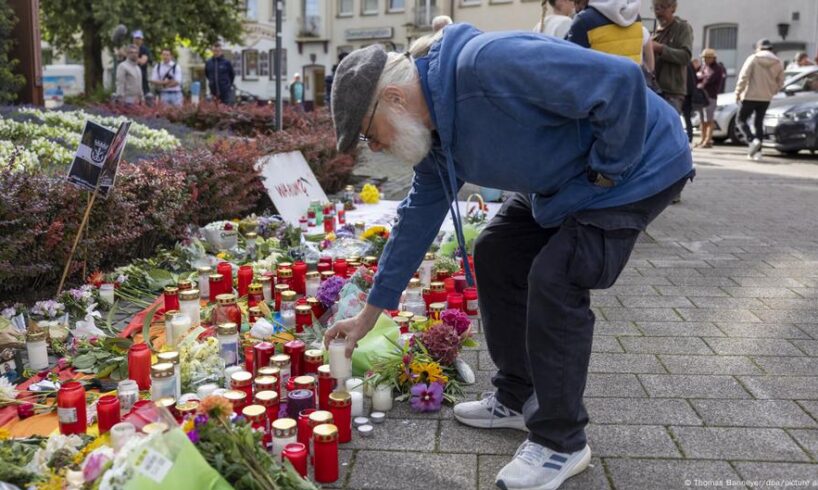
On August 23, 2024, a Friday evening, an attacker with a knife targeted revelers at a Solingen street party, held to celebrate the western German city’s 650th anniversary. He stabbed the people around him indiscriminately, right in front of the stage, deliberately aiming for their throats.
Three people were killed and 10 people were injured, some of them critically. The man who was charged, Issa Al H., was arrested a day later after turning himself in to the police. The crime horrified Germany.
Fact check: Disinformation against Muslims on the rise
To view this video please enable JavaScript, and consider upgrading to a web browser that supports HTML5 video
A rejected asylum seeker
Issa Al H., who was 26 at the time of the crime, arrived in Germany in December 2022 as an asylum seeker. He had taken the so-called Balkan route via Bulgaria, and initially found shelter in an emergency accommodation center in the western German city of Paderborn. Later, he was housed in Solingen, about 150 kilometers (92 miles) away. In his asylum application, he explained that he had left Syria to avoid military conscription.
Although he was then supposed to be deported to Bulgaria in 2023, the process for his return failed. He was not known to the German security authorities as an Islamist before the 2024 attack.
His planned deportation stalled because of bureaucratic failures and organizational hurdles. Issa Al H. was registered in Bulgaria in December 2022 and according to the European Union’s Dublin Regulation, the southeastern European country was responsible for processing his asylum application.
Germany submitted a request for Bulgaria to take over the application, which was agreed to. A six-month window was allowed for Issa Al H.’s transfer, but it expired. When Al H. was due to be deported from Germany to Bulgaria on June 5, 2023, he could not be found at his accommodation in Paderborn.
He returned shortly thereafter, but the facility’s managers did not tell the relevant immigration authority that he was back. Officials also failed to organize a new flight to deport him.
Because Germany missed the six-month deadline, it became responsible under the Dublin Regulation for processing the asylum application.
Logistical constraints had previously further hampered deportation to Bulgaria. Transfers were only possible on certain weekdays and at certain times via scheduled flights to the Bulgarian capital Sofia. This led to a situation whereby there could only be about 10 deportations a week to Bulgaria from the whole of Germany.
Complex rules govern Europe’s asylum process
To view this video please enable JavaScript, and consider upgrading to a web browser that supports HTML5 video
An ‘Islamist-motivated act of terror’
The Public Prosecutor General accused the defendant of being a member of the so-called “Islamic State” terror group, and accordingly of having decided to commit “an attack on those he viewed as infidels.”
According to the indictment, the defendant was in contact with members of the fundamentalist Islamist terror organization, IS, via a messenger service. They had assured him that IS would claim responsibility for the attack and use it as propaganda.
After the attack, IS announced that it had been committed by one of its “soldiers.”
Political debate was spurred by the attack
The terror attack in Solingen intensified the already fraught dispute about asylum and immigration in Germany, which was a hot topic during the recent federal election campaign.
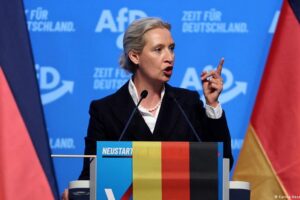
The far-right Alternative for Germany (AfD) party used the case to advance its anti-migrant agenda.
Researchers who study extremism warned against instrumentalizing the Solingen attack, and emphasized the danger of an increase in anti-Muslim sentiment.
Olaf Scholz, who was chancellor at the time, spoke of a “terrible crime.” Germany must respond with the full force of the law, the center-left Social Democrat (SPD) politician said shortly afterwards.
A few weeks later, his coalition of SPD, Greens and neoliberal Free Democrats (FDP) agreed on a “security package,” which included quicker deportations, more supervision for people who could pose a threat to public safety, and more spaces in pre-deportation detention centers.
In addition, weapons laws were tightened to make it more difficult for people to access and carry knives and other potentially dangerous objects.
Should Germany change its migration policy?
To view this video please enable JavaScript, and consider upgrading to a web browser that supports HTML5 video
Following the change of government in early May, the new coalition of the conservative Christian Democrats and Christian Social Union (CDU/CSU) and the SPD, led by Chancellor Friedrich Merz of the CDU, decided upon several more measures to tighten asylum policies, including a de facto entry ban of migrants who do not have sufficient paperwork.
The coalition also expanded pre-deportation detention to more effectively manage the return of people obliged to leave the country, and strengthened border controls to limit irregular migration.
In his first state-of-the-nation speech, Merz defended the harsher approach to asylum policy and emphasized the necessity of the measures for domestic security. The Greens accused the government of a lack of consultation with European Union partners, while the Alternative for Germany (AfD) claimed that the regulations did not go far enough.
This article was originally written in German. It was first published in May 2025 and later updated to reflect news developments..
*Editor’s note: DW follows the German press code, which stresses the importance of protecting the privacy of suspected criminals or victims and urges us to refrain from revealing the full names of alleged criminals.
While you’re here: Every Tuesday, DW editors round up what is happening in German politics and society. You can sign up here for the weekly email newsletter, Berlin Briefing.