Senior lecturer in media at Monash University Dr Daniel Black says many parents today grew up playing video games and are therefore arguably more open to their possible benefits than earlier generations.
“Any new form of media is greeted by adults catastrophising about how it will do harm to children – think rock’n’roll, television … If you go back far enough, novels caused concern because of their supposedly negative effects on youth,” Black says. “The concerns dissipate when the young people who first adopted that media grow up and demonstrate it didn’t turn them into homicidal maniacs or anything, and understand it and are comfortable with it.”
Some of the key findings from the Australia Plays 2025 report, including those around parents and video games.Credit: IGEA/Bond University
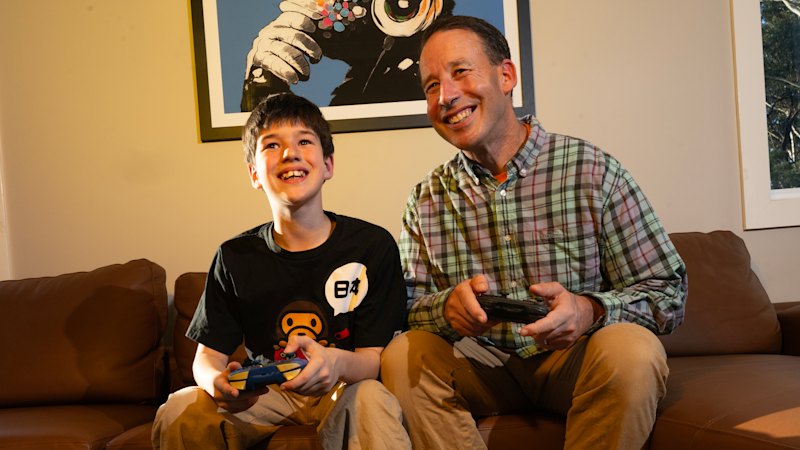
This is the case for Mike, who refers to himself as a “tragic from the ’80s”. He has played video games all his life, which has given him the confidence to navigate them alongside his child.
The parents surveyed for the IGEA report cited many reasons for deciding to play video games with their kids, with 49 per cent saying they’re a fun way for children to learn, 48 per cent believing they can improve problem-solving skills, and 39 per cent saying they encourage creativity and enhance cognitive skills.
While this holds true for Mike, he also sees it as an opportunity to monitor his son’s interactions with gaming, and to teach him healthy habits and discipline for later in life. “I control what sorts of games we play, the time we play for. I also find it teaches him little things like sharing, learning to win and learning to lose.”
Loading
They also become more relaxed while gaming together, Mike says, which in turn helps them to naturally open up to each other about unrelated topics like school and friends. Brand says this is quite common for parents who co-play with their kids, and that video games can offer several subtle yet effective “teachable moments”, especially if there are instances of violence or misogyny in a game.
While some parents may be horrified by the idea of prioritising gaming in a household, Brand says certain situations may call for it. “Let’s say there’s a socio-emotional challenge. If video games can help take the edge off that challenge, they should be prioritised.”
Advocates say playing video games with your kids can aid family connection and keep you up-to-date with how your child operates in the digital world.Credit: iStock
Notably, Brand says rules and boundaries are still important, as long as they’re not arbitrarily imposed. According to the IGEA report, 75 per cent of parents said they set rules for their children’s gaming. This can become particularly important when children play with other users online, since unregulated use could expose them to greater risk of cyberbullying or age-inappropriate content.
Senior lecturer in strategic communication at CQUniversity Dr Fae Heaselgrave says every family will approach gameplay rules differently.
Loading
“Setting rules, or not, is a very personal decision, but there are some guardrails that have been found to work more effectively,” she says. “Saying to a child they have to finish gaming by 6pm often doesn’t work because so many games have timed trials or progress milestones that need to be completed before exiting. So learning to be flexible is important for a harmonious household.”
In-game parental controls, such as restricting in-game purchases or banning expletives, can also be useful, Brand says. More than two-thirds of the adults surveyed in the report said they’re either completely or quite familiar with in-game controls. There’s probably a positivity bias here, Brand notes, though it still indicates growing confidence among parents around how to best adapt video games to their parental advantage.
“Parents are often so busy with work that they need those technological controls or shortcuts that help them,” Brand says.
Although awareness is strengthening, chief executive of IGEA Australia and NZ Ron Curry says we must continue to break down ongoing negative stereotypes around gaming and children.
“No matter what you do, there’s an inherent risk. But if parents understand what the risks are, it helps them mitigate them,” Curry says. “Gaming generally creates a culture of understanding of the world. Whether that’s outside the game or inside the game, I think parents need to help guide that building of connection.”
Make the most of your health, relationships, fitness and nutrition with our Live Well newsletter. Get it in your inbox every Monday.