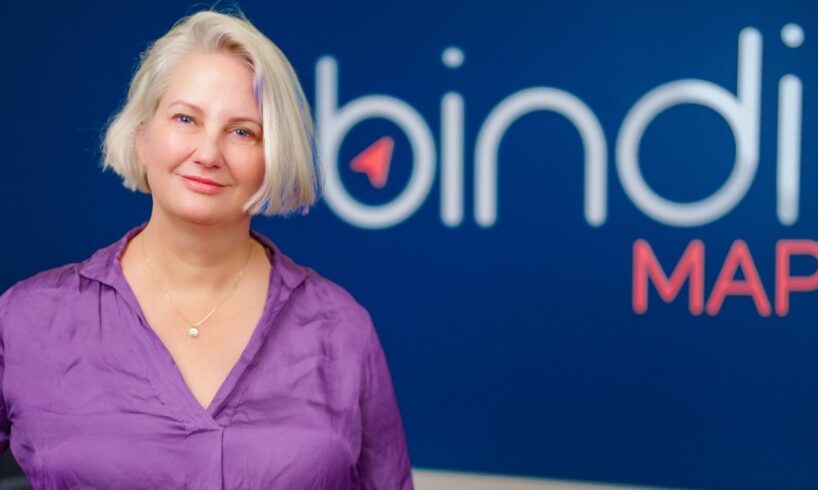
Indoor wayfinding startup BindiMaps has fallen into administration and reemerged under new ownership, with plans to expand beyond navigational tools built for Australians with vision impairment and wheelchair users.
BindiMaps uses a natural language system, maps, and text cues to guide users through shopping centres, office towers, and other complex buildings, promising turn-by-turn navigation and accessible routes with more detail than mainstream options like Google Maps.
Launched in 2017 by Anna Wright, Mladen Jovanovic, and Tony Burrett, the Sydney-based startup secured investment from the likes of VC fund Artesian and $1 million in grant funding from the NSW government.
Its accessible wayfinding technology was adopted by Australia Post, NSW Parliament House, Sunshine Coast Airport, and the Australian Open, among others.
KMPG also signed up, with BindiMaps providing wayfinding for its Sydney and Canberra offices.
Smarter business news. Straight to your inbox.
For startup founders, small businesses and leaders. Build sharper instincts and better strategy by learning from Australia’s smartest business minds. Sign up for free.
By continuing, you agree to our Terms & Conditions and Privacy Policy.
The consultancy deepened its partnership in August, with its specialist startup team assisting BindiMaps with “strategic growth strategies, including connecting BindiMaps with potential investors”.
Despite its growing uptake and KPMG partnership, the business struggled financially in recent months.
A tight startup investment market — and a delayed research and development tax incentive refund — ultimately led to BindiMaps’ voluntary administration in late September.
Documents listed by the Australian Securities and Investments Commission show parent company BindiMaps Pty Ltd appointed Stephen Wesley Hathway of Helm Advisory as administrator on September 30.
Linas Jarasius and Bret Duckers of Price Young Advisors acquired the business out of administration earlier this month and now operate the BindiMaps system.
Speaking to SmartCompany, Jarasius outlined their plan for the business: creating a “leaner, meaner” operation servicing a broader range of users.
Related Article Block Placeholder
Article ID: 298520
BindiMaps had built its technology and then found customers, he said, but the new owners plan to aggressively find its next customer base and build the platform around their needs.
The underlying technology is capable of competing against world-leading wayfinding platforms, Jarasius said, flagging its potential use across more hospitals, airports, and stadiums.
New commercial focus, without losing original users
The business downsized through the administration, and now counts five staff and one contractor on the books.
Wright — whose own experience with a degenerative retinal condition inspired BindiMaps — is in advanced negotiations with its new owners about a senior leadership role.
Speaking to SmartCompany, Wright said BindiMaps could pursue new commercial opportunities without compromising usage for its original userbase.
“We need to talk to large hospitals, shopping centres, universities — and they are the ones that pay to put BindiMaps in,” she said.
“So the better the return on investment we can make for them, the more likely it is that they will install Bindimaps.”
If both disabled and able-bodied users can navigate through the system, “then that hospital is more likely to get BindiMaps, which means it’s going to be more available for everybody to use”.
As many as 80% of users already access BindiMaps without turning on any accessibility features, she said.
“So they’re not using it in a wheelchair, and they’re not using it in voice talkback mode.
We know from the data, able-bodied people get just as lost inside of a large, complicated hospital building as anybody else does.
“It’s just that there’s not always been a tool like BindiMaps that’s been available for people.”
While Jarasius and Duckers hope to steer BindiMaps towards profitability, Wright, speaking from a disability technology conference, reiterated the startup’s commitment to its original users.
“When we say everybody, we mean everybody in our products,” she said.
“That is still going to continue with the new owners, which is very important to me personally … this has been the thing that I’ve been championing since the beginning.”