January 18, 2026 — 7:50pm
Save
You have reached your maximum number of saved items.
Remove items from your saved list to add more.
Save this article for later
Add articles to your saved list and come back to them anytime.
Got it
AAA
To submit a letter to The Age, email [email protected]. Please include your home address and telephone number below your letter. No attachments. See here for our rules and tips on getting your letter published.
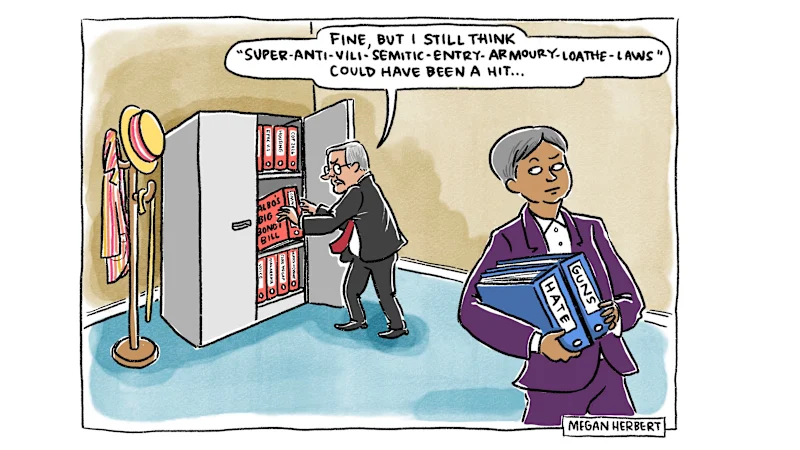
Photo: Megan Herbert
TENNIS
Great to see the Australian Open in town again this summer and read all about those who make it happen (“The people who keep the Open on the ball”, 17/1), however, there’s one group who seems to be overlooked. Ballkids compete for the honour but that’s just it, it’s only an honour. I’m sure readers have no idea that they don’t get paid. Yes, they do get their uniforms and vouchers for food but, considering the hours they put in and their parents’ time taking them to and fro, some pay should be involved.
I realise they are under the legal age to work but the performance arts pay kids and there are special conditions for their employment.
Susanna Lewis, Kew
Major events soak up state’s cash
The Australian Open has spent $1 billion on infrastructure (“Weighing up whether $1b spent on Open is worth it”, 18/1), and the Australian Grand Prix Corporation has received a similar amount from the state government. While the government claims that these events give Victorians a warm feeling, the more pressing needs such as state debt, education, health and climate action are left the poorer.
Geoff Gowers, Merricks North
Kennett’s foresight on big build
When it was first built, Jeff Kennett labelled the new tennis centre “Cain’s cathedral”. Kennett was being critical of a Labor big build. He was right, the place is a white elephant.
John Rawson, Mernda
Tiley orchestrates another winner
Saturday evening’s opening ceremony stunningly exceeded this tennis fan’s expectations. It is abundantly clear that Craig Tiley, CEO of Tennis Australia and director of the Australian Open, is at the very top of his game, a champion of international sports administration who is consistently engaging and engaged with players and fans’ welfare and satisfaction. We are indeed very fortunate to have him on our team belting out winner after winner.
Sydney Shadid, Highett
Bringing down the house
Well done, Craig Tiley and Tennis Australia for having truly local Australian musicians, Crowded House, performing at the opening ceremony of the Australian Open. Maybe the AFL will follow their example when it engages performers for the 2026 grand final entertainment.
Dianne Anderson, Bundoora
Marketing needs to be on point
What a fun night at the tennis on Friday, seeing world-famous brands do activations on and around centre court. Next year, why not make it clearer when the actual competition starts? And you can rebrand pre-week as the “Australian Not Yet Open”.
Sam Davies, Paris, France
Celebrate the good role models
This tennis season, we should be talking only about Aussie players who are highly ranked, moving up in the rankings whatever their level, are humble and modest, and are a good role model for aspiring junior players.
David Cayzer, Clifton Hill
Update the rules on racquet abuse
It’s high time to update the rules over penalties for players who lose their temper and go on to destroy their racquet in a completely childish and unprofessional manner. This sort of childish behaviour brings tennis into disrepute.
Brian Noble, Taylors Hill
Game, set and match
As a true believer, I will maintain my heroic and principled stance of not watching gram slam tennis until the perverse destroyer of tennis beauty – the double-handed backhand – is outlawed; unless Roger Federer becomes a late wild-card entry; or I get access to a corporate box.
Paul Jurkovsky, Ferntree Gully
THE FORUM
Lesson learnt
It seems that Prime Minister Anthony Albanese has learnt one thing from the Yes vote failure in the Voice referendum (“Labor forced to retreat over hate speech law”, 18/1): If you don’t have bipartisan support when needed, you withdraw and work on it. Shame that wasn’t the process when the Yes vote lost support from the Liberals.
Leah Billeam, Portarlington
Legislation dilemma
Parliamentarians and community leaders have correctly raised concern about the federal government’s draft bill responding to antisemitism, hate and extremism. Yet, we can only marvel at our stunningly efficient government, which released its 144-page bill on January 13 and required submissions by January 15 (possibly achieving a Guinness record for the shortest exposure-draft period in world history).
However, the real question is whether we need legislative rather than educative responses to social challenges, while a consequent issue relates to who shall rightly discern between hatred and legitimate public discourse.
David D’Lima, Sturt, SA
Democracy at work
The reporting of the government’s decision to remove the anti-vilification component of the proposed legislation in response to the Bondi attack is heavily laden with the language of capitulation. We can expect more of this from the Coalition who are yet to offer any meaningful proposals on how the legislation should be drafted.
In a world where we are seeing democracy under fire, perhaps we can view the retreat as a demonstration of our robust democracy at work where the Senate was unlikely to pass the omnibus bill.
When the parliament resumes, let’s hope more constructive dialogue and unity of purpose will result in anti-vilification laws that protect our citizens and strengthen the foundations of a cohesive society.
Anne Lyon, Camberwell
The world’s a stage
Thank you, Malcolm Knox, for your piece on the “cancellation” of Shakespeare (“No Bard thing he wasn’t invited”, 17/1). As the director of the postponed Sydney production of The Merchant of Venice, I suggest that it’s better for all to have Shakespeare reinstated.
I take issue with the conflation of Shakespeare with the undeniably antisemitic times in which he lived.
Surely, it’s more beneficial to explore the perennial relevance of great work, rather than presume to know the beliefs of its author. From this perspective, it’s possible to see that “Shylock can’t climb out from under his own history”, but neither can we. The point of staging great works is to transcend both our own history and any baggage we bestow on the work.
What’s clear from my living with the play for the past six months is that Shakespeare’s Shylock lives, not as a historical artifact, but as a dramatic character.
So, when we return to the stage with The Merchant of Venice this August, we’ll join Shylock and the other characters in their play. After all, “the play’s the thing”.
Paul C. Kininmonth,
director, The Merchant of Venice,
Such Stuff Productions, Sydney
Worthwhile journey
At Tullamarine Airport, the routine is familiar: Shoes off, laptops out, liquids declared. Once, the question was simple: did you pack your own bags? Increasingly, it feels like a test of whether you packed your own ideas and whether they have been cleared. If you think airports are stressful, try entering an Australian art gallery these days.
The Adelaide Writers’ Week controversy made this clear. A Palestinian-Australian writer’s invitation was withdrawn as culturally insensitive, triggering resignations, boycotts, government intervention, and the festival’s cancellation. A literary festival undone not by books, but by pre-emptive fear.
Institutions have replaced risk with reassurance. Disagreement is treated as failure. Ambiguity, satire and complexity are discouraged. Moral posturing is prioritised over artistic merit. Audiences are sorted rather than engaged, the cultural space shrinks, and literature loses its nerve.
Art has never been safe. Its role is to unsettle, provoke and expose contradiction, not to certify “correct” attitudes. If cultural institutions want to regain trust, they must dismantle the security theatre. Let ideas pass unscreened.
Andrew McIlroy, Golden Point
Related Article
Housing values
Along with water and food, housing is a basic survival need for all. The article, “Top agent reported for alleged flips of properties” (18/1), is a trivial, yet illustrative, example of how we view real estate.
Housing is seen as just another product within the free market from which great profits can be made. Simply occupying my house over the past 60 years, my property has made me a millionaire. Many people create economic security for themselves by owning several houses and exploiting government incentives to do this.
The common observation that any government allowing property prices to fall would not be re-elected indicates the insanity of the situation. If people just owned the one house needed for survival, then the actual price of housing becomes almost irrelevant to those moving from one house to another.
It is beyond this letter to advise on a better system, but it is certain the current one is unfair and must change dramatically, along with our own value systems.
Howard Tankey, Box Hill North
Locals lose out
Great news for those looking to pick up a cheap holiday home (“Surf’s up: What you can expect to buy in Victorian coastal hotspots for $1m or less”, 18/1). But you are pricing out locals who have low-paying but vital occupations. Think aged care and childcare workers, council employees or hospitality workers.
This article is another example of the growing wealth divide in Australia and the impact on our social cohesion.
Barry Lizmore, Ocean Grove
Enemies and allies
US President Donald Trump has threatened to invade Greenland and announced tariffs on Europe for not supporting his position (“Trump announces escalating tariffs on European nations”, 18/1). At the same time, Prime Minister Anthony Albanese describes the United States as “our greatest friend and ally”. I’m not sure what alternative universe he lives in, but it’s certainly not one occupied by most thinking Australians.
Nick Roberts, Shepparton
A healthy choice
The two medical articles, “Trump’s autism claim debunked” and “It was thought impossible, but an Australian heart has shown, little by little, that it can repair itself” (both 18/1), show the value of research in medicine and the need for proof. This Australian research will be life-saving, and the findings will be implemented to save lives.
The American medical system is poorly run, expensive and subject to the whims of RFK Jr and President Donald Trump.
Stay in Australia; it may be a matter of life and death.
Dennis Fitzgerald, Box Hill
What are they smoking?
The Age editorial (17/1) noted federal government tobacco excise had halved from $16.3 billion since 2020. This supports estimates that the illicit tobacco trade is worth $5.7 to $8.5 billion in annual revenue. Assuming a 50 per cent profit margin, illicit tobacco sales generate cash flow of $2.85 billion to $4.25 billion per annum. That’s a bigger cash flow than most of the top 100 companies listed on the Australian Stock Exchange.
A substantial reduction in tobacco excise would destroy a primary source of crime cash flow. What is the federal government smoking to let this go on?
Education on the dangers of tobacco smoking has been successful over many years but a good minority remain committed smokers. A change in excise (and more resources on the dangers of tobacco smoking) is unlikely to trigger a huge increase in smoking but it will move the committed smokers back to legal retailers like supermarkets and milk bars.
The government response so far has been to create a new bureaucracy, the Illicit Tobacco and E-cigarette Commission. It’s helpful with statistics but doesn’t seem to have any impact on growth in illicit tobacco with some predicting 80 per cent tobacco market share by the end of 2026.
Surely, the federal government understands the importance of cash flow to organise crime. It has the power to stop it immediately.
Anton Whitehead, Portsea
All pay levy
Your correspondent (Letters, 18/1) labours under the misapprehension that city people do not pay the Emergency Services and Volunteers Fund Levy. He is wrong: all Victorian property owners, including businesses, pay the levy via their council rates.
Peter Price, Southbank
Holding the hose
I feel sorry for Premier Jacinta Allan. Labor has never had the support of the CFA, and she is being blamed for poor recruiting, natural attrition and disinterest in joining the organisation for the drop in manpower. As for breakdown of equipment, I wonder if they have heard of maintenance? It seemed to work when I was in the army.
John Cain, McCrae
Sands of time
I read that coastal erosion is so bad at Port Fairy that formerly dumped rubbish, such as old fridges, has been emerging on the beaches (“As coastal erosion bites, why there are some rays of hope”, 18/1).
Local action is being taken to address the problem. Very good, but nevertheless there is an upside to it. If the erosion continues eastwards, we might finally uncover the Mahogany Ship.
Peter Drum, Coburg
Fast-forward
An article about setting up a video store in a garage as a retro homage (“Rewinding to the glory days of video stores”, 16/1): Retro … really? There is a perfectly functioning video store in Lakes Entrance. Must be heaps of others.
Robert Edis, Lakes Entrance
AND ANOTHER THING …
Trump
He has an extreme obsession for power, wealth and fame and an inflated self-esteem, grandiose delusions of importance and a belief in having superior abilities. When I read that I immediately thought of Donald Trump but it’s a description of a megalomaniac.
Richard Crago, Burwood East
A rally in Copenhagen, Denmark, over President Donald Trump’s ambitions to take control of Greenland.Bloomberg
Trump now wants all countries to approve his illegal takeover of Greenland or they will face penalties. Is blackmail still a crime?
John Walsh, Watsonia
Once Trump has swallowed Canada and Greenland, if he discovers there’s a USA in AUStralia, we’re doomed to digestion.
Paul Drakeford, Kew
Hate speech
He’s a wily one, our PM, cooking up a bill that, like the Voice referendum, is almost certain not to pass.
Ruja Varon, Malvern
It was true when Paul Keating said it of the Senate in 1989, and now it’s obviously still true: Unrepresentative swill!
Mike Smith, Sandringham
So we don’t have to rewrite the words of Handel’s Messiah now? Phew.
Pamela Lloyd, West Brunswick
I hate the word “hate”.
Peter O’Brien, Newport
Australia Day
As we approach January 26, the annual debate on our national day and the date will recommence. My suggestion is May 9, the date of the first Australian parliament.
Phil Burnham, Collingwood
A date to suit most would be February 6. This was the date of the first Australasian Federation Conference held in 1890, where delegates discussed the “coming together” of the colonies as a Federation.
Joel Matthews, Bright
Furthermore
Why is it that so many writers these days are averse to the word, that? I can only conclude that they are also averse to clarity.
Alan Eason, Miami, Qld
Finally
After making great strides, the Fletcher Jones journey has come to an end.
Jim Pilmer, Camberwell
Editor’s pick
The Opinion newsletter is a weekly wrap of views that will challenge, champion and inform your own. Sign up here.
To submit a letter to The Age, email [email protected]. Please include your home address and telephone number below your letter. No attachments. See here for our rules and tips on getting your letter published.
Save
You have reached your maximum number of saved items.
Remove items from your saved list to add more.