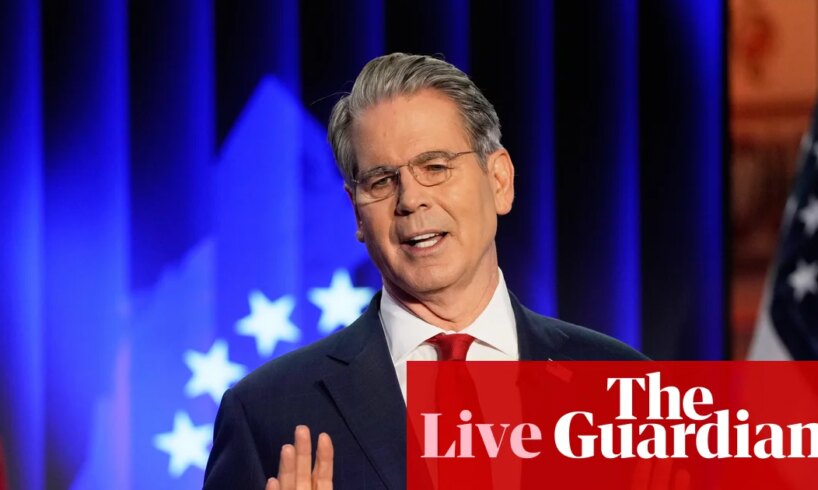
Von der Leyen: Greenland tariff threat is a mistake, a deal is a deal
Turning to the Greenland crisis, EC president Ursula von der Leyen declares that “tariffs are a mistake, particularly between long-term allies”.
She reminds Davos that the US and Europe reached a trade deal last year.
In a nod to President Trump, as he jets towards Davos, von der Leyen says:
In politics as in business, a deal is a deal.
And when friends shake hands, it must mean something.
Von der Leyen adds that Europe considers the people of the Uniter States not just our allies, but our friends.
Plunging us into a downwards spiral would only help the adversities we are both committed to keeping out of the strategic landscape, she warns.
And Europe will be “unflinching, united and proportional” in its response, she insists.
Von der Leyen then explains that Europe is working on a package for arctic security.
It will have three points:
that the soverienty of Greenland and Denmak is non-negotiable
a massive investment surge in Greenland.
work with the US on wider Arctic security, which she says is in both sides’ joint interest.
Von der Leyen then pledges that Europe will work with its regional partners to strengthen their combined security; including UK, Canada, Iceland and others, as it adjusts to a new security architecture.
Share
Updated at 11.55 CET
Key events
Show key events only
Please turn on JavaScript to use this feature
Macron: Europe must restore level playing field and protect itself
Europe has to fix its key issues, Macron continues, citing the lack of growth, and the lack of GDP per capita growth.
European competitiveness still lacks behind that of the US, he points out.
And he then calls for tougher action by Europe to protect its companies and markets, insisting that “protection does not mean protectionism.”
Macron warns that some European industries are being “literally killed” by the lack of respect for a level-playing field, and suggests there is a case for “European preference” to support its domestic industry.
He says:
Europe are the only ones not to protect their own companies and their own markets when other countries do not respect a level playing field.
Europe must strengthen its protections against dumping of products from overseas, and more overseas investment, to help rebalance with China.
Share
Accepting a new colonial approach doesn’t make sense, Emmanuel Macron continues, suggesting that we cannot accept a world where the law of the strongest hold sway.
Passively accepting a new subordination does not make sense, he adds.
Share
Macron: We are approaching a time of instability
Emmanual Macron begins his speech to Davos by joking that “This is a time of peace, stability and predictability”….
…before warning WEF that it is clear that we are reaching a time of instability, of inbalances.
That is from both a security point of view, and an economic point of view, he says.
Macron says that there were more than 60 wars in 2024, even though “I understand some of them were fixed” (a jibe at Donald Trump’s claim to have ended several wars?).
Macron then declares that it is”unacceptable” when competition with the US aims to subordinate Europe, especially when it is being used as leverage to obtain territory (ie Greenland…).
Share
Updated at 14.28 CET
Now its Emmanuel Macron’s turn to take to the stage at Davos.
Earlier the French president was spotted sporting a pair of sunglasses inside the congress centre here in Davos, having recently suffered an eye condition (reported to be a burst blood vessel).
President Emmanuel Macron meeting Canadian prime minister Mark Carney during the World Economic Forum (WEF) annual meeting in Davos today Photograph: Raphaël Lafargue/ABACA/Shutterstock
He’s wearing them again now, as he gladhands various bigwigs in the front row of the audience, before being introduced by Larry Fink who is talking about his love of France.
Fink says that the economic debate in France has changed over the last decade; there is broad agreement today that economic growth matters, he says, and he gives Macron the credit.
You can make an argument that no French leader has led his country at a more pivotal time since World War 2, Fink suggests.
Share
French president Emmanuel Macron and Canada’s prime minister Mark Carney have met inside the WEF congress centre this lunchtime:
Prime Minister Mark Carney meets with French President Emmanuel Macron as they attend the World Economic Forum in Davos, Switzerland today Photograph: Canadian Press/ShutterstockShare
Harvard economist Kenneth Rogoff says European governments are really worked up over Trump’s threat to impose new tariffs over support for Greenland.
Rogoff said today:
“It’s no accident he did this just before coming here and got the Europeans all riled up. Suck all the oxygen out of the room so everyone would be talking about nothing else.”
ShareVon der Leyen urges European independence in response to ‘seismic change’ – videoShare
The governor of California, Gavin Newsom, called Europe’s reaction to Trump “pathetic” and “embarrassing” and urged European leaders to unite and stand up to the United States.
Newsom told reporters at Davos, via Associated Press:
“It is time to get serious, and stop being complicit,”
He also decried the chasm between what Europeans are saying in public to Trump versus what they say privately among themselves.
“This guy’s playing folks for fools,” Newsom said:
“I mean, everybody’s talking behind his back. They’re laughing at him, and meanwhile, they’re sucking up to him.”
According to Bloomberg, Newsom also produced an eye-catching analogy:
“There’s no diplomacy with Donald Trump — he’s a T-Rex, you mate with him or he devours you.”
Share
Donald Trump’s dream of a grand signing ceremony in Davos for his “Board of Peace” — with the president at the helm and a $1 billion membership fee — is melting away today, Bloomberg reports.
They say:
With widespread concern that the Trump administration is assembling a rival outfit to the United Nations, the list of fellow Group of Seven leaders who are politely declining the invitation is growing. Trump wasted no time in venting his anger at them one by one.
That included Trump threatening France with 200% tariffs on champagne, and roasting UK prime minister Keir Starmer over the decision to cede the Chagos Islands to Mauritius.
Share
Correction corner: The Nixon shock which preceeded the first WEF annual meeting in Davos was, of course, in 1971 not 1961 as I mistyped earlier. Apologies!
Share
Updated at 13.11 CET
BoE’s Bailey: Must be “careful” what we do to support US Fed independence
Kalyeena Makortoff
MPs have grilled Bank of England governor Andrew Bailey about another Trump target: US Federal Reserve chair Jerome Powell.
Powell is facing a criminal investigation by the US DoJ over alleged “abuse of taxpayer dollars” linked to renovations to the central bank’s HQ in Washington, which is widely suspected to be punishment for not cutting interest rates as fast as Trump would like.
Policymakers and CEOs have since started rallying around the Fed, raising concerns about threats to central bank independence.
That includes Bailey, who last week signed a letter of support for Powell alongside nine counterparts, including the European Central Bank’s Christine Lagarde, and Michele Bullock of the Reserve Bank of Australia.
When asked about his support for Powell, Bailey told the Treasury Committee on Tuesday that while it was not his place to “intervene” in domestic US issues, there were particular concerns for how this was affecting the US dollar as the world’s reserve currency.
He told MPs:
So it is pretty unprecedented for other central bank governors to to do this [send a letter],but I think it’s you know, it’s a point that we have to make in this situation.
But…we have to be careful what we do.
I will say also – because Jay Powell is a close colleague and a friend of mine – I’ve said before in public and I’ll say it again, he is, in my view, a man of the utmost integrity.
Share
Nadella: AI needs to show it is delivering positive outcomes
Heather Stewart
Satya Nadella, the chief executive of Microsoft, who was interviewed by BlackRock CEO Larry Fink on stage at Davos this morning, warned that AI could lose public support, if it cannot show that it is delivering positive outcomes, well beyond the tech sector.
“I would say you lose even the social permission to take something like energy, which is a scarce resource,” to power AI, he told WEF, if it is not “improving educational outcomes, public sector efficiency, private sector competitiveness – across all sectors, small and large. That, to me, really is the goal.”
He added that in the near future, what he called the “token factories” – the datacentres – that underpin the technology, will be “diffused all around the world, like electricity”.
Asked whether current elevated valuations for the big tech firms represent a bubble, as many analysts have warned, Nadella said, “for this not to be a bubble, by definition, it requires that the benefits of this are much more evenly spread. A tell tale sign of this as a bubble, is if all we’re talking about are the tech firms.”
Instead, he said, a sign that AI investment will deliver, would be if instead of the tech firms, debate turns to real-world examples, such as, “here is a drug that was brought into the market, that’s super-successful because AI accelerated the clinical trial”.
Share
China’s vice-premier He Lifeng, has followed Ursula von der Leyen onto the Davos stage, and made a pitch for multilateral co-operation.
He tells delegates here that the future of the world hinges on cooperation, and the most effective way to achiece that is through solidarity.
In an apparent reference to the White House, He says solving problems together is more effective than pointing fingers.
He says China welcome countries who want to reach trade agreements, but not at the expense of third parties.
China, of course, has long been a target for Donald Trump due to its large trade surplus with America.
He insists that China never purposefully pursues a trade surplus (!), and says it is willing to vigorously expand its imports – to become not only the factory of the world, but also the world’s market.
He also tells WEF that the world must not return to the “law of the jungle where the strong bully the weak” (which might be a relief to Taiwan!).
And in a flowery conclusion, He calls on Davos delegates to work together to steer the world economy through the “vast blue ocean”, breaking through all winds and waves.
Share
Updated at 12.14 CET
Bank of England’s Bailey: We ‘have to remain very alert’ amid Greenland threats
Kalyeena Makortoff
Bank of England governor Andrew Bailey said officials “need to remain very alert” to how rising geopolitical tensions could threaten financial stability, amid growing concerns over Trump’s threats to annex Greenland.
Bank of England governor Andrew Bailey appears at the Treasury Committee. Photograph: Parliament TV
Bailey did not directly respond to questions about Greenland, referring instead to how the Bank’s December financial stability report said risks to financial stability had increased over the past year.
He told the Treasury Committee:
I do think that geopolitical tensions and particularly trade issues, are an important part of that.
Now, that does not mean to say that I want say that any particular issue is trigger.
But the level of geopolitical uncertainty, and the level of geopolitical issues, is obviously a big consideration because they can have financial stability consequences.
Bailey said that while financial markets and global economic growth were more stable than expected given the events of the past year (think Trump’s previous tariff threats), he warned that did not suggest the same would happen going forward:
Neither of them I take as a source of any assurance going forward.
We have to remain very alert to these things.
Share
Updated at 11.57 CET
Von der Leyen: Greenland tariff threat is a mistake, a deal is a deal
Turning to the Greenland crisis, EC president Ursula von der Leyen declares that “tariffs are a mistake, particularly between long-term allies”.
She reminds Davos that the US and Europe reached a trade deal last year.
In a nod to President Trump, as he jets towards Davos, von der Leyen says:
In politics as in business, a deal is a deal.
And when friends shake hands, it must mean something.
Von der Leyen adds that Europe considers the people of the Uniter States not just our allies, but our friends.
Plunging us into a downwards spiral would only help the adversities we are both committed to keeping out of the strategic landscape, she warns.
And Europe will be “unflinching, united and proportional” in its response, she insists.
Von der Leyen then explains that Europe is working on a package for arctic security.
It will have three points:
that the soverienty of Greenland and Denmak is non-negotiable
a massive investment surge in Greenland.
work with the US on wider Arctic security, which she says is in both sides’ joint interest.
Von der Leyen then pledges that Europe will work with its regional partners to strengthen their combined security; including UK, Canada, Iceland and others, as it adjusts to a new security architecture.
Share
Updated at 11.55 CET
Turning to the Ukraine war, Ursula von der Leyen says Russia shows no sign of abating, no sign of remorse, no sign of seeking pace – just the contrary.
Last week’s bombing of Ukraine’s energy infrastructure left millions facing darkness, cold, and food shortages.
She declares, to applause:
This must end.
We all want peace in Ukraine, von der Leyen continues, saying Europe recognises president Trump’s role in pushing peace talks forward.
Ukraine must be in a position of strength to go to the negotiating table, she adds, which is why the EU agreed a €90bn loan.
Share
Source