January 22, 2026 — 1:47am
Save
You have reached your maximum number of saved items.
Remove items from your saved list to add more.
Save this article for later
Add articles to your saved list and come back to them anytime.
Got it
AAA
Brussels: US President Donald Trump has ruled out using force to seize Greenland after months of leaving the option on the table in his row with European leaders over the territory, adjusting his stance amid fears of a trade war over the dispute.
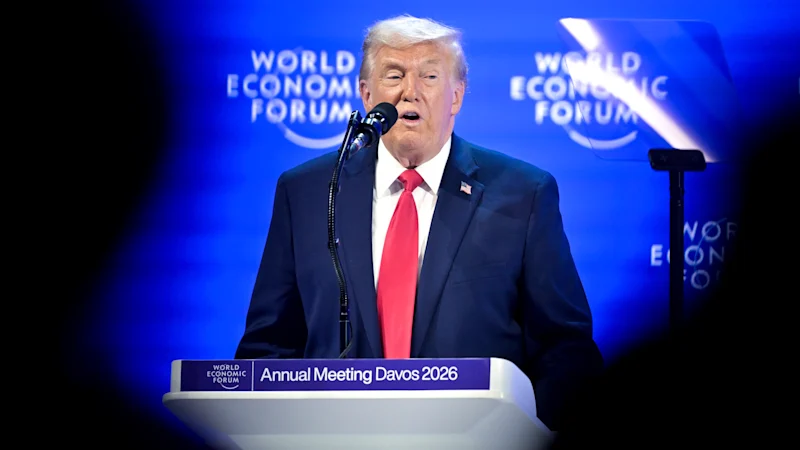
Trump repeated his demand for ownership of Greenland in a major address in Switzerland on Wednesday (early Thursday, AEDT) and warned that America would “remember” if it did not get the island, but he made his first clear statement about not using military force to get his way.
US President Donald Trump speaks during the 56th annual meeting of the World Economic Forum in Davos, Switzerland.AP
“I don’t have to use force. I don’t want to use force. I won’t use force,” he said.
Trump made the statement during an address to about 1000 delegates at the World Economic Forum in the Swiss town of Davos, and he emphasised his remarks to show that he knew he had clarified a key concern among political and business leaders.
In a long and sometimes rambling address, the US President complained about the NATO alliance, said he wanted to end the “bloodbath” in Ukraine and took aim at leaders such as French President Emmanuel Macron and Canadian Prime Minister Mark Carney, who spoke yesterday about the need to stand up to major powers.
Trump claimed that only the US could defend Greenland in a future war because of its importance in missile defence, and he based his claim to the territory on the role of the US in the Second World War, when it kept Greenland from falling into enemy hands and chose to return it to Denmark at the end of the conflict – a decision he called stupid.
“We never asked for anything and we never got anything,” he said about the claim to Greenland.
“We probably won’t get anything unless I decide to use excessive strength and force, where we would be, frankly, unstoppable.
“But I won’t do that. OK? Now everyone’s saying: ‘Oh, good’. That’s probably the biggest statement I made, because people thought I would use force.”
He then said he did not have to use force and did not want to use force, and he added: “I won’t use force.”
This was the first time Trump has ruled out using force over Greenland, an option the White House has mentioned in the past despite concerns in Europe that this would amount to an American attack on the Kingdom of Denmark, a NATO member and an ally of the US since the Second World War.
Two weeks ago, amid headlines about the use of force, the White House said in a statement: “The president and his team are discussing a range of options to pursue this important foreign policy goal, and of course, utilising the US military is always an option at the commander-in-chief’s disposal.”
Related Article
Trump’s statement on Greenland was welcomed by the audience at Davos, with some of the those in the front rows giving him a standing ovation at the end of his speech, but he did not remove the threat of economic penalties on NATO allies that disagree with him.
Trump has threatened countries with new tariffs of 10 per cent to start on February 1, rising to 25 per cent on June 1, because they reject his claim to Greenland. The tariffs would apply to Denmark, Finland, France, Germany, the Netherlands, Norway, Sweden and the United Kingdom.
Macron used his address in Davos on Tuesday to reject a “new imperialism” and called for a strong European trade response to threats, a stance being backed by several leaders who have called Trump’s threat “blackmail” and support a retaliation on trade.
European Commission President Ursula von der Leyen, who struck a trade deal with Trump last year to avoid higher tariffs, took a hard line against the US leader in an address to the European Parliament.
“In this increasingly lawless world, Europe needs its own levers of power,” she said. The Parliament voted to halt its ratification of the trade deal, given Trump’s new tariff threat.
Carney, who has backed the Europeans in their rejection of Trump’s demand for Greenland, appeared to anger the US president with his address at Davos on Tuesday, in which he urged middle powers join forces on trade and other fronts to oppose great powers.
“The middle powers must act together, because if we’re not at the table, we’re on the menu,” Carney said.
Trump remarked on the “tough” speech from Macron – and noted the sunglasses he was wearing due to an eye condition – but he was sharply critical of Carney and hinted at retaliation against Canada.
The US President said his plan for a new missile defence system, called the Golden Dome, would defend Canada as well as America.
Attendees at the World Economic Forum listen to the address of US President Donald Trump.AP
“Canada gets a lot of freebies from us, by the way,” he said. “They should be grateful also, but they’re not. I watched your prime minister yesterday, he wasn’t so grateful. But they should be grateful to US. Canada lives because of the United States.”
He also said Denmark was being ungrateful by refusing to hand over Greenland when the US had defended the territory during the Second World War.
“What I’m asking for is a piece of ice, cold and poorly located, that can play a vital role in world peace and world protection,” he said about America and its NATO allies.
Related Article
“It’s a very small ask compared to what we have given them for many, many decades,” he said.
“But the problem with NATO is that we’ll be there for them 100 per cent but I’m not sure that they’ll be there for us.
“So with all of the money we expend, with all of the blood, sweat and tears, I don’t know that they’d be there for us. They’re not there for us on Iceland.”
Trump mentioned Iceland at least four times when he appeared to mean Greenland.
The comments repeated a common argument from Trump about the need for NATO allies to do more on defence, but he did not escalate any of his threats against the allies over the Greenland dispute and instead took one potential threat – military force – off the table.
“So they have a choice,” he said of the decision for NATO allies.
Save
You have reached your maximum number of saved items.
Remove items from your saved list to add more.