Reform and One Nation are neither bland nor tepid. They have a clear identity that is appealing to voters bored by the “broad-church”, middle-of-the-road frameworks of the major parties.
To some, NZ First shares those attributes, even if it’s been in Parliament for three decades and has mixed results in terms of its actions around the Cabinet table living up to its rhetoric.
Winston Peters told the Herald last year he was observing the rise of Reform (he calls Farage his friend) and its targeting of immigration policy, calling it “very compelling”.
“I think that there are things to do with that party and New Zealand First which are so similar. That is why we’ve got confidence going into the future,” he said.
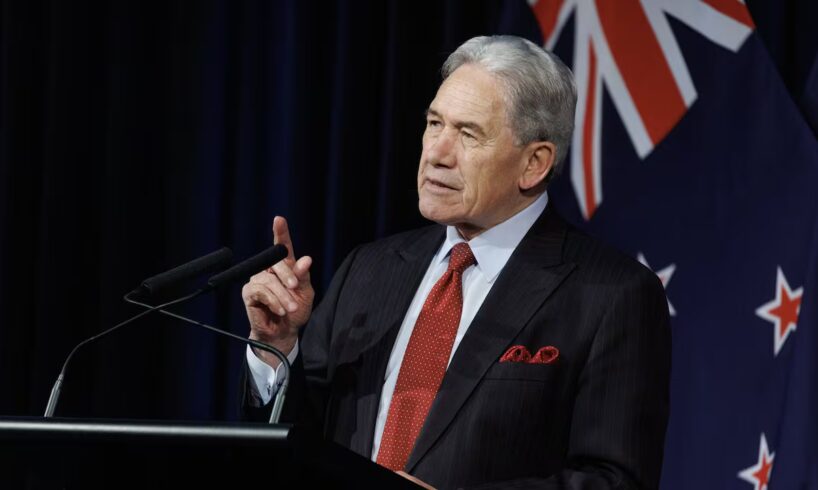
Winston Peters is watching the rise of Nigel Farage’s Reform. Photo / Winston Peters
Distinguishing NZ First to other parties in Parliament – and within the governing coalition – seemed to be a key focus for Peters late last year.
“We are the only socially conservative party, and we’re proud of it,” he said during Parliament’s adjournment debate.
“We are the only nationalist party with a ‘nationalist’ with a capital ‘N’. We are the only patriotic party, a word that is so often judged and criticised. We stand proud to be patriots of a country called New Zealand. What’s more important is that we’re the only party that brings political balance to the spectrum of extremes.”
The Taxpayers’ Union-Curia poll out today shows NZ First with its best-ever result on that specific poll (which has only been going since 2021) and clearly positioned it as the country’s third-most popular party.
NZ First still has a way to go before it’s truly tangoing with either Labour or National, but the party’s consistent rise in the polls over 2025, and now into early 2026, is remarkable considering it’s currently at the heart of government.
Both Reform and One Nation can spend every day attacking the UK and Australian Labour Governments respectively over every policy, every decision, every word. Peters’ job is far more difficult and requires much more nuance.
The veteran politician has so far threaded the needle of only rarely deviating from Government policy but still being able to distance NZ First from his coalition partners on some issues.
Asset sales and the India Free Trade Agreement are two notable examples. NZ First’s views on those issues are reflective of its overall position on economic nationalism and immigration.
Winston Peters has navigated some of the usual difficulties for minor parties in government. Photo / Mark Mitchell
The increase in NZ First’s support (by 3.8 points) in this latest poll won’t be down to any one thing but likely highlights its current momentum.
It won’t have hurt that Peters appeared to be the main voice of the Government over the summer break.
While Christopher Luxon was invisible during several globally significant events Peters had a platform as Foreign Affairs Minister to appear measured on the likes of the US incursion into Venezuela and on the protests in Iran.
His social media post rebuking Reserve Bank Governor Dr Anna Breman for her decision to support US Federal Reserve head Jerome Powell in the face of Donald Trump was a reminder that he isn’t afraid to go out on his own and say what he wishes.
Having a clear identity and not being seen as irremovably attached to the Government also helps when the general sentiment to those in the Beehive is souring.
While on these poll results, the coalition Government would be re-elected, New Zealanders view on the direction the country is heading has fallen in the past month. The net direction indicator is now at –16.4%, which is down 9.8 points.
It’s a good reminder that while business confidence may be roaring and other economic figures are positive, that doesn’t mean everyone is feeling it. At least not yet.
The Prime Minister is well aware of that, saying in his State of the Nation speech this week that while there is “real cause for optimism”, his focus was to translate that “into real results for New Zealanders”.
Luxon needs to be careful about celebrating an economic recovery too soon, in case the increasingly erratic Trump sends global markets tumbling (as he has done just this week with his Greenland aspirations).
Prime Minister Christopher Luxon was invisible early this year. Photo / Michael Craig
The poll also shows the continued slow decline for the Greens and Act. Both parties held a steady amount of attention in late 2024 and early 2025 for various reasons but seem to have been unable to maintain that.
The Greens, despite their revolving door of MPs and staff, appeared to be the actual opposition party early last year, presenting real ideas and an alternative Budget, while also landing a few hits on the Government. But as Labour reawakened from its policy-slumber, the Greens lost a bit of spark.
Act, meanwhile, had the Treaty Principles Bill keeping it in the headlines as well as its privatisation push. It may have slowed down a touch when leader David Seymour took on the Deputy Prime Minister role, which consequently also took one responsibility off Peters.
Their fortunes are not irreversible by any means. Having the election in November means a long campaign, presenting the opportunity for mistakes, but also to persuade voters back.
Peters will obviously want his party to keep growing. It’s no accident there are examples of policy crossover between what NZ First is pushing and what could traditionally be seen as ideas belonging to the Labour Party.
But he’s been in a strong position before. In early-to-middle 2017, an election year, NZ First was edging into the double digits on several polls, before it weakened after the Jacinda Ardern leadership twist.
Peters still ended up kingmaker, but he will be gunning for more this rodeo.
Jamie Ensor is the NZ Herald’s Chief Political Reporter, based in the Press Gallery at Parliament. He was previously a TV reporter and digital producer in the Newshub Press Gallery office. He was a finalist in 2025 for Political Journalist of the Year at the Voyager Media Awards.